
Quetiapine Stats & Data
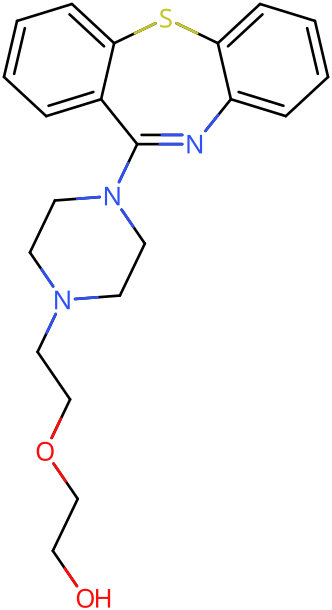
OCCOCCN1CCN(CC1)C1=Nc2ccccc2Sc2ccccc12URKOMYMAXPYINW-UHFFFAOYSA-NPharmacology
DrugBankDescription
Initially approved by the FDA in 1997, quetiapine is a second-generation atypical antipsychotic used in schizophrenia, major depression, and bipolar disorder. Quetiapine demonstrates a high level of therapeutic efficacy and low risk of adverse effects during long-term treatment. It is well-tolerated and a suitable option for some patients with high sensitivity to other drugs, such as Clozapine and Olanzapine.
Mechanism of Action
Although the mechanism of action of quetiapine is not fully understood, several proposed mechanisms exist. In schizophrenia, its actions could occur from the antagonism of dopamine type 2 (D2) and serotonin 2A (5HT2A) receptors. In bipolar depression and major depression, quetiapine's actions may be attributed to the binding of this drug or its metabolite to the norepinephrine transporter. Additional effects of quetiapine, including somnolence, orthostatic hypotension, and anticholinergic effects, may result from the antagonism of H1 receptors, adrenergic α1 receptors, and muscarinic M1 receptors, respectively.
Pharmacodynamics
Quetiapine improves the positive and negative symptoms of schizophrenia and major depression by acting on various neurotransmitter receptors, such as the serotonin and dopamine receptors. In bipolar disorder, it improves both depressive and manic symptoms. **A note on suicidality in young patients and administration in the elderly** Quetiapine can cause suicidal thinking or behavior in children and adolescents and should not be given to children under 10 years of age. It is important to monitor for suicidality if this drug is given to younger patients. In addition, this drug is not indicated for the treatment of psychosis related to dementia due to an increased death rate in elderly patients taking this drug.
Metabolism
The metabolism of quetiapine occurs mainly in the liver. Sulfoxidation and oxidation are the main metabolic pathways of this drug. According to in vitro studies, cytochrome P450 3A4 metabolizes quetiapine to an inactive sulfoxide metabolite and also participates in the metabolism of its active metabolite, N-desalkyl quetiapine. CYP2D6 also regulates the metabolism of quetiapine. In one study, three metabolites of N-desalkylquetiapine were identified. Two of the metabolites were identified as N-desalkylquetiapine sulfoxide and 7-hydroxy-N-desalkylquetiapine. CYP2D6 has been found to be responsible for metabolism of quetiapine to 7-hydroxy-N-desalkylquetiapine, a pharmacologically active metabolite. Individual differences in CYP2D6 metabolism may be present, which may affect the concentrations of the active metabolite.
Absorption
Quetiapine is rapidly and well absorbed after administration of an oral dose. Steady-state is achieved within 48 hours Peak plasma concentrations are achieved within 1.5 hours. The bioavailability of a tablet is 100%. The steady-state Cmax of quetiapine in Han Chinese patients with schizophrenia after a 300 mg oral dose of the extended released formulation was approximately 467 ng/mL and the AUC at steady-state was 5094 ng·h/mL. Absorption of quetiapine is affected by food, with Cmax increased by 25% and AUC increased by 15%.
Indication
Quetiapine is used in the symptomatic treatment of schizophrenia. In addition, it may be used for the management of acute manic or mixed episodes in patients with bipolar I disorder, as a monotherapy or combined with other drugs. It may be used to manage depressive episodes in bipolar disorder. In addition to the above indications, quetiapine is used in combination with antidepressant drugs for the treatment of major depression. Some off-label uses for this drug include the management of post-traumatic stress disorder (PTSD), generalized anxiety disorder, and psychosis associated with Parkinson's disease.
Half-life
The average terminal half-life of quetiapine is about 6-7 hours.
Protein Binding
The protein binding of quetiapine is 83%.
Elimination
After an oral dose of radiolabeled quetiapine, less than 1% of unchanged drug was detected in the urine, suggesting that quetiapine is heavily metabolized. About 73% of a dose was detected in the urine, and about 20% in the feces.
Volume of Distribution
Quetiapine distributes throughout body tissues. The apparent volume of distribution of this drug is about 10±4 L/kg.
Clearance
The clearance of quetiapine healthy volunteers in the fasted state during a clinical study was 101.04±39.11 L/h. Elderly patients may require lower doses of quetiapine, as clearance in these patients may be reduced by up to 50%. Those with liver dysfunction may also require lower doses.
Receptor Profile
Receptor Actions
Receptor Binding
Measured Affinities
Guide to PHARMACOLOGYMeasured binding and functional data for quetiapine, curated by the IUPHAR/BPS Guide to PHARMACOLOGY. Each row cites the paper it came from. Lower concentrations mean tighter binding — a value in the sub-nanomolar range indicates a very potent interaction.
| Target | Action | Measure | Value | Concentration | Species | Source |
|---|---|---|---|---|---|---|
| D2 receptor DRD2 | Antagonist | pKi | 7.2 | 63.1 nM | Human | PMID 9430133 |
| 5-HT2A receptor HTR2A | Full agonist | pKi | 7 | 100 nM | Human | PMID 8935801 |
| NET SLC6A2 | Inhibition | pKi | 6.03 | 933.25 nM | Human | PMID 18059438 |
| 5-ht1e receptor HTR1E | Full agonist | pKi | 5.9 | 1,259 nM | Human | PMID 8935801 |
| 5-HT1D receptor HTR1D | Full agonist | pKi | 5.7 | 1,995 nM | Human | PMID 8935801 |
| 5-HT1F receptor HTR1F | Full agonist | pKi | 5.6 | 2,512 nM | Human | PMID 8935801 |
| 5-HT1A receptor HTR1A | Full agonist | pKi | — | — | Human | — |
| 5-HT2A receptor HTR2A | Antagonist | pKi | — | — | Human | — |
| H1 receptor HRH1 | Antagonist | pKi | — | — | Human | — |
Reading this. pKi, pEC50 and pIC50 are negative log molar values, so a higher number means a tighter interaction; the concentration column converts them for you. Values from non-human species are laboratory measurements and do not translate directly to human effect. Receptor affinity is not a dose — it describes what a molecule binds, not how much of it is safe to take.
Receptor data from the IUPHAR/BPS Guide to PHARMACOLOGY (v2026.2), licensed CC BY-SA 4.0. Matched to this substance by InChIKey.
History & Culture
1985–1997
Quetiapine was developed by the pharmaceutical company AstraZeneca during the mid-1980s through the 1990s as part of efforts to improve upon first-generation antipsychotic medications. The compound received approval from the U.S. Food and Drug Administration in September 1997 and was subsequently marketed under the brand name Seroquel. Within a decade of its initial approval, quetiapine had received regulatory authorization in over 80 countries worldwide.
2007–2023
Quetiapine quickly became one of the most commercially successful psychiatric medications globally. By 2007, it was among the ten top-selling drugs worldwide alongside other second-generation antipsychotics. Annual sales reached approximately $5.7 billion globally, with roughly half of that revenue coming from the United States market alone. The original U.S. patent was set to expire in 2011 but received a pediatric exclusivity extension that pushed expiration to March 2012. Following patent expiration, generic formulations became widely available. Despite increased competition from generics, quetiapine remained the most frequently prescribed second-generation antipsychotic in the United States by 2013, with over 14 million prescriptions dispensed that year. As of 2023, it ranked as the 65th most commonly prescribed medication in the country with more than 10 million annual prescriptions.
2010–present
In 2010, AstraZeneca agreed to pay a $520 million settlement to resolve allegations of improper marketing practices and mishandling of clinical trial data. Internal company communications revealed that the manufacturer had suppressed and misrepresented research findings showing quetiapine lacked superior efficacy compared to older first-generation antipsychotic medications. Similar concealment occurred with studies demonstrating significant risks of obesity and weight gain. The company also reportedly resisted requests from the FDA to inform prescribing physicians about diabetes risks that were greater than previously acknowledged.
While recreational use remains relatively uncommon compared to other psychoactive substances, reports of quetiapine misuse have emerged in medical literature. This pattern appears driven primarily by the drug's sedative and anxiolytic properties rather than its antipsychotic effects, with individuals seeking it for sleep induction or general calming. Non-medical use has been particularly noted within correctional settings. Some estimates suggest that a substantial proportion of inmates presenting with psychiatric complaints in certain facilities may be attempting to obtain quetiapine through feigned symptoms. The prevalence of misuse in prisons compared to community settings is attributed to quetiapine's availability as a regularly prescribed sedative within these institutions, combined with the general unavailability of more commonly sought substances behind bars.
Subjective Effects
Physical
The physical effects of quetiapine can be broken down into several components which progressively intensify proportional to dosage.
- Sedation
- Dizziness
- Dehydration
- Motor control loss
- Headaches
Cognitive
The general head space of quetiapine is often described as one of sleepiness, emptiness, apathy, stupor and catatonia. The specific cognitive effects can be broken down into several components which progressively intensify proportional to dosage.
- Thought deceleration
- Emotion suppression
- Information processing suppression
- Language suppression
- Amnesia
- Anxiety suppression
Forked from Subjective Effect Documentation by Josie Kins, September 2015. Via dose.wiki (CC0).
Quetiapine likely has a low toxicity relative to dose. Although simply trying this substance at a low to moderate dosage is considered as quite safe, there is an emerging controversy regarding quetiapine fatalities. Approximately 10,000 lawsuits against AstraZeneca for problems ranging from slurred speech and chronic insomnia to death have been filed by individuals from civilian populations. Both typical and atypical antipsychotics can cause tardive dyskinesia. According to one study, rates are lower with the atypicals at 3.9% as opposed to the typicals at 5.5%.
Carcinogenicity
No indication of carcinogenicity to humans (not listed by IARC).
Toxicity (DrugBank)
The oral LD50 if quetiapine in rats is 2000 mg/kg. **Overdose information** Some signs and symptoms of a quetiapine overdose include sedation, drowsiness, tachycardia, and hypotension. Clinical trials demonstrate that overdoses of up to 30 grams of quetiapine did not result in death. A lethal outcome was reported in a clinical trial after an overdose of 13.6 grams of quetiapine. In the case of an acute overdose, ensure to maintain an airway and provide adequate ventilation and oxygenation. Gastric lavage following intubation (if necessary) along with activated charcoal and a laxative may be considered. The possibility of obtundation, seizure or dystonic reaction of the head and neck following overdose may create a risk of aspiration with induced emesis. Cardiac monitoring should also take place. **A note on QT-interval prolongation in an overdose** Postmarketing reports reveal increases in the cardiac QT interval in cases of quetiapine overdose, concomitant illness, and in those taking drugs that increase QT interval or affect electrolyte levels. Note that disopyramide, procainamide, and quinidine may exert additive QT-prolonging effects when administered in patients who have overdosed with quetiapine, and should be avoided.
Tolerance & Pharmacokinetics
drugs.wikiTolerance Decay
Experience Report Analysis
ErowidDemographics
Gender Distribution
Age Distribution
Reports Over Time
Effect Analysis
ErowidEffects aggregated from 60 experience reports (60 single-substance Erowid)
Effect Sentiment Distribution
Confidence Distribution
Each bar is the share of reports mentioning the effect; its whisker, and the band on the rows below, is the 95% interval: where the share could plausibly be with other reports of the same kind.
Positive Effects 6
Adverse Effects 5
Show 3 neutral or unclassified mentions
Also reported in combinations. In the 67 Quetiapine reports where another drug was taken too, 13 (19.4%) mention hospital, emergency services or an overdose, 4 (6.0%) a seizure and 13 (19.4%) psychosis. In the 60 single-substance reports: 15.0%, 3.3% and 18.3%. These are not in the figures above: they cannot be put down to Quetiapine alone, and a mention is not always something that happened to the writer.
Dose-Response Correlation
How effect frequency changes across dose levels. Whiskers, and the numbers' hover text, give each figure's 95% interval.
Not drawn, too few reports (a dose tier needs 20): Oral Common (n=11). Why 20?
Dosage Distribution
Dose distribution from experience reports, one dose per report (the first listed). Doses above Q3 + 3×IQR, far above what people typically take, are left out of the median and range and listed under each route: most are real heavy doses or overdoses, not mistakes.
1 dose more than 50 times the median may be a typing or unit error and is not in the figures either: check the report.
Real-World Dose Distribution
ErowidFrom 183 of 200 recorded dose entries: those that state a weight (mg, g or µg), in routes with at least five of them. Values above Q3 + 3×IQR, far above what people typically take, are left out; they can include real heavy doses and overdoses, not only mistakes.
Oral (n=177)
Common Combinations
Most co-occurring substances, as a share of all 127 reports filed under Quetiapine; whiskers are 95% intervals
Form / Preparation
Most common forms and preparations, as a share of the 56 reports that give one; whiskers are 95% intervals
Body-Weight Dosing
Dose per kg of body weight, one dose per report (the first listed), from reports giving a weight of 30–250 kg. Doses above Q3 + 3×IQR, far above what people typically take, are left out of the median and range and listed under each route.
1 dose more than 50 times the median may be a typing or unit error and is not in the figures either: check the report.
Redose Patterns
Redosing behavior across 99 reports
Legal Status
| Country | Status | Notes |
|---|---|---|
| Australia | Prescription Only | Regulated as a prescription-only medicine. Not scheduled as a prohibited or controlled substance but restricted to medical dispensing. |
| Austria | Prescription Only | Available exclusively through prescription. Not scheduled as a controlled substance under Austrian drug laws but regulated as a prescription pharmaceutical. |
| Canada | Prescription Only | Available by prescription only. Multiple branded and generic formulations are marketed in Canada, with the original patent having expired. |
| France | Prescription Only | Unscheduled as a controlled substance but legally restricted to prescription-only status under French pharmaceutical regulations. |
| Germany | Prescription Only (Anlage 1 AMVV) | Regulated as a prescription medicine under Anlage 1 of the Arzneimittelverschreibungsverordnung (AMVV), the German regulation governing prescription requirements for medicinal products. |
| Switzerland | Abgabekategorie B (Prescription Only) | Classified under Abgabekategorie B in the Swiss pharmaceutical dispensing system, meaning it can only be dispensed with a valid medical prescription. |
| United Kingdom | Prescription Only | Available only by prescription. The substance is not scheduled under the Misuse of Drugs Act but regulated as a prescription-only medicine under pharmaceutical legislation. |
| United States | Unscheduled (Prescription Only) | Quetiapine is not a scheduled controlled substance but requires a prescription for legal sale and distribution. FDA approved the drug in 1997. Possession without a prescription is not criminalized, though sales and distribution are restricted to licensed entities and require valid prescriptions. |
Harm Reduction
drugs.wikiQuetiapine is used primarily for schizophrenia, bipolar disorder, and as adjunct therapy in major depressive disorder. It is associated with sedation, weight gain, and metabolic side effects. Risk of extrapyramidal symptoms is lower than typical antipsychotics. Off-label use for insomnia is common but not officially recommended due to side effect profile.
References
Data Sources
Cited References
- Gefvert et al. 2001 - D2 and 5HT2A receptor occupancy PET study
- Kapur et al. 2000 - Rapid D2 dissociation PET study
- Nord et al. 2013 - Norepinephrine transporter occupancy
- PMC: Quetiapine Misuse and Abuse
- Psychopharmacology Institute: Mechanism of Action
- StatPearls: Quetiapine
- DrugBank: Quetiapine Salts
- DrugBank: Quetiapine Biointeractions
- DrugBank: Quetiapine Clinical Use
- DrugBank: Quetiapine Pharmacology
- DrugBank: Quetiapine Efficacy
- DrugBank: Quetiapine Quality of Life