
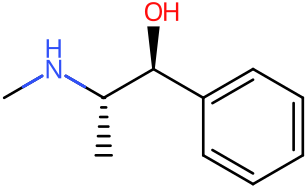
Pseudoephedrine Stats & Data
CNC(C)C(O)c1ccccc1KWGRBVOPPLSCSI-WCBMZHEXSA-NPharmacology
DrugBankDescription
Pseudoephedrine is structurally related to ephedrine but exerts a weaker effect on the sympathetic nervous system. Both drugs naturally occur in in ephedra plant which have a history of use in traditional Eastern medicine and were first researched in the west in 1889. The decongestant effect of pseudoephedrine was described in dogs in 1927.
Mechanism of Action
Pseudoephedrine acts mainly as an agonist of alpha adrenergic receptors and less strongly as an agonist of beta adrenergic receptors. This agonism of adrenergic receptors produces vasoconstriction which is used as a decongestant and as a treatment of priapism. Pseudoephedrine is also an inhibitor of norepinephrine, dopamine, and serotonin transporters. The sympathomimetic effects of pseudoephedrine include an increase in mean arterial pressure, heart rate, and chronotropic response of the right atria. Pseudoephedrine is also a partial agonist of the anococcygeal muscle. Pseudoephedrine also inhibits NF-kappa-B, NFAT, and AP-1.
Pharmacodynamics
Pseudoephedrine causes vasoconstriction which leads to a decongestant effect. It has a short duration of action unless formulated as an extended release product. Patients should be counselled regarding the risk of central nervous system stimulation.
Metabolism
Pseudoephedrine is <1% N-demethylated to an inactive metabolite. The majority of pseudoephedrine is eliminated unmetabolized in the urine.
Absorption
A 240mg oral dose of pseudoephedrine reaches a Cmax of 246.3±10.5ng/mL fed and 272.5±13.4ng/mL fasted, with a Tmax of 6.60±1.38h fed and 11.87±0.72h fasted, with an AUC of 6862.0±334.1ng\*h/mL fed and 7535.1±333.0ng\*h/mL fasted.
Indication
Pseudoephedrine is a sympathomimetic amine used for its decongestant activity.
Half-life
The mean elimination half life of pseudoephedrine is 6.0h.
Protein Binding
-pseudoephedrine is 6.6±0.4% bound to human serum albumin and 22.5±3.2% protein bound in serum. +pseudoephedrine is 6.7±1.2% protein bound to human serum albumin and 25.4±3.9% protein bound in human serum.
Elimination
55-75% of an oral dose is detected in the urine as unchanged pseudoephedrine.
Volume of Distribution
The apparent volume of distribution of pseudoephedrin is 2.6-3.3L/kg.
Clearance
A 60mg oral dose of pseudoephedrine has a clearance of 5.9±1.7mL/min/kg.
Pseudoephedrine acts directly on both alpha- and, to a lesser degree, beta-adrenergic receptors. Through direct action on alpha-adrenergic receptors in the mucosa of the respiratory tract, pseudoephedrine produces vasoconstriction.
Carcinogenicity
No indication of carcinogenicity to humans (not listed by IARC).
Toxicity (DrugBank)
The oral LD50 of pseudoephedrine is 2206mg/kg in rats and 726mg/kg in mice. Patients experiencing an overdose of pseudoephedrine may present with giddiness, headache, nausea, vomiting, sweating, thirst, tachycardia, precordial pain, palpitations, difficulty urinating, muscle weakness, muscle tension, anxiety, restlessness, insomnia, toxic psychosis, cardiac arrhythmias, circulatory collapse, convulsions, coma, and respiratory failure. Treat overdose with symptomatic and supportive treatment including removal of unabsorbed drug.
Effect Profile
Curated + 6 ReportsStrong euphoria with strong anxiety/jitters, moderate focus and stimulation
Tolerance & Pharmacokinetics
drugs.wikiTolerance Decay
Experience Report Analysis
ErowidDemographics
Gender Distribution
Age Distribution
Reports Over Time
Effect Analysis
ErowidEffects aggregated from 6 experience reports (6 single-substance Erowid)
Effect Sentiment Distribution
Confidence Distribution
Each bar is the share of reports mentioning the effect; its whisker, and the band on the rows below, is the 95% interval: where the share could plausibly be with other reports of the same kind.
Too few reports for bars: these effects come from 6 single-substance Erowid reports, and a bar is drawn only from 20 reports or more. With fewer, a percentage cannot tell a common effect from a rare one. Counts are shown instead. Why 20?
Positive Effects 2
Adverse Effects 1
Also reported in combinations. In the 15 Pseudoephedrine reports where another drug was taken too, 3 mention hospital, emergency services or an overdose, 2 a seizure and 1 psychosis (too few reports for percentages). In the 6 single-substance reports: 1, 0 and 0. These are not in the figures above: they cannot be put down to Pseudoephedrine alone, and a mention is not always something that happened to the writer.
Real-World Dose Distribution
ErowidFrom 41 of 42 recorded dose entries: those that state a weight (mg, g or µg), in routes with at least five of them. Values above Q3 + 3×IQR, far above what people typically take, are left out; they can include real heavy doses and overdoses, not only mistakes.
Oral (n=36)
Common Combinations
Most co-occurring substances, as a share of all 21 reports filed under Pseudoephedrine; whiskers are 95% intervals
Form / Preparation
Most common forms and preparations, as a share of the 11 reports that give one
Too few reports for bars: these forms come from 11 reports, and a bar is drawn only from 20 reports or more. With fewer, a percentage cannot tell a common effect from a rare one. Counts are shown instead. Why 20?
- Pill / Tablet 7 of 11
- Liquid 4 of 11
Body-Weight Dosing
Dose per kg of body weight, one dose per report (the first listed), from reports giving a weight of 30–250 kg. Doses above Q3 + 3×IQR, far above what people typically take, are left out of the median and range and listed under each route.
2 reports gave a dose above the typical range (13.355–15.612 mg/kg), so they are not in the figures above. Listing a dose here does not mean it is safe.
Show the reports
- 15.612 mg/kg · another drug taken too
- 13.355 mg/kg
Redose Patterns
Redosing behavior across 16 reports
Too few reports for a chart: redosing is known from 16 reports, and a split is drawn only from 20 reports or more. Counts are shown instead. Why 20?
- Single dose 14 of 16
- Redosed 2 of 16