
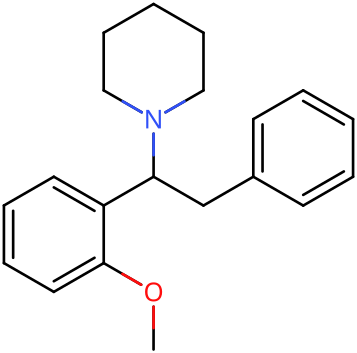
Methoxphenidine Stats & Data
COc1ccccc1C(Cc1ccccc1)N1CCCCC1QXXCUXIRBHSITD-UHFFFAOYSA-NSubjective Effects
Physical
- Tactile disconnection: This results in typical states of progressive physical disconnection but is far more consciously controllable than that of other dissociatives. This allows one to choose how much of their body they are currently aware of and connected to simply by directing their focus towards it.
- Spontaneous tactile sensations: The MXP body high is a soft, pleasurable vibrating sensation. It can be felt all over the body and progressively intensifies throughout the onset before dissipating once the peak has been reached.
- Tactile suppression: This partially to entirely suppresses one's sense of touch, creating feelings of numbness within the extremities. It is responsible for the anaesthetic properties of this substance.
- Physical autonomy
- Motor control loss: A loss of gross and fine motor control alongside of balance and coordination is prevalent within MXP and becomes especially strong at higher dosages.
- Physical euphoria: This results in feelings of physical euphoria which range between mild pleasure to powerful all-encompassing bliss.
- Decreased bodily weight: This creates the sensation that the body is floating and has become entirely weightless. This effect is strangely stimulating and encourages physical activities at low to moderate dosages.
- Dizziness
Cognitive
- Consciousness disconnection
- Acceleration of thought
- Ego suppression, loss and death
- Time distortion: Feelings of time dilation and more time having passed than it actually has are common at moderate to strong dosages.
- Euphoria
- Conceptual thinking
Sensory
- Enhancements
- Visual disconnection: This eventually results in the MXP equivalent of the K-hole, consisting of holes, spaces and voids alongside of structures.
- Internal hallucinations: (Autonomous entities; settings, sceneries, and landscapes; alterations in perspective and scenarios and plots) - These hallucinatory states can be described as dream like in nature. They are more common within dark environments and can be described as internal in their manifestation, lucid in believability, mostly unimmersive in style and extremely controllable in their content in a way which allows one to choose what they wish to see.
Forked from Subjective Effect Documentation by Josie Kins, March 2014. Via dose.wiki (CC0).
Effect Profile
Curated + 10 ReportsStrong dissociative depth with strong motor impairment and mania, moderate insight
Duration Timeline
BluelightCommunity Effects
TripSitTolerance & Pharmacokinetics
drugs.wikiTolerance Decay
Rapid tolerance build is commonly reported with frequent dissociative use; decay back to baseline typically requires weeks. Values are heuristic aggregates from user reports across dissociatives; specific MXP kinetics are poorly characterized. Avoid consecutive-day use to limit escalation and compulsive redosing.
Cross-Tolerances
Experience Report Analysis
ErowidDemographics
Gender Distribution
Age Distribution
Reports Over Time
Effect Analysis
ErowidEffects aggregated from 10 experience reports (10 single-substance Erowid)
Effect Sentiment Distribution
Confidence Distribution
Each bar is the share of reports mentioning the effect; its whisker, and the band on the rows below, is the 95% interval: where the share could plausibly be with other reports of the same kind.
Too few reports for bars: these effects come from 10 single-substance Erowid reports, and a bar is drawn only from 20 reports or more. With fewer, a percentage cannot tell a common effect from a rare one. Counts are shown instead. Why 20?
Positive Effects 2
Adverse Effects 1
Show 5 neutral or unclassified mentions
Also reported in combinations. In the 20 Methoxphenidine reports where another drug was taken too, 2 (10.0%) mention hospital, emergency services or an overdose, 0 (0.0%) a seizure and 3 (15.0%) psychosis. In the 10 single-substance reports: 3, 0 and 0. These are not in the figures above: they cannot be put down to Methoxphenidine alone, and a mention is not always something that happened to the writer.
Dosage Distribution
Dose distribution from experience reports, one dose per report (the first listed). Doses above Q3 + 3×IQR, far above what people typically take, are left out of the median and range and listed under each route: most are real heavy doses or overdoses, not mistakes.
Real-World Dose Distribution
ErowidFrom 43 of 49 recorded dose entries: those that state a weight (mg, g or µg), in routes with at least five of them. Values above Q3 + 3×IQR, far above what people typically take, are left out; they can include real heavy doses and overdoses, not only mistakes.
Oral (n=31)
Insufflated (n=10)
Common Combinations
Most co-occurring substances, as a share of all 30 reports filed under Methoxphenidine; whiskers are 95% intervals
Form / Preparation
Most common forms and preparations, as a share of the 23 reports that give one; whiskers are 95% intervals
Body-Weight Dosing
Dose per kg of body weight, one dose per report (the first listed), from reports giving a weight of 30–250 kg. Doses above Q3 + 3×IQR, far above what people typically take, are left out of the median and range and listed under each route.
Redose Patterns
Redosing behavior across 25 reports
Harm Reduction
drugs.wikiMXP is a diarylethylamine dissociative (diphenidine family), not an arylcyclohexylamine; conflating it with ketamine-like arylcyclohexylamines can mislead dosing expectations and risk assessment. Its effects can be slower to build than expected, making early redoses risky due to delayed peaks; many cases of over-intoxication follow stacking doses too closely. Several medical reports describe prolonged agitation, confusion, and need for sedation after high doses or polydrug use, underscoring its unpredictability compared with ketamine. Combining MXP with CNS depressants (alcohol, opioids, GHB/GBL, sedatives) markedly increases risk of blackouts, aspiration, accidents, and respiratory complications even if dissociatives alone are not strong respiratory depressants. Stimulant combinations can worsen cardiovascular strain and agitation; serotonergic antidepressants (SSRIs/SNRIs/MAOIs) may interact unpredictably because the diarylethylamine class has had mixed and incompletely characterized monoaminergic activity signals—err on the side of avoiding. Tolerance to dissociatives can build quickly with repeated use and shows cross-tolerance within the class, which tempts dose escalation and elevates harm. Chronic heavy dissociative use (well-documented with ketamine) is linked to urinary tract symptoms; specific MXP data are sparse, so prudent spacing and hydration are advisable to reduce potential urological stress. Because supply is unregulated, mislabeling and unexpected adulterants are common; using a reputable drug checking service (or at minimum reagent tests) before consumption reduces the risk of consuming the wrong drug or a dangerously potent adulterant. Non-medical IV use greatly elevates risk (unknown excipients, microbial contamination, local tissue injury, dosing overshoot); if someone nevertheless intends to inject, single-substance use, sterile technique, and micron filtration reduce but do not remove these risks. Strong set and setting effects are reported: high or chaotic doses can precipitate paranoia, delusions, or unsafe behavior; a sober sitter, safe environment, and avoiding hazards (roads, water, heights) meaningfully reduce accident risk. Accurate milligram measurement with a calibrated scale and volumetric dosing practices reduce accidental overdosing when working with variable-potency RC powders. Space sessions by at least 2–4 weeks to manage tolerance and reduce compulsive redosing patterns; consider pre-planning a cap on total session dose.
References
Cited references
- Erowid — Methoxphenidine (MXP) Vault
- Helander et al., 2015 — Intoxications by the dissociative NPS diphenidine and methoxphenidine (Clin Toxicol)
- Bluelight — The Big & Dandy Methoxphenidine / MXP / 2-MeO-Diphenidine Thread (classification discussion)
- Hi‑Ground — Ketamine page (dissociative combo cautions applicable class‑wide)
- TripSit Wiki — Diphenidine (class similarities and interaction cautions)
- Drug Users Bible — MXP page (community-collated dosage/duration)
- Toronto Drug Checking Service — Why drug checking matters (unregulated supply variability)