
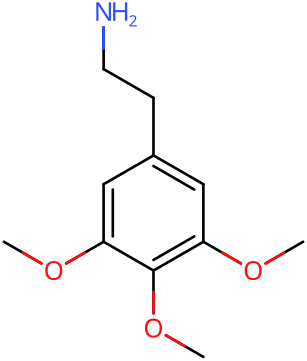
Mescaline Stats & Data
NCCc1cc(OC)c(OC)c(OC)c1RHCSKNNOAZULRK-UHFFFAOYSA-NPharmacology
DrugBankMechanism of Action
Hallucinogens, including mescaline, psilocybin, and lysergic acid diethylamide (LSD), profoundly affect perception, cognition, and mood. All known drugs of this class are 5-HT(2A) receptor (2AR) agonists, yet closely related 2AR agonists such as lisuride lack comparable psychoactive properties. Why only certain 2AR agonists are hallucinogens and which neural circuits mediate their effects are poorly understood. By genetically expressing 2AR only in cortex, we show that 2AR-regulated pathways on
Metabolism
It is metabolized in the liver by mescaline oxidase into numerous inactive metabolites. These include 3,4,5-trimethoxyphenylacetic acid; 3,4,5-trimethoxybenzoic acid; 3,4-dihydroxy-5-methoxy-phenyl-lacetyl glutamine; 3-hydroxy-4,5-dimethoxyphenylethylamine; N-acetylmescaline; and N-acetyl-3,4-dimethoxy-5-hydroxyphenylethylamine.
Receptor Profile
Receptor Actions
Measured Affinities
Guide to PHARMACOLOGYMeasured binding and functional data for mescaline, curated by the IUPHAR/BPS Guide to PHARMACOLOGY. Each row cites the paper it came from. Lower concentrations mean tighter binding — a value in the sub-nanomolar range indicates a very potent interaction.
| Target | Action | Measure | Value | Concentration | Species | Source |
|---|---|---|---|---|---|---|
| 5-HT2A receptor HTR2A | Agonist | pEC50 | 5.59 | 2,570 nM | Human | PMID 12877591 |
Reading this. pKi, pEC50 and pIC50 are negative log molar values, so a higher number means a tighter interaction; the concentration column converts them for you. Values from non-human species are laboratory measurements and do not translate directly to human effect. Receptor affinity is not a dose — it describes what a molecule binds, not how much of it is safe to take.
Receptor data from the IUPHAR/BPS Guide to PHARMACOLOGY (v2026.2), licensed CC BY-SA 4.0. Matched to this substance by InChIKey.
History & Culture
4000 BCE–present
Archaeological evidence from sites across the United States, Mexico, and Peru demonstrates that mescaline-containing cacti have been used in ceremonial and spiritual contexts for over 6,000 years. The San Pedro cactus has been in continuous spiritual and medicinal use in Peru for more than 3,000 years, a tradition that persisted even through post-Spanish Conquest attempts at suppression. Upon early contact with the Huichol people in Mexico, Europeans documented the use of peyote in Native American religious ceremonies. At the time of the Spanish conquest, religious and ceremonial peyote use was widespread throughout the Aztec Empire and northern Mexico. However, religious persecution by colonial authorities confined its use primarily to areas near the Pacific coast and into southwest Texas. By 1880, peyote practices began spreading northward, with the Kiowa and Comanche peoples inaugurating a new form of peyote ceremony. These religious traditions were legally incorporated in the United States in 1920 as the Native American Church and have since spread across North America as far as Saskatchewan, Canada.
1840–1919
Botanical investigations of peyote commenced in the 1840s, and the drug was subsequently listed in the Mexican pharmacopeia. The first publication documenting the use of mescal buttons appeared in 1887, authored by John Raleigh Briggs. That same year, German pharmacologist Louis Lewin obtained his first sample of the peyote cactus, identified numerous previously unknown alkaloids within it, and later published the first methodical pharmacological analysis of the plant. In 1897, German chemist Arthur Heffter achieved the isolation and identification of mescaline, demonstrating that this compound was exclusively responsible for the psychoactive and hallucinogenic effects of peyote. Subsequent research would reveal that other peyote constituents such as hordenine, pellotine, and anhalinine also possess pharmacological activity. The complete synthesis of mescaline was first accomplished by Ernst Späth in 1919.
1950–present
Investigations into the potential therapeutic applications of mescaline commenced during the 1950s. In 1955, English politician Christopher Mayhew participated in an experimental session for the BBC's Panorama program, ingesting 400 mg of mescaline under the supervision of psychiatrist Humphry Osmond. Although the footage was ultimately deemed too controversial for broadcast, Mayhew described the experience as "the most interesting thing I ever did." Mescaline has influenced numerous artists and writers throughout the 20th and 21st centuries. Salvador Dalí experimented with the substance believing it would enable access to his subconscious for artistic purposes. Allen Ginsberg's peyote vision in San Francisco inspired Part II of his seminal poem "Howl," while Ken Kesey consumed peyote prior to writing One Flew Over the Cuckoo's Nest. Hunter S. Thompson documented his first mescaline experience in "First Visit with Mescalito," published in Songs of the Doomed, and the substance features prominently in Fear and Loathing in Las Vegas. Philip K. Dick was inspired to write Flow My Tears, the Policeman Said after his own mescaline experience.
Subjective Effects
Physical
The physical effects of mescaline can be broken down into several components which progressively intensify proportional to dosage.
- Spontaneous tactile sensations: The "body high" of mescaline can be described as proportionally intense in comparison to its accompanying visual and cognitive effects. It is manifested in a number of forms including an intense soft warm glow that grows over the body that is capable of becoming extremely physically euphoric. This is most similar to MDMA and Psilocin and is consistently manifested throughout the experience. This is contrasted by an intensely pleasurable yet sharp, cold electric tingling sensation which moves up and down the body. This is most similar to LSD and is also consistently manifested throughout the trip. The final physical effect noticed throughout the experience is an intense energetic pins and needles sensation that manifests itself in the form of a continuously shifting and tingling sensation that travels up and down the body in spontaneous waves. This is most similar to 2C-B and is not entirely consistent throughout the trip.
- Stimulation: In terms of its effects on the physical energy levels of the tripper, mescaline is usually considered to be very energetic and stimulating without being forced. For example, when taken in any environment it will usually encourage physical activities such as running, walking, climbing or dancing. In comparison, other more commonly used psychedelics such as psilocin are generally sedating and relaxed.
- Nausea: Nausea is commonly reported when consumed in moderate to high dosages and either passes instantly once the tripper has vomited or gradually fades by itself as the peak sets in.
- Tactile enhancement: Feelings of enhanced tactile sensations are consistently present at moderate levels throughout most mescaline trips. Once Level 8B geometry is reached, an intense sensation of suddenly becoming aware of and being able to feel every single nerve ending across a person's entire body all at once is consistently present.
- Bodily control enhancement
- Salivation
- Increased heart rate
- Pupil dilation
- Wakefulness
Cognitive
The cognitive effects of mescaline can be broken down into several components which progressively intensify proportional to dosage. In comparison to other psychedelics such as Psilocin, LSA and ayahuasca, mescaline is significantly more stimulating and fast-paced in terms of the specific style of thought stream produced and contains a large number of potential effects.
- Current mind state enhancement
- Thought acceleration
- Novelty enhancement
- Time distortion
- Analysis enhancement: This effect is consistent in its manifestation and introspection dominant.
- Déjà vu
- Multiple thought streams
- Personal bias suppression
- Conceptual thinking
- Immersion enhancement
- Memory suppression
- Ego death
- Personality regression
- Thought loops
- Feelings of interdependent opposites
- Delusions
- Unity and interconnectedness
- Feelings of self-design
- Spirituality enhancement
- Thought disorganization
- Simultaneous emotions
Sensory
- Enhancements
- Distortions
- Hallucinations
- Synaesthesia
- Machinescapes
Mescaline presents a full and complete array of possible visual distortions which generally includes:
- Drifting: (melting, flowing, breathing and morphing) - In comparison to other psychedelics, this effect can be described as highly detailed, slow and smooth in motion, static in their appearance and realistic in style.
- Tracers
- After images
- Symmetrical texture repetition
- Colour shifting
- Scenery slicing
Mescaline presents a full and complete array of possible visual enhancements which generally includes:
- Acuity enhancement
- Colour enhancement
- Pattern recognition enhancement
Mescaline produces a full range of high level hallucinatory states in a fashion that is more consistent and reproducible than that of many other commonly used psychedelics
- Transformations
- Internal hallucinations: (autonomous entities; settings, sceneries, and landscapes; alterations in perspective and scenarios and plots) - In comparison to other psychedelics such as LSD, mescaline produces a high level of hallucinations embedded within visual geometry. This particular effect commonly contains hallucinations with scenarios, settings, concepts and autonomous entity contact. They are more common within dark environments and can be described as lucid in believability, interactive in style and almost exclusively of religious, spiritual, mystical or a transcendental nature in their overall theme.
- Unspeakable horrors
Forked from Subjective Effect Documentation by Josie Kins, August 2015. Via dose.wiki (CC0).
Toxicity
PsychonautWikiThe toxicity and long-term health effects of recreational mescaline use does not appear to have been studied in any scientific context and the exact toxic dose is unknown. However, there are no known fatal overdoses within the scientific literature. Anecdotal reports suggest that there are no negative health effects attributed to simply trying mescaline by itself at low to moderate doses and using it very sparingly (but nothing can be completely guaranteed). Independent research should always be done to ensure that a combination of two or more substances is safe before consumption. It is strongly recommended that one use harm reduction practices when using this substance.
Addiction & dependence
Mescaline is not habit-forming, and the desire to use it can actually decrease with use. It is most often self-regulating. Tolerance to the effects of mescaline is built almost immediately after ingestion.
Effect Profile
Curated + 375 ReportsStrong visuals, headspace, and auditory effects with strong body load
Duration Timeline
BluelightEmpirical Duration
Erowid ReportsMedian times after the dose that Erowid reports state. A curve is drawn only when reports state all four points (onset, peak begins, comedown begins, back to baseline) and the medians fall in that order. No point is estimated from another.
Community Effects
TripSitTolerance & Pharmacokinetics
drugs.wikiTolerance Decay
Classic psychedelic cross-tolerance pattern inferred from user reports and HR references; magnitude varies. Data quality: mixed formal/anecdotal.
Cross-Tolerances
Demographics
Gender Distribution
Age Distribution
Reports Over Time
Effect Analysis
Erowid + BluelightEffects aggregated from 348 experience reports (298 single-substance Erowid + 77 Bluelight)
Effect Sentiment Distribution
Confidence Distribution
Each bar is the share of reports mentioning the effect; its whisker, and the band on the rows below, is the 95% interval: where the share could plausibly be with other reports of the same kind.
Positive Effects 82
Adverse Effects 42
Show 21 more adverse effects
Show 20 neutral or unclassified mentions
Also reported in combinations. In the 222 Mescaline reports where another drug was taken too, 15 (6.8%) mention hospital, emergency services or an overdose, 5 (2.3%) a seizure and 10 (4.5%) psychosis. In the 298 single-substance reports: 2.7%, 0.7% and 2.7%. One or more of the three comes up more often in the combination reports (12.2% against 5.4%), by more than chance would explain; that does not show the combination caused it. These are not in the figures above: they cannot be put down to Mescaline alone, and a mention is not always something that happened to the writer.
Dose-Response Correlation
How effect frequency changes across dose levels. Whiskers, and the numbers' hover text, give each figure's 95% interval.
View data table
| Effect | Heavy (n=59) |
|---|---|
| Visual Distortions | 78.0% (95% interval 66 to 87 percent) |
| Nausea | 64.4% (95% interval 52 to 75 percent) |
| Color Enhancement | 59.3% (95% interval 47 to 71 percent) |
| Euphoria | 49.2% (95% interval 37 to 62 percent) |
| Empathy | 45.8% (95% interval 34 to 58 percent) |
| Stimulation | 45.8% (95% interval 34 to 58 percent) |
| Music Enhancement | 40.7% (95% interval 29 to 53 percent) |
| Anxiety | 39.0% (95% interval 28 to 52 percent) |
| Sedation | 37.3% (95% interval 26 to 50 percent) |
| Closed-Eye Visuals | 35.6% (95% interval 25 to 48 percent) |
| Confusion | 30.5% (95% interval 20 to 43 percent) |
| Auditory Effects | 30.5% (95% interval 20 to 43 percent) |
| Muscle Tension | 28.8% (95% interval 19 to 41 percent) |
| Body High | 27.1% (95% interval 17 to 40 percent) |
| Tactile Enhancement | 27.1% (95% interval 17 to 40 percent) |
Subjective Effect Ontology
Experience ReportsStructured effect tags extracted from 570 Erowid & Bluelight experience reports using a controlled vocabulary of 220+ canonical effects across 15 domains.
Auditory
Cognitive
Emotional
Gastrointestinal
Motor
Somatic
Tactile
Visual
Dose–Effect Mapping
Experience ReportsHow reported effects shift across dose tiers, based on 298 single-substance experience reports. The shaded band on each bar is its 95% interval. An arrow (↑ ↓) marks a change between the lowest and highest tier that count an effect only when the gap is bigger than chance would explain; ~ means no clear change. How changes are called
Limited tier coverage — most reports fall within the Heavy range. Effects at other dose levels may not be represented.
| Effect | Heavy (n=59) | Change with dose |
|---|---|---|
| visual distortions | ||
| nausea | ||
| color enhancement | ||
| euphoria | ||
| empathy | ||
| stimulation | ||
| music enhancement | ||
| anxiety | ||
| sedation | ||
| closed-eye visuals | ||
| confusion | ||
| auditory effects | ||
| muscle tension | ||
| body high | ||
| tactile enhancement | ||
| introspection | ||
| headache | ||
| dissociation | ||
| focus enhancement | ||
| motor impairment |
Showing top 20 of 33 effects
Dosage Distribution
Dose distribution from experience reports, one dose per report (the first listed). Doses above Q3 + 3×IQR, far above what people typically take, are left out of the median and range and listed under each route: most are real heavy doses or overdoses, not mistakes.
5 reports gave a dose above the typical range (225,000–1,075,000 mg), so they are not in the figures above. Listing a dose here does not mean it is safe.
Show the reports
- 1,075,000 mg
- 758,000 mg
- 450,000 mg
- 300,000 mg
- 225,000 mg · another drug taken too
Real-World Dose Distribution
ErowidFrom 222 of 572 recorded dose entries: those that state a weight (mg, g or µg), in routes with at least five of them. Values above Q3 + 3×IQR, far above what people typically take, are left out; they can include real heavy doses and overdoses, not only mistakes.
Oral (n=222)
Common Combinations
Most co-occurring substances, as a share of all 520 reports filed under Mescaline; whiskers are 95% intervals
Form / Preparation
Most common forms and preparations, as a share of the 458 reports that give one; whiskers are 95% intervals
Body-Weight Dosing
Dose per kg of body weight, one dose per report (the first listed), from reports giving a weight of 30–250 kg. Doses above Q3 + 3×IQR, far above what people typically take, are left out of the median and range and listed under each route.
5 reports gave a dose above the typical range (4,090.909–15,291.607 mg/kg), so they are not in the figures above. Listing a dose here does not mean it is safe.
Show the reports
- 15,291.607 mg/kg
- 9,546.599 mg/kg
- 7,758.621 mg/kg
- 4,285.714 mg/kg
- 4,090.909 mg/kg · another drug taken too
Redose Patterns
Redosing behavior across 466 reports
Legal Status
| Country | Status | Notes |
|---|---|---|
| Australia | Schedule 9 | Listed as a Schedule 9 substance under the Poisons Standard, defined as a substance with high potential for causing harm requiring special precautions during handling. Possession, supply, and use are restricted to specialized or authorized users with appropriate skills and permissions. |
| Canada | Schedule III (CDSA) | Mescaline is classified under Schedule III of the Controlled Drugs and Substances Act. However, the peyote cactus (Lophophora williamsii) is specifically exempt from scheduling, as are living Echinopsis pachanoi and Echinopsis peruviana specimens. Raw mescaline and dried cactus preparations remain prohibited. |
| France | Controlled substance | Mescaline in raw form and dried mescaline-containing cacti are classified as illegal drugs. However, living peyote and Echinopsis cacti may be cultivated without restriction due to specific legislative exemptions. |
| Germany | Controlled substance | Mescaline in raw form and dried mescaline-containing cacti are controlled under German narcotics law. Living peyote (Lophophora williamsii) and Echinopsis cacti are specifically exempt from legislation and may be cultivated. |
| Netherlands | Controlled substance | Mescaline in raw form and dried mescaline-containing cacti are prohibited under drug control legislation. Living specimens of peyote and Echinopsis species are exempt and may be grown without legal restriction. |
| Russia | Schedule I | Mescaline, its derivatives, and all mescaline-containing plants are banned as narcotic drugs under Schedule I of Russian drug control legislation. Unlike some other jurisdictions, no exemption exists for living cacti. |
| United Kingdom | Class A | Purified mescaline powder is controlled as a Class A substance under the Misuse of Drugs Act 1971, carrying the most severe penalties. However, dried mescaline-containing cacti can be legally purchased and sold. |
| United States | Schedule I | Classified as a Schedule I hallucinogen under the Comprehensive Drug Abuse Prevention and Control Act of 1970. Religious exemptions exist for groups such as the Native American Church under the American Indian Religious Freedom Act of 1978, and many states permit peyote use with sincere religious intent. Colorado decriminalized synthetic mescaline (but not cactus-derived mescaline) via Proposition 122 in November 2022. Echinopsis cacti remain technically controlled but are commonly sold as ornamental plants. |
Harm Reduction
drugs.wikiLong onset and long duration increase the risk of impatience-redosing; wait at least 3 hours before considering any change. Many users find cactus teas/extracts cause significant nausea and vomiting; purified salts tend to be gentler but GI upset is still common. Cardiovascular stimulation (increased heart rate and blood pressure) occurs; people with cardiac or hypertension issues should avoid or seek medical clearance. Supply is often misrepresented: pressed “mescaline pills” and microdots are almost never true mescaline and are frequently LSD/DOx/2C-x/MDxx—use reagent testing and, when possible, a lab drug-checking service. Dose by weight with a calibrated mg scale and know the salt form (HCl vs sulfate/citrate) before comparing numbers. Combining with MAOIs (irreversible) or lithium has a poor safety record and should be avoided; RIMAs markedly potentiate and alter character and nausea. Set, setting, and sitter matter: plan 12–16+ hours of downtime, hydrate, avoid heat stress, and have a calm space prepared. Tolerance to classic psychedelics develops quickly and crosses between mescaline, LSD, and psilocin; spacing sessions by 1–2+ weeks helps restore sensitivity. Avoid driving, swimming, or hazardous activities until fully baseline the next day. For severe anxiety or dysphoria, reduce stimulation (lights/sounds), breathe slowly, change environment, and seek support; medical management may involve benzodiazepines but that should be clinician-guided.
References
Cited References
- Alcohol and Drug Foundation: Mescaline
- Bluedark: Mescaline
- Dinis-Oliveira et al. 2019: Pharmacokinetic and Pharmacodynamic Aspects of Peyote and Mescaline
- DrugWise: Mescaline
- Erowid: Mescaline Vault
- Holze et al. 2024: Acute dose-dependent effects of mescaline
- Holze et al. 2025: Pharmacokinetics and Pharmacodynamics of Oral Mescaline Hydrochloride
- PsychonautWiki: Mescaline
- TripSit: Drug Combinations
- TripSit: Mescaline
- Uthaug et al. 2022: Comparative acute effects of mescaline, LSD, and psilocybin
Additional references
- TripSit Wiki: Mescaline (dose/duration, HR, metabolism)
- Erowid archive: Drugs & Poisons (peyote/mescaline overview; duration 6–10 h; limited metabolism)
- DrugWise: Mescaline (general info; rarity)
- Bluelight: LSD & Lithium thread (seizure risk reports with serotonergic psychedelics)
- TripSit combination chart (general MAOI and combo cautions)
- Drug Checking Service (Toronto): lab testing availability (general HR rationale)