
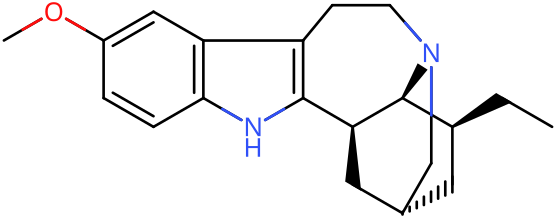
Ibogaine Stats & Data
CCC1CC2CN3CCc4c5cc(OC)ccc5nc4C(C2)C13HSIBGVUMFOSJPD-CFDPKNGZSA-NPharmacology
DrugBankMechanism of Action
... In this study, /researchers/ first characterized the actions of ibogaine on ethanol self-administration in rodents. Ibogaine decreased ethanol intake by rats in two-bottle choice and operant self-administration paradigms. Ibogaine also reduced operant self-administration of ethanol in a relapse model. Next, /the researchers/ identified a molecular mechanism that mediates the desirable activities of ibogaine on ethanol intake. Microinjection of ibogaine into the ventral tegmental area (VTA),
Metabolism
Ibogaine is a psychoactive alkaloid that possesses potential as an agent to treat opiate and cocaine addiction. The primary metabolite arises via O-demethylation at the 12-position to yield 12-hydroxyibogamine. In this report, evidence is presented that the O-demethylation of ibogaine observed in human hepatic microsomes is catalyzed primarily by the polymorphically expressed cytochrome P-4502D6 (CYP2D6). An enzyme kinetic examination of ibogaine O-demethylase activity in pooled human liver micr
Receptor Profile
Receptor Actions
Measured Affinities
Guide to PHARMACOLOGYMeasured binding and functional data for ibogaine, curated by the IUPHAR/BPS Guide to PHARMACOLOGY. Each row cites the paper it came from. Lower concentrations mean tighter binding — a value in the sub-nanomolar range indicates a very potent interaction.
| Target | Action | Measure | Value | Concentration | Species | Source |
|---|---|---|---|---|---|---|
| SERT SLC6A4 | Inhibition | pIC50 | 6.3 | 501.19 nM | Human | PMID 35707155 |
Reading this. pKi, pEC50 and pIC50 are negative log molar values, so a higher number means a tighter interaction; the concentration column converts them for you. Values from non-human species are laboratory measurements and do not translate directly to human effect. Receptor affinity is not a dose — it describes what a molecule binds, not how much of it is safe to take.
Receptor data from the IUPHAR/BPS Guide to PHARMACOLOGY (v2026.2), licensed CC BY-SA 4.0. Matched to this substance by InChIKey.
History & Culture
The use of Tabernanthe iboga has been practiced for centuries among Central African foragers in Gabon, Cameroon, and surrounding countries, with this ethnobotanical knowledge eventually passed to the Bwiti tribe of Gabon. Within the Bwiti religion, iboga serves as a sacrament central to numerous spiritual practices, including rites of passage, spiritual communion, resolution of pathological problems, and communication with ancestors. The plant remains fundamental to indigenous society in these regions, holding such cultural significance that in 2000, the Council of Ministers of the Republic of Gabon declared iboga a national treasure.
1889–1901
The use of iboga in African spiritual ceremonies was first documented by French and Belgian explorers in the 19th century, with early reports attributed to French naval physician and Gabon explorer Marie-Théophile Griffon du Bellay. The first formal botanical description of Tabernanthe iboga was published in 1889. Twelve years later, in 1901, ibogaine was independently isolated from the plant by two research groups: Dybowski and Landrin, and separately by Haller and Heckel, both working with samples obtained from Gabon.
1930s–1966
Total synthesis of ibogaine was achieved in 1956, with its molecular structure subsequently confirmed through X-ray crystallography in 1960. Additional synthetic methodologies continued to be developed, with G. Büchi accomplishing a complete synthesis in 1966. During this period, ibogaine also maintained a commercial presence in France. From the 1930s through 1966, it was marketed as Lambarène, an extract of Tabernanthe manii promoted as a mental and physical stimulant. Each tablet contained approximately 200 mg of extract with relatively low doses of 4 to 8 mg ibogaine. The product gained popularity among post-World War II athletes before being withdrawn from the French market in 1966 when ibogaine-containing products were prohibited. Another formulation marketed during this era was Iperton, which contained Tabernanthe iboga extract at 40 mg per dose unit.
1962–1992
Anecdotal observations regarding ibogaine's potential therapeutic effects began emerging in the early 1960s. The compound's anti-addictive properties were discovered serendipitously in 1962 by Howard Lotsof, then 19 years old, when he and five friends—all heroin users—noticed subjective reductions in craving and withdrawal symptoms while taking the substance. Subsequent observations convinced Lotsof of its potential utility in treating substance dependence, leading him to contract with a Belgian company to produce ibogaine tablets for clinical trials in the Netherlands. He was awarded a United States patent for the product in 1985. Beyond addiction treatment, ibogaine was also explored in psychotherapeutic contexts during this period. Researchers documented physician-patient interactions emphasizing early memory recall and the reliving of past experiences, with notable work conducted by Claudio Naranjo. In 1992, Eric Taub established the first ibogaine treatment center at an offshore location near the United States, initiating treatments and advocating for broader recognition of the compound. He was subsequently joined in Costa Rica by Lex Kogan, another prominent figure in the field. Together, they systematized ibogaine administration protocols and established medically monitored treatment clinics across several countries. Since then, clinics have been founded worldwide to serve individuals seeking to reduce or eliminate dependence on other substances, particularly opioids.
2025–present
Interest in ibogaine as a potential treatment for addiction has continued to grow. In 2025, the state of Texas allocated $50 million to fund clinical research on ibogaine, with the stated goal of developing FDA-approved treatments for opioid use disorder, co-occurring substance use disorders, and other ibogaine-responsive conditions. The initiative, supported by former Governor Rick Perry, established a consortium of universities, hospitals, and drug developers, positioning Texas as a potential center for psychedelic medicine research.
Ibogaine has appeared in various cultural and media contexts over the decades. In 1972, gonzo journalist Hunter S. Thompson published a satirical article in Rolling Stone while covering the Democratic primary campaign, falsely asserting that candidate Edmund Muskie was addicted to ibogaine. The piece was not recognized as satire by many readers and other journalists, and the unfounded accusation reportedly damaged Muskie's reputation—Thompson later expressed surprise that anyone had believed it. The substance has also been the subject of several books. Author and Yippie activist Dana Beal co-authored "The Ibogaine Story" in 1997. Daniel Pinchbeck described his personal ibogaine experience in "Breaking Open the Head" (2002) and a subsequent Guardian article titled "Ten years of therapy in one night" (2003). More recently, musician and author Geoff Rickly based his debut novel "Someone Who Isn't Me" on his experiences with heroin addiction and treatment at an ibogaine clinic in Mexico.
Toxicity
Ibogaine's toxicity is cardiac, and it is well documented: it blocks hERG potassium channels at the same concentrations used to treat addiction (IC50 around 3–4 µM against human plasma levels that reach up to 11 µM), prolonging the QT interval and setting up ventricular arrhythmias. Alper's forensic series counted 19 deaths temporally associated with ibogaine over 1990–2008; most involved pre-existing (mainly cardiovascular) disease or other drugs, and deaths occurred up to three days after dosing. That delay is the signature of noribogaine, the active metabolite: it blocks hERG about as potently as ibogaine and its half-life is 28–49 hours, so the danger window outlasts the trip by days — one documented case's QTc stayed prolonged for 12 days. Arrhythmias are also documented in people with no cardiac history. The clinical screening standards exist for good reason: a resting 12-lead ECG (exclusion at QTc 450 ms in males / 470 ms in females), potassium and magnesium checked and corrected before dosing (low levels independently prolong QT), no significant cardiac history, and continuous ECG monitoring during treatment. Unsupervised use is where the deaths concentrate.
Effect Profile
Curated + 50 ReportsStrong visuals, headspace, and auditory effects with strong body load
Moderate insight with strong motor impairment, moderate mania, mild dissociative depth
Tolerance & Pharmacokinetics
drugs.wikiTolerance Decay
Acute tachyphylaxis to re-dosing is common due to persistent noribogaine; functional sensitivity returns over days–weeks. Repeated high-dose use is uncommon due to intensity and cardiotoxic window.
Cross-Tolerances
Demographics
Gender Distribution
Age Distribution
Reports Over Time
Effect Analysis
Erowid + BluelightEffects aggregated from 50 experience reports (33 single-substance Erowid + 17 Bluelight)
Effect Sentiment Distribution
Confidence Distribution
Each bar is the share of reports mentioning the effect; its whisker, and the band on the rows below, is the 95% interval: where the share could plausibly be with other reports of the same kind.
Rows resting on fewer than 20 reports show a count (“3 of 7”) instead of a bar. Why 20?
Positive Effects 31
Adverse Effects 36
Show 16 more adverse effects
Show 17 neutral or unclassified mentions
Also reported in combinations. In the 13 Ibogaine reports where another drug was taken too, 3 mention hospital, emergency services or an overdose, 1 a seizure and 1 psychosis (too few reports for percentages). In the 33 single-substance reports: 15.2%, 0.0% and 6.1%. These are not in the figures above: they cannot be put down to Ibogaine alone, and a mention is not always something that happened to the writer.
Dosage Distribution
Dose distribution from experience reports, one dose per report (the first listed). Doses above Q3 + 3×IQR, far above what people typically take, are left out of the median and range and listed under each route: most are real heavy doses or overdoses, not mistakes.
1 report gave a dose above the typical range (30,000 mg), so it is not in the figures above. Listing a dose here does not mean it is safe.
Show the report
Real-World Dose Distribution
ErowidFrom 61 of 67 recorded dose entries: those that state a weight (mg, g or µg), in routes with at least five of them. Values above Q3 + 3×IQR, far above what people typically take, are left out; they can include real heavy doses and overdoses, not only mistakes.
Oral (n=58)
Common Combinations
Most co-occurring substances, as a share of all 46 reports filed under Ibogaine; whiskers are 95% intervals
Form / Preparation
Most common forms and preparations, as a share of the 22 reports that give one; whiskers are 95% intervals
Body-Weight Dosing
Dose per kg of body weight, one dose per report (the first listed), from reports giving a weight of 30–250 kg. Doses above Q3 + 3×IQR, far above what people typically take, are left out of the median and range and listed under each route.
1 dose more than 50 times the median may be a typing or unit error and is not in the figures either: check the report.
Redose Patterns
Redosing behavior across 27 reports
Legal Status
| Country | Status | Notes |
|---|---|---|
| Gabon | National Treasure (Protected) | Declared a national treasure by the Council of Ministers of the Republic of Gabon in 2000. Iboga is fundamental to the Bwiti religion and is used legally for ceremonial purposes including rites of passage, spiritual communion, and communication with ancestors. Traditional and religious use is protected under national recognition. |
Harm Reduction
drugs.wikiIbogaine and its active metabolite noribogaine inhibit cardiac hERG channels at clinically relevant concentrations, prolonging ventricular repolarization (QT interval) and predisposing to torsades de pointes; adverse cardiac events can appear days after a single dose due to noribogaine’s long half-life. Pre-dose screening (12-lead ECG, QTc, heart history) and correction of electrolytes (potassium, magnesium) materially reduce arrhythmia risk. High-variability plant products (root bark/TA) complicate dosing; ibogaine HCl allows weight-based calculations (typical ‘flood’ 15–25 mg/kg) but still requires continuous monitoring and ready access to advanced cardiac care. Significant ataxia, vertigo, bradycardia, and vomiting are common during peaks; patients should remain supine with assistance to minimize falls and aspiration. Because noribogaine is a strong SERT inhibitor and ibogaine/noribogaine are metabolized by polymorphic CYP2D6, poor metabolizers or those taking CYP2D6 inhibitors can experience prolonged exposure and QT risk; dose reduction and extended monitoring are prudent. Combining ibogaine with methadone and other potent QT-prolongers is a well-documented hazard; most clinical protocols require opioid transitions/washouts and continuous telemetry. Stimulants (including cocaine/amphetamines) amplify cardiac risk during and for several days post-dose; strict abstinence is recommended pre/post. Anti-emetics like ondansetron also prolong QT; if anti-nausea medication is clinically necessary, it should be selected and monitored by medical staff. Post-ibogaine, opioid tolerance often drops; relapse can therefore be more lethal—harm-reduction planning (naloxone, support, follow-up) is essential. Legal status varies widely; in many countries ibogaine is controlled or unapproved for treatment—unregulated settings may lack the monitoring capacity required for safe administration.
References
Data Sources
Cited References
- Alper et al. 1999: Treatment of Acute Opioid Withdrawal with Ibogaine
- Drugs.com: Iboga
- Erowid: Ibogaine Basics
- Erowid: Ibogaine FAQ
- Koenig & Hilber 2015: The Anti-Addiction Drug Ibogaine and the Heart
- Mačiulaitis et al. 2008: Ibogaine, an anti-addictive drug
- PsychonautWiki: Ibogaine
- Erowid: Ibogaine Basics
- DrugWise: Ibogaine
- Erowid: Ibogaine Article
Additional references
- Bluelight: hERG blockade, QT prolongation mechanisms (links to NCBI PMC433/533 series)
- NCBI PMC: Anti-addiction drug ibogaine prolongs AP in human iPSC cardiomyocytes (QT risk)
- NCBI PMC: Ibogaine cardiac ion channel profile incl. hERG inhibition
- NCBI PMC: The Anti-Addiction Drug Ibogaine and the Heart: A Delicate Relation (review)
- Bluelight: Flood dose norms (≈17–25 mg/kg HCl) and supervision cautions
- Bluelight: Noribogaine half-life 28–49 h (linking PubMed)
- UNODC World Drug Report (Erowid mirror): Ataxia and potential cardiac interactions
- Isomer Design (Isomer Design): Ibogaine identifiers and synonyms
- Bluelight: Biology/Pharmacology notes—SERT inhibition, dose bands, duration