
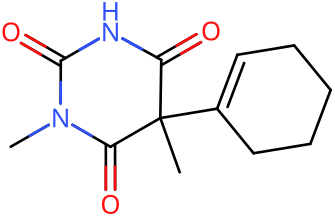
Hexobarbital Stats & Data
UYXAWHWODHRRMR-UHFFFAOYSA-NPharmacology
DrugBankDescription
A barbiturate that is effective as a hypnotic and sedative.
Mechanism of Action
Hexobarbital binds at a distinct binding site associated with a Cl- ionopore at the GABA-A receptor, increasing the duration of time for which the Cl- ionopore is open. The post-synaptic inhibitory effect of GABA in the thalamus is, therefore, prolonged.
Pharmacodynamics
Hexobarbital is a barbiturate derivative having hypnotic and sedative effects. It was subsequently used in the 1940s and 1950s as an anesthetic for surgery. Furthermore, the agent also demonstrates a fairly quick onset of action that also possesses a short duration of action. However it can be difficult to control the depth of anesthesia with hexobarbital which makes it quite dangerous, and it has now been replaced by safer drugs in human medicine, usually thiopental would be the barbiturate of choice for this application these days.
Indication
For the induction of anesthesia prior to the use of other general anesthetic agents and for induction of anesthesia for short surgical, diagnostic, or therapeutic procedures associated with minimal painful stimuli.
Hexobarbital binds at a distinct binding site associated with a Cl- ionopore at the GABA-A receptor, increasing the duration of time for which the Cl- ionopore is open. The post-synaptic inhibitory effect of GABA in the thalamus is, therefore, prolonged.
Carcinogenicity
No indication of carcinogenicity to humans (not listed by IARC).
Toxicity (DrugBank)
Symptoms of an overdose typically include sluggishness, incoordination, difficulty in thinking, slowness of speech, faulty judgment, drowsiness or coma, shallow breathing, staggering, and in severe cases coma and death.
Health effects (PubChem excerpts)
They cause slurred speech, disorientation and "drunken" behavior. They are physically and psychologically addictive. They cause slurred speech, disorientation and "drunken" behavior. They are physically and psychologically addictive.
Tolerance & Pharmacokinetics
drugs.wikiNo tolerance chart. Our decay curves for these drugs were estimates, and a curve can make tolerance look longer-lasting than it is, which is the dangerous direction.
How fast tolerance to these drugs fades after a break has not been measured well enough to draw, so don't count on a dose you used to take still being safe: after time off, start with a much smaller amount and don't use alone. Mixing sedatives with each other, with alcohol or with opioids sharply raises the risk of a fatal overdose. If you've been using regularly, don't stop suddenly: withdrawal from benzodiazepines, alcohol or GHB/GBL can cause seizures or delirium, so get medical help to cut down gradually. With barbiturates, you get used to the effects much more than to a dangerous dose, so the gap between a dose that works and one that kills shrinks the more you use. Stopping suddenly after regular use can cause convulsions and delirium.
Sources: FRANK: benzodiazepines · Alcohol and Drug Foundation: GHB · FDA 2020: benzodiazepine boxed warning · FDA 2019: gabapentinoids and breathing · NHS: alcohol use disorder · Phenobarbital label: drug abuse and dependence