
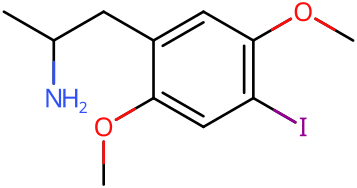
DOI Stats & Data
BGMZUEKZENQUJY-UHFFFAOYSA-NReceptor Profile
Receptor Actions
Receptor Binding
Measured Affinities
Guide to PHARMACOLOGYMeasured binding and functional data for DOI, curated by the IUPHAR/BPS Guide to PHARMACOLOGY. Each row cites the paper it came from. Lower concentrations mean tighter binding — a value in the sub-nanomolar range indicates a very potent interaction.
| Target | Action | Measure | Value | Concentration | Species | Source |
|---|---|---|---|---|---|---|
| 5-HT2B receptor Htr2b | Full agonist | pKi | 7.6 | 25.12 nM | Rat | — |
| 5-HT2A receptor Htr2a | Full agonist | pKi | 7.1 | 79.43 nM | Rat | PMID 11040033 |
| 5-HT1F receptor HTR1F | Full agonist | pKi | 5.8 | 1,585 nM | Human | PMID 8380639 |
| 5-HT2A receptor HTR2A | Full agonist | pKi | — | — | Human | — |
| 5-HT2B receptor HTR2B | Full agonist | pKi | — | — | Human | — |
| 5-HT2C receptor HTR2C | Full agonist | pKi | — | — | Human | — |
| 5-ht1e receptor HTR1E | Full agonist | pKi | — | — | Human | — |
Reading this. pKi, pEC50 and pIC50 are negative log molar values, so a higher number means a tighter interaction; the concentration column converts them for you. Values from non-human species are laboratory measurements and do not translate directly to human effect. Receptor affinity is not a dose — it describes what a molecule binds, not how much of it is safe to take.
Receptor data from the IUPHAR/BPS Guide to PHARMACOLOGY (v2026.2), licensed CC BY-SA 4.0. Matched to this substance by InChIKey.
History & Culture
1973–1991
DOI was first synthesized and described in the scientific literature by Ronald Coutts and Jerry Malicky in 1973. The compound later received more detailed documentation, including its psychoactive effects in humans, when Alexander Shulgin included it in his 1991 book PiHKAL (Phenethylamines I Have Known and Loved). Among the psychedelic amphetamines, DOI shares with DOB the distinction of being one of the most potent compounds in its class.
DOI has become an important tool in neuroscience research, particularly for studying serotonergic systems. The compound can be synthesized with various radioactive iodine isotopes, making it valuable for mapping the distribution of serotonin 5-HT2A receptors in the brain. The radioactive iodine-125 form used in PET imaging was developed in the laboratory of David E. Nichols. The fact that DOI remained unscheduled at the federal level in the United States significantly facilitated its widespread adoption in research settings. At least one neurochemical research company on the East Coast began offering DOI commercially for experimental purposes, though the company appeared aware of the compound's psychedelic properties—at one point nearly doubling its price and adding restrictions against telephone orders. Beyond its utility as a research ligand, DOI has demonstrated unexpected pharmacological properties in laboratory studies. Cell research has shown the compound to be an extremely potent inhibitor of tumour necrosis factor-alpha inflammation at picomolar concentrations. TNF-alpha is a significant target in research on degenerative conditions including rheumatoid arthritis and Alzheimer's disease.
2007–present
In January 2007, British police reported that three young men had fallen ill after reportedly consuming DOI at a rave in Biggleswade, near Milton Keynes. Authorities issued warnings for others who may have taken the substance to seek medical attention. This incident represented an early indication that DOI had begun circulating as a recreational drug in the United Kingdom. A notable criminal case in South Australia involved a man named Cody Edwards, who was convicted in the killing of Synamin Bell. Edwards pleaded guilty to manslaughter rather than murder after claiming that DOI had induced paranoia, leading him to act in what he characterized as self-defence when he fatally beat the mother of three with a dumbbell. The case drew attention due to the controversial reduced charge.
Subjective Effects
Physical
- Spontaneous tactile sensations
- Euphoria
- Stimulation
- Nausea
- Bodily control enhancement
- Tactile enhancement
- Temperature regulation loss
- Increased heart rate
- Pupil dilation
Cognitive
- Empathy, love and sociability enhancement
- Analysis enhancement
- Time distortion
- Novelty enhancement
- Emotion enhancement
- Immersion enhancement
- Memory suppression
- Ego death
- Unity and interconnectedness
- Wakefulness
- Increased libido
Sensory
- Enhancements
- Distortions
- Hallucinations
- Drifting: (melting, flowing, breathing and morphing)
- Tracers
- Symmetrical texture repetition
- Colour shifting
- Scenery slicing
- Acuity enhancement
- Colour enhancement
- Pattern recognition enhancement
- Transformations
- Internal hallucinations: (autonomous entities; settings, sceneries, and landscapes; alterations in perspective and scenarios and plots)
Forked from Subjective Effect Documentation work by Josie Kins, August 2016. Via dose.wiki (CC0).
Toxicity
PsychonautWikiThe toxicity and long-term health effects of recreational DOI do not seem to have been studied in any scientific context and the exact toxic dose is unknown. This is because DOI is a research chemical with very little history of human usage. Anecdotal reports from users suggests that there are no negative health effects attributed to simply trying it by itself at low to moderate doses and using it very sparingly (but nothing can be completely guaranteed). Independent research should always be done to ensure that a combination of two or more substances is safe before consumption. It is strongly recommended that one use harm reduction practices when using this substance.
Effect Profile
Curated + 42 ReportsStrong visuals, headspace, and auditory effects with strong body load
Strong stimulation and euphoria with strong anxiety/jitters, low focus
Community Effects
TripSitTolerance & Pharmacokinetics
drugs.wikiTolerance Decay
Cross-Tolerances
Demographics
Gender Distribution
Age Distribution
Reports Over Time
Effect Analysis
Erowid + BluelightEffects aggregated from 42 experience reports (25 single-substance Erowid + 17 Bluelight)
Effect Sentiment Distribution
Confidence Distribution
Each bar is the share of reports mentioning the effect; its whisker, and the band on the rows below, is the 95% interval: where the share could plausibly be with other reports of the same kind.
Rows resting on fewer than 20 reports show a count (“3 of 7”) instead of a bar. Why 20?
Positive Effects 45
Adverse Effects 38
Show 17 more adverse effects
Show 8 neutral or unclassified mentions
Also reported in combinations. In the 17 DOI reports where another drug was taken too, 3 mention hospital, emergency services or an overdose, 0 a seizure and 1 psychosis (too few reports for percentages). In the 25 single-substance reports: 12.0%, 0.0% and 8.0%. These are not in the figures above: they cannot be put down to DOI alone, and a mention is not always something that happened to the writer.
Dosage Distribution
Dose distribution from experience reports, one dose per report (the first listed). Doses above Q3 + 3×IQR, far above what people typically take, are left out of the median and range and listed under each route: most are real heavy doses or overdoses, not mistakes.
1 report gave a dose above the typical range (15.9 mg), so it is not in the figures above. Listing a dose here does not mean it is safe.
Show the report
Real-World Dose Distribution
ErowidFrom 31 of 51 recorded dose entries: those that state a weight (mg, g or µg), in routes with at least five of them. Values above Q3 + 3×IQR, far above what people typically take, are left out; they can include real heavy doses and overdoses, not only mistakes.
Oral (n=29)
Common Combinations
Most co-occurring substances, as a share of all 42 reports filed under DOI; whiskers are 95% intervals
Form / Preparation
Most common forms and preparations, as a share of the 27 reports that give one; whiskers are 95% intervals
Body-Weight Dosing
Dose per kg of body weight, one dose per report (the first listed), from reports giving a weight of 30–250 kg. Doses above Q3 + 3×IQR, far above what people typically take, are left out of the median and range and listed under each route.
1 report gave a dose above the typical range (0.265 mg/kg), so it is not in the figures above. Listing a dose here does not mean it is safe.
Show the report
Redose Patterns
Redosing behavior across 29 reports
Legal Status
| Country | Status | Notes |
|---|---|---|
| Australia | Controlled (disputed) | Sources conflict on current status. One source indicates DOI is controlled, noting it has been found on blotter sold as LSD. Another source states it is not listed in the Standard for the Uniform Scheduling of Medicines and Poisons (SUSMP). Caution advised regarding current legal status. |
| Austria | Illegal (NPSG) | Prohibited under the Neue-Psychoaktive-Substanzen-Gesetz (New Psychoactive Substances Act). Possession, production, and sale are illegal. |
| Brazil | Illegal | Listed as a controlled substance on Portaria SVS/MS nº 344. Possession, production, and sale are prohibited. |
| Canada | Schedule III CDSA | Controlled as of October 12, 2016 under a broad definition covering 2,5-dimethoxyphenethylamine derivatives. This includes most 2C compounds, DOx series, and related phenethylamines. |
| Denmark | Schedule I | Added to the list of Schedule I controlled substances on April 8, 2007, alongside 2C-E, 2C-P, and DOC. |
| Germany | Anlage II BtMG | Controlled under Anlage II of the Betäubungsmittelgesetz (Narcotics Act, Schedule II) as of December 13, 2014. Manufacturing, possession, import, export, purchase, sale, procurement, or dispensing without a license is illegal. |
| Japan | Designated Substance (Shitei-Yakubutsu) | Controlled under the Pharmaceutical Affairs Law as a Designated Substance. Possession and sale are prohibited. |
| Latvia | Schedule I | Classified as a Schedule I controlled substance under national drug legislation. |
| New Zealand | Schedule 3 / Class C | Controlled under the catch-all Analogues section in Schedule 3 (Class C) of New Zealand's drug laws, which covers structural analogs of scheduled substances. |
| Sweden | Schedule I | Classified as a Schedule I substance as of August 30, 2007, published by the Medical Products Agency in regulation LVFS 2007:10. |
| Switzerland | Controlled (with research exemption) | Considered a controlled substance as a defined derivative of α-Methylphenethylamine under Verzeichnis E point 130. Legal when used for scientific or industrial purposes. |
| Turkey | Illegal | Classified as a controlled drug. Possession, production, supply, and import are prohibited. |
| United Kingdom | Illegal (Psychoactive Substances Act) | Prohibited under the Psychoactive Substances Act 2016, which came into effect on May 26, 2016. Production, supply, and import are illegal. |
| United States | Unscheduled (Federal Analogue Act may apply) | Not federally scheduled. However, it would likely be considered an analog of DOB, meaning sales for human consumption or possession with intent to ingest could be prosecuted under the Federal Analogue Act. DOI is regularly used in animal and in vitro research, which has been cited as a reason against scheduling. |
| United States - Florida | Schedule I | Controlled as a Schedule I substance under Florida state law, separate from federal scheduling. |