
DOC Stats & Data
CC(CC1=CC(=C(C=C1OC)Cl)OC)NACRITBNCBMTINK-UHFFFAOYSA-NPharmacology
DrugBankMetabolism
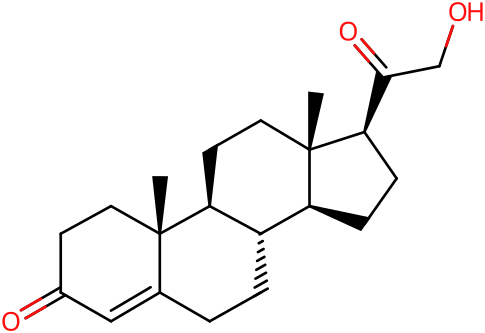
21-hydroxy-progesterone is a known human metabolite of progesterone.
Receptor Profile
Receptor Actions
Receptor Binding
History & Culture
1972–1973
DOC was originally synthesized by Ronald Coutts and Jerry Malicky at the University of Alberta in Canada. Their work describing the compound was published in the scientific literature in 1973 as part of research into analogues of DOM and related substituted amphetamines. The substance remained largely obscure for nearly two decades following its initial synthesis.
1989–1991
Prior to becoming widely known, DOC appeared in forensic analysis of designer amphetamine samples, with the compound being identified in Canadian drug seizures as early as 1989. Human usage was subsequently popularized following the 1991 publication of PiHKAL (Phenethylamines I Have Known And Loved) by Alexander Shulgin, which provided detailed information on the compound's synthesis and pharmacological effects. Shulgin characterized DOC as an "archetypical psychedelic" with pronounced effects, noting that everything is present "in spades" compared to the more subtle qualities of related two-carbon phenethylamines.
2005–present
DOC has remained uncommon on traditional illicit drug markets, instead circulating primarily through online research chemical vendors operating in legal grey areas. Sales of DOC distributed on blotting paper and in capsule form were reported in late 2005 and again in late 2007. The compound's availability in blotter format has led to instances of misrepresentation, with DOC sometimes being sold as LSD by unscrupulous dealers. A notable example occurred in December 2007 when police in Contra Costa County, California seized blotter paper suspected to be LSD that laboratory analysis revealed to contain DOC instead.
Subjective Effects
Physical
- Spontaneous tactile sensations: The "body high" of DOC is manifested as somewhat intense in comparison to most classical psychedelics such as LSD. The sensation itself can be described as a constantly present yet somewhat mild energetic pins and needles sensation that encompasses a person’s entire body. It is usually felt over every square inch of the skin, but occasionally manifests itself in the form of a continuously shifting tingling sensation that travels up and down the body in spontaneous waves.
- Stimulation: In terms of its effects on the physical energy levels of the tripper, DOC is usually considered to be extremely stimulating at levels which do not become overwhelming, resulting in a shakiness and unsteadiness of the hands but encouraging one to move around, run, dance, climb and generally engage in physical activities. In comparison, other more commonly used psychedelics such as psilocin are generally sedating and relaxed.
- Tactile enhancement: Feelings of enhanced tactile sensation are consistently present at moderate levels throughout most DOC trips.
- Nausea: Mild to extreme nausea is reported when consumed in moderate to high dosages and either passes once the person has vomited or gradually fades by itself as the peak sets in.
- Vasoconstriction: This effect is usually only present at higher dosages, but can be particularly uncomfortable.
- Bodily control enhancement
- Pupil dilation
- Increased blood pressure
Cognitive
- Empathy, love and sociability enhancement: This component is consistently manifested only in the context of social settings in which one is within the company of others. These feelings of sociability, love and empathy are a little weaker and less sharp than those found on substances such as MDMA and 2C-B, but still prove strong enough to provide long lasting therapeutic effects.
- Analysis enhancement
- Thought acceleration
- Time distortion
- Novelty enhancement
- Immersion enhancement
- Conceptual thinking
- Thought connectivity
- Current mind state enhancement
- Personal bias suppression
- Memory suppression
- Ego death
- Wakefulness
Sensory
- Enhancements
- Distortions
- Hallucinations
DOC presents a full and complete array of possible visual distortions which generally includes:
- Drifting: (melting, flowing, breathing and morphing) - In comparison to other psychedelics, this effect can be described as highly detailed, slow and smooth in motion, static in appearance and unrealistic/cartoon-like in style.
- Tracers
- After images
- Symmetrical texture repetition
- Colour shifting
- Scenery slicing
- Diffraction
DOC presents a full and complete array of possible visual enhancements which generally includes:
- Visual acuity enhancement
- Colour enhancement
- Pattern recognition enhancement
DOC and other substituted amphetamines produce a full range of high level hallucinatory states in a fashion that is more consistent and reproducible than that of many other commonly used psychedelics. This holds particularly true in comparison to other substances within the phenethylamine family. These effects include:
- Transformations
- Internal hallucinations: (autonomous entities; settings, sceneries, and landscapes; alterations in perspective and scenarios and plots) - In comparison to other psychedelics such as LSD, DOC is extremely high in internal hallucinations. They are more common within dark environments and can be comprehensibly described through its variations as lucid in believability, interactive in style, new experiences in content, autonomous in controllability, geometry-based in style and almost exclusively of a religious, spiritual, mystical or transcendental nature in their overall theme.
Forked from Subjective Effect Documentation work by Josie Kins, September 2015. Via dose.wiki (CC0).
Toxicity
PsychonautWikiThe toxicity and long-term health effects of recreational DOC use do not seem to have been studied in any scientific context and the exact toxic dose is unknown. Anecdotal reports suggest that there are no negative health effects attributed to simply trying DOC by itself at low to moderate doses and using it very sparingly (but nothing can be completely guaranteed). Independent research should always be done to ensure that a combination of two or more substances is safe before consumption. Medical literature reports multiple physical complications associated with the use of DOC. An individual's cause of death was reported as DOC toxicity and confirmed with GC-MS in the Journal of Analytical Toxicology.
Effect Profile
Curated + 108 ReportsStrong visuals, headspace, and auditory effects with strong body load
Strong stimulation and euphoria with strong anxiety/jitters, mild focus
Duration Timeline
BluelightEmpirical Duration
Erowid ReportsMedian times after the dose that Erowid reports state. A curve is drawn only when reports state all four points (onset, peak begins, comedown begins, back to baseline) and the medians fall in that order. No point is estimated from another.
No curve: the stated times run backwards. Reports put the start of the comedown (T+8h, 7 reports) before the start of the peak (T+9h, 8 reports). Each time is the median of a different set of reports, so they are shown as stated, not rearranged.
Community Effects
TripSitTolerance & Pharmacokinetics
drugs.wikiTolerance Decay
Tolerance to DOC (and classic psychedelics) rises sharply after an experience and then decays over about 1–2 weeks; model and ratios are heuristic, inferred from user reports, not measured pharmacology.
Cross-Tolerances
Demographics
Gender Distribution
Age Distribution
Reports Over Time
Effect Analysis
Erowid + BluelightEffects aggregated from 93 experience reports (43 single-substance Erowid + 65 Bluelight)
Effect Sentiment Distribution
Confidence Distribution
Each bar is the share of reports mentioning the effect; its whisker, and the band on the rows below, is the 95% interval: where the share could plausibly be with other reports of the same kind.
Positive Effects 68
Adverse Effects 48
Show 28 more adverse effects
Show 22 neutral or unclassified mentions
Also reported in combinations. In the 40 DOC reports where another drug was taken too, 6 (15.0%) mention hospital, emergency services or an overdose, 4 (10.0%) a seizure and 4 (10.0%) psychosis. In the 43 single-substance reports: 16.3%, 0.0% and 9.3%. These are not in the figures above: they cannot be put down to DOC alone, and a mention is not always something that happened to the writer.
Dosage Distribution
Dose distribution from experience reports, one dose per report (the first listed). Doses above Q3 + 3×IQR, far above what people typically take, are left out of the median and range and listed under each route: most are real heavy doses or overdoses, not mistakes.
1 report gave a dose above the typical range (28 mg), so it is not in the figures above. Listing a dose here does not mean it is safe.
Show the report
Real-World Dose Distribution
ErowidFrom 83 of 118 recorded dose entries: those that state a weight (mg, g or µg), in routes with at least five of them. Values above Q3 + 3×IQR, far above what people typically take, are left out; they can include real heavy doses and overdoses, not only mistakes.
Oral (n=71)
Insufflated (n=8)
Common Combinations
Most co-occurring substances, as a share of all 83 reports filed under DOC; whiskers are 95% intervals
Form / Preparation
Most common forms and preparations, as a share of the 59 reports that give one; whiskers are 95% intervals
Body-Weight Dosing
Dose per kg of body weight, one dose per report (the first listed), from reports giving a weight of 30–250 kg. Doses above Q3 + 3×IQR, far above what people typically take, are left out of the median and range and listed under each route.
2 reports gave a dose above the typical range (0.163–0.281 mg/kg), so they are not in the figures above. Listing a dose here does not mean it is safe.
Show the reports
Redose Patterns
Redosing behavior across 63 reports
Legal Status
| Country | Status | Notes |
|---|---|---|
| Austria | Controlled (NPSG) | Prohibited under the Neue-Psychoaktive-Substanzen-Gesetz (New Psychoactive Substances Act). Possession, production, and sale are illegal without authorization. |
| Brazil | Controlled | Listed on Portaria SVS/MS nº 344. Possession, production, and sale are prohibited. |
| Canada | Schedule I CDSA | Controlled under the Controlled Drugs and Substances Act. Additionally covered by the 2016 regulation controlling phenethylamines with a 2,5-dimethoxyphenylethamine core structure. Illegal to sell, buy, or possess without valid legal exemption. |
| China | Category I psychotropic substance | Controlled since October 2015. Illegal to sell, buy, import, export, or manufacture without authorization. |
| Denmark | Schedule I | Added to the list of Schedule I controlled substances as of April 8, 2007, alongside 2C-E, 2C-P, and DOI. |
| Finland | Controlled | Possession, production, and sale are prohibited under national drug legislation. |
| Germany | Anlage I BtMG | Listed in Anlage I of the Betäubungsmittelgesetz (Narcotics Act) since February 1, 1997. Manufacturing, possession, importation, exportation, purchase, sale, procurement, and dispensing are all prohibited without a license. |
| Israel | Controlled | Possession, production, and sale are prohibited under national drug legislation. |
| Latvia | Schedule I | Classified as a Schedule I controlled substance under Latvian law. |
| Netherlands | Controlled | Possession, production, and sale are prohibited under the Opium Act. |
| New Zealand | Class C | Controlled as an amphetamine analogue under Schedule III (Class C) of New Zealand's controlled substances legislation. |
| Poland | Uncontrolled | As of 2011, DOC was not a controlled substance and no analogue law covered it. Current status may have changed. |
| Switzerland | Controlled (Verzeichnis E) | Regulated as a defined derivative of α-methylphenethylamine under Verzeichnis E point 130. Permitted for scientific or industrial purposes only. |
| Turkey | Controlled | Classified as a controlled drug. Illegal to possess, produce, supply, or import. |
| United Kingdom | Class A | Controlled under the Misuse of Drugs Act 1971 through the amphetamine analogue clause. Class A/Schedule I classification prohibits sale, purchase, and possession without a license. |
| United States | Unscheduled (Federal Analogue Act applies) | Not federally scheduled, but may be prosecuted as an analogue of DOM or DOB under the Federal Analogue Act when sold for human consumption or possessed with intent to ingest. Specifically listed as Schedule I in Florida state law. |
Harm Reduction
drugs.wikiDOC is a potent psychedelic amphetamine with a slow onset and very long duration; because onset may take 2–3 hours, redosing early greatly increases the risk of accidental overdose and an excessively long experience. Verified drug-checking programs have repeatedly found DOC sold as LSD on blotter; when ingesting unknown blotter, wait at least 3 hours before redosing, ideally after reagent/lab testing, to avoid stacking doses of a long-acting compound. DOC can cause peripheral vasoconstriction and stimulant-like effects (elevated heart rate/blood pressure, chest tightness) especially at higher doses; those with cardiovascular disease or hypertension should avoid it and all users should avoid combining with other vasoconstrictors (stimulants, decongestants, high-dose caffeine). Lithium has been repeatedly associated with seizures and severe adverse reactions when combined with classic psychedelics; treat this combination as dangerous and avoid it. Mixing with MAOIs is also considered dangerous due to unpredictable potentiation and hypertensive risk; tramadol adds seizure risk and serotonergic toxicity potential. If acute anxiety or dysphoria occur, non-pharmacological de-escalation (calm environment, breathing, reassurance) is first-line; benzodiazepines can attenuate the experience but should not be combined with alcohol or other depressants due to additive sedation and respiratory depression. Because activity is in the low-milligram range, use a calibrated milligram scale or volumetric dosing; never eyeball powder. DOC commonly disrupts sleep; plan for next-day impairment and avoid driving or operating machinery during and after effects. Tolerance builds rapidly after one dose and substantially reduces effects for about 1–2 weeks; cross-tolerance exists with other serotonergic psychedelics (e.g., LSD, DOB/DOM). Human pharmacokinetic data (including elimination half-life) are not established; reported half-life figures online are estimates inferred from long duration rather than measured studies, so dose-spacing and conservative titration are essential. Drug checking (reagent and, where available, lab confirmation) is strongly recommended for any blotter or liquid purported to be LSD given frequent mislabeling with DOx compounds in some markets.
References
Data Sources
Cited References
- Barnett et al. 2014 - Fatal DOC Intoxication Case Report
- Burish et al. 2015 - DOC Seizure Case Report
- Coutts & Malicky 1973 - Synthesis of DOM Analogs
- DEA Federal Register 2022 - DOC Schedule I Placement
- PiHKAL Entry #64 - DOC
- Talaie et al. 2009 - Tramadol Seizure Risk
- TripSit: DOC Factsheet
- Bluelight: DOC Drug Info
- UNODC: 2013 Report on Research Chemicals
- PiHKAL Mirror: Pihkal
Additional references
- Erowid DOC – Dosage page (dose, onset, duration)
- Erowid DOC Vault (general overview)
- Saferparty (Zurich) warning – DOC sold as LSD (Mar 22, 2024)
- Saferparty blog – LSD blotter evaluation 2024/posted 2025 (mislabel rate; DOC found)
- Erowid LSD FAQ – multiple chemicals on blotter (incl. DOC)
- EUDA/DIMS Annual Report 2024 – LSD content overview; non‑LSD blotters occur
- TripSit – Drug combinations (class guidance incl. MAOIs, tramadol; stimulant/caffeine cautions)
- TripSit – How to deal with a bad trip (non‑pharmacologic support; benzodiazepines mentioned)
- TripSit – Volumetric converter (best practice for microgram‑potent compounds)
- Bluelight – DOC vasoconstriction/dose nonlinearity discussion (community harm‑reduction)
- Erowid LSD Health & Interactions – lithium + psychedelics seizures (extrapolated caution)
- PubChem – 2,5-Dimethoxy-4-chloroamphetamine (synonyms/identity)