
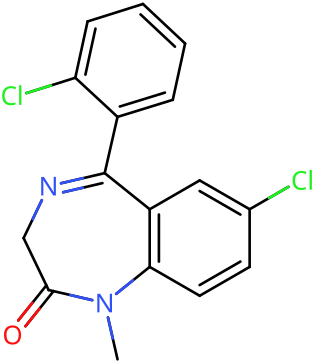
Diclazepam Stats & Data
Clc1ccc2N(C)C(=O)CN=C(c3ccccc3Cl)c2c1VPAYQWRBBOGGPY-UHFFFAOYSA-NInteraction Warnings
This combination can result in an increased risk of vomiting during unconsciousness and death from the resulting suffocation. If this occurs, users should attempt to fall asleep in the recovery position or have a friend move them into it.
It is dangerous to combine benzodiazepines with stimulants due to the risk of excessive intoxication. Stimulants decrease the sedative effect of benzodiazepines, which is the main factor most people consider when determining their level of intoxication. Once the stimulant wears off, the effects of benzodiazepines will be significantly increased, leading to intensified disinhibition as well as other effects.
Pharmacology
DrugBankDescription
Patented by Hoffmann-La Roche during the 1960s, diclazepam —also known as 2-Chlorodiazepam and RO5-3448 —is an analog to diazepam, which never found a proper medical use and thus never made it to market. However, it has gained popularity in the online designer drug market in recent years to become one of the leading designer benzodiazepine drugs (DBZDs) in Europe. Official reports from leading drug agencies state that diclazepam is pharmacologically comparable to diazepam and exerts similar effects on users. This makes sense, given their high level of structural similarity. They also have comparable pharmacokinetic qualities as both compounds exhibit long-acting effects.
Metabolism
Studies on the metabolism of diclazepam have sketched a detailed picture of its metabolic pathway. Diclazepam’s metabolism is hepatic; it is transformed in the liver through N-demethylation and hydroxylation by cytochrome P450 enzymes. Diclazepam produces three pharmacologically active metabolites: delorazepam, lorazepam, and lormetazepam, which can be detected in urine for 6, 19, and 11 days, respectively.
Half-life
The elimination half-life of diclazepam is 42 hours, which is considerably above average.
Receptor Profile
Receptor Actions
History & Culture
Diclazepam was first synthesized in 1960 by Leo Sternbach and his research team at Hoffman-La Roche, the same laboratory responsible for developing numerous other benzodiazepines including diazepam (Valium). Despite being created during the golden age of benzodiazepine discovery, diclazepam was never developed into a marketed pharmaceutical product and remained largely obscure for decades. The compound emerged in the 2010s as part of the novel psychoactive substance (NPS) market, where it became available through online vendors as an unscheduled research chemical. Unlike its parent compound diazepam, diclazepam has never undergone formal clinical trials to establish its safety and efficacy in humans. Its appearance in the research chemical market prompted regulatory responses in several countries during the mid-to-late 2010s and early 2020s.
Subjective Effects
Physical
The physical effects of diclazepam can be broken down into several components which progressively intensify proportional to dosage.
- Sedation: In terms of energy level alterations, this drug is extremely sedating and often results in an overwhelmingly lethargic state. At higher levels, this causes users to suddenly feel as if they are extremely sleep deprived and have not slept for days, forcing them to sit down and generally feel as if they are constantly on the verge of passing out instead of engaging in physical activities. This sense of sleep deprivation increases proportional to dosage and eventually becomes powerful enough to force a person into complete unconsciousness.
- Motor control loss
- Respiratory depression
- Muscle relaxation
- Dizziness
Cognitive
The cognitive effects of diclazepam can be broken down into several components which progressively intensify proportional to dosage. The general head space of diclazepam is described by many as one of intense sedation and decreased inhibition. It contains a large number of typical depressant cognitive effects. Paradoxical reactions to benzodiazepines such as increased seizures (in epileptics), aggression, increased anxiety, violent behavior, loss of impulse control, irritability and suicidal behavior sometimes occur (although they are rare in the general population, with an incidence rate below 1%). These paradoxical effects occur with greater frequency in recreational abusers, individuals with mental disorders, children, and patients on high-dosage regimes.
- Amnesia
- Anxiety suppression
- Thought deceleration
- Disinhibition
- Information processing suppression
- Euphoria
- Compulsive redosing
- Delusions of sobriety: This is the false belief that one is perfectly sober despite obvious evidence to the contrary such as severe cognitive impairment and an inability to fully communicate with others.
Forked from Subjective Effect Documentation by Josie Kins, September 2015. Via dose.wiki (CC0).
Toxicity
PsychonautWikiDiclazepam likely has a low toxicity relative to dose. However, it is potentially lethal when mixed with depressants like alcohol or opioids. It is strongly recommended that one use harm reduction practices, such as volumetric dosing, when using this substance to ensure the accurate administration of the intended dose.
Overdose
Benzodiazepine overdose may occur when a benzodiazepine is taken in extremely heavy quantities or concurrently with other depressants. This is particularly dangerous with other GABAergic depressants such as barbiturates and alcohol since they work in a similar fashion, but bind to distinct allosteric sites on the GABAA receptor. Thus, their effects potentiate one another.
Effect Profile
Curated + 8 ReportsStrong anxiolysis with moderate cognitive impairment and euphoria, mild sedation
Tolerance & Pharmacokinetics
drugs.wikiNo tolerance chart. Our decay curves for these drugs were estimates, and a curve can make tolerance look longer-lasting than it is, which is the dangerous direction.
How fast tolerance to these drugs fades after a break has not been measured well enough to draw, so don't count on a dose you used to take still being safe: after time off, start with a much smaller amount and don't use alone. Mixing sedatives with each other, with alcohol or with opioids sharply raises the risk of a fatal overdose. If you've been using regularly, don't stop suddenly: withdrawal from benzodiazepines, alcohol or GHB/GBL can cause seizures or delirium, so get medical help to cut down gradually.
Sources: FRANK: benzodiazepines · Alcohol and Drug Foundation: GHB · FDA 2020: benzodiazepine boxed warning · FDA 2019: gabapentinoids and breathing · NHS: alcohol use disorder
Cross-Tolerances
Experience Report Analysis
ErowidDemographics
Gender Distribution
Age Distribution
Reports Over Time
Real-World Dose Distribution
ErowidFrom 17 of 22 recorded dose entries: those that state a weight (mg, g or µg), in routes with at least five of them. Values above Q3 + 3×IQR, far above what people typically take, are left out; they can include real heavy doses and overdoses, not only mistakes.
Oral (n=15)
Common Combinations
Most co-occurring substances, as a share of all 21 reports filed under Diclazepam; whiskers are 95% intervals
Form / Preparation
Most common forms and preparations, as a share of the 9 reports that give one
Too few reports for bars: these forms come from 9 reports, and a bar is drawn only from 20 reports or more. With fewer, a percentage cannot tell a common effect from a rare one. Counts are shown instead. Why 20?
- Pill / Tablet 7 of 9
- Liquid 2 of 9
Redose Patterns
Redosing behavior across 11 reports
Too few reports for a chart: redosing is known from 11 reports, and a split is drawn only from 20 reports or more. Counts are shown instead. Why 20?
- Single dose 8 of 11
- Redosed 3 of 11
Benzodiazepine Equivalence
Diclazepam - 1mg ~=10mg Diazepam.
Legal Status
| Country | Status | Notes |
|---|---|---|
| Canada | Schedule IV CDSA | Listed as a controlled benzodiazepine under Schedule IV of the Controlled Drugs and Substances Act. All benzodiazepines fall under this classification in Canada. |
| Germany | Anlage II BtMG | Controlled under Anlage II of the Betäubungsmittelgesetz (Narcotics Act) since November 21, 2015. Manufacturing, possession, import, export, purchase, sale, procurement, or dispensing without a license is prohibited. |
| Poland | IV-P (controlled) | Classified under the IV-P group since January 27, 2022. Ownership, possession, and sale are illegal. |
| Russia | Schedule III | Controlled as a Schedule III substance since 2017 under Russian narcotics legislation. |
| Switzerland | Controlled (Verzeichnis E) | Specifically named as a controlled substance under Verzeichnis E of Swiss narcotics legislation. |
| Turkey | Illegal | Classified as a controlled drug substance. Possession, production, supply, and importation are prohibited. |
| United Kingdom | Class C | Controlled as a Class C substance under the Misuse of Drugs Act since May 31, 2017. Possession, production, and supply are illegal. |
| United States | Schedule I | Controlled as a Schedule I substance under the Controlled Substances Act since January 23, 2023. Classified as having high abuse potential with no currently accepted medical use. |
Harm Reduction
drugs.wikiDiclazepam is a long-acting designer benzodiazepine (Roche code Ro5‑3448) that metabolises to delorazepam, lorazepam and lormetazepam; these active metabolites extend impairment and drug-test detection windows beyond the parent half-life. In serum, parent drug may be detectable to ~4 days and delorazepam up to ~10 days; urine windows can be longer. Do not drive or operate machinery the day after dosing if any residual sedation is felt. Dosing in unregulated markets is highly variable; analytical work found nominal “1 mg” tablets actually contained ~0.59–1.39 mg (median ~0.95 mg). Treat all products as potentially mislabelled and use drug checking when possible. The onset can feel subtle for the first hours; avoid redosing to “chase” effects—accumulation leads to blackouts and risky disinhibition. Combining with other CNS depressants (alcohol, opioids, GHB/GBL, barbiturates) markedly increases the risk of respiratory depression, loss of consciousness and aspiration; this combination is strongly discouraged. Tramadol with benzodiazepines is flagged as dangerous (sedation, seizure risk); place anyone who becomes unresponsive in the recovery position and call emergency services. Because diclazepam converts to prescribed benzodiazepines, expect positive immunoassay/confirmatory tests for benzos (including lorazepam/delorazepam) for days after use. RC benzodiazepines are frequently mis-sold or cross-contaminated (e.g., bromazolam or norflurazepam in “alprazolam” tablets), underscoring the value of drug checking and cautious test dosing. Avoid abrupt cessation after repeated use; seek medical support for a gradual taper using a longer-acting benzodiazepine if needed. If preparing solutions for accurate low dosing, use a known solvent and concentration (volumetric dosing) and label clearly; never “eyeball” doses.
References
Cited References
- Bareggi et al. 1988 - Pharmacokinetics of Diclazepam
- Erowid Experience Vault: Diclazepam
- Kim et al. 2023 - Discriminative Stimulus and Reinforcing Effects
- NCBI: PMC - Assessment of NPS Benzodiazepines Availability
- TripSit Wiki: Benzodiazepines
- TripSit Factsheet: Diclazepam
- Drug Users Bible: Diclazepam
- TripSit Wiki: Benzodiazepines
- Drug-Do: Benzos
Additional references
- TripSit — Benzodiazepines index (includes Diclazepam Ro5‑3448, ~42 h half-life, ~1 mg typical potency)
- Drugs‑Forum — The New Drug Phenomenon (summary of diclazepam PK, active metabolites, real-world tablet content variability)
- EUDA (EU Drugs Agency) — Benzodiazepines drug profile (dependence, CNS depressant risks, withdrawal)
- TripSit Wiki — Drug combinations (benzos with GHB/GBL, tramadol and other depressants flagged as dangerous)
- Hi‑Ground — Benzos factsheet (practical HR on mixing with depressants, stimulants, antipsychotics, antihistamines)
- Saferparty Zürich — Multiple alerts showing frequent mislabelling of benzo tablets in the market (e.g., bromazolam sold as etizolam; norflurazepam sold as Xanax)
- Bluelight — Diclazepam discussion threads (onset subtlety, equivalence debates; risk of blackouts with redosing)
- SubstanceSearch — Diclazepam overview (community‑sourced potency/duration heuristics)