
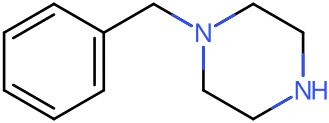
BZP Stats & Data
N1CCN(CC1)Cc1ccccc1IQXXEPZFOOTTBA-UHFFFAOYSA-NPharmacology
DrugBankDescription
Benzylpiperazine (BZP) is a recreational drug with euphoriant and stimulant properties. The effects produced by BZP are comparable to those produced by amphetamine. Adverse effects have been reported following its use including acute psychosis, renal toxicity and seizures. Deaths from piperazine derivatives are extremely rare, but there has been at least one death apparently due to BZP alone.
Receptor Profile
Receptor Actions
Effect Profile
Curated + 10 ReportsStrong stimulation with strong anxiety/jitters, low euphoria and focus
Tolerance & Pharmacokinetics
drugs.wikiTolerance Decay
Tolerance patterns inferred from stimulant-like use; high uncertainty. Many users report diminished effects after consecutive-day use and substantial recovery after 1–2 weeks off. Avoid frequent redosing within a single session to limit adverse events.
Cross-Tolerances
Experience Report Analysis
ErowidDemographics
Gender Distribution
Age Distribution
Reports Over Time
Effect Analysis
ErowidEffects aggregated from 10 experience reports (10 single-substance Erowid)
Effect Sentiment Distribution
Confidence Distribution
Each bar is the share of reports mentioning the effect; its whisker, and the band on the rows below, is the 95% interval: where the share could plausibly be with other reports of the same kind.
Too few reports for bars: these effects come from 10 single-substance Erowid reports, and a bar is drawn only from 20 reports or more. With fewer, a percentage cannot tell a common effect from a rare one. Counts are shown instead. Why 20?
Positive Effects 3
Adverse Effects 3
Show 1 neutral or unclassified mention
Also reported in combinations. In the 20 BZP reports where another drug was taken too, 3 (15.0%) mention hospital, emergency services or an overdose, 1 (5.0%) a seizure and 2 (10.0%) psychosis. In the 10 single-substance reports: 1, 0 and 0. These are not in the figures above: they cannot be put down to BZP alone, and a mention is not always something that happened to the writer.
Dosage Distribution
Dose distribution from experience reports, one dose per report (the first listed). Doses above Q3 + 3×IQR, far above what people typically take, are left out of the median and range and listed under each route: most are real heavy doses or overdoses, not mistakes.
1 report gave a dose above the typical range (2,000 mg), so it is not in the figures above. Listing a dose here does not mean it is safe.
Show the report
Common Combinations
Most co-occurring substances, as a share of all 30 reports filed under BZP; whiskers are 95% intervals
Form / Preparation
Most common forms and preparations, as a share of the 21 reports that give one; whiskers are 95% intervals
Body-Weight Dosing
Dose per kg of body weight, one dose per report (the first listed), from reports giving a weight of 30–250 kg. Doses above Q3 + 3×IQR, far above what people typically take, are left out of the median and range and listed under each route.
1 report gave a dose above the typical range (29.412 mg/kg), so it is not in the figures above. Listing a dose here does not mean it is safe.
Show the report
Redose Patterns
Redosing behavior across 22 reports
Legal Status
| Country | Status | Notes |
|---|---|---|
| Australia | BZP is banned in all Australian states. | Victoria, the last state in which it was legal, changed its classification on 1 September 2006, when BZP and piperazine analogs become illegal in the federal schedules, which are enacted by all Australian states and territories. |
| Canada | In Canada, Benzylpiperazine and salts of benzylpiperazine are classified as Schedule III controlled substances under the Controlled Drugs and Substances Act. | |
| Finland | Scheduled in "government decree on narcotic substances, preparations and plants" and is hence illegal. | |
| New Zealand | Based on the recommendation of the EACD, the New Zealand government passed legislation which placed BZP, along with other piperazine derivatives (TFMPP, mCPP, pFPP, MeOPP, and MBZP), into Class C of the Misuse of Drugs Act 1975. | A ban was intended to come into effect in New Zealand on 18 December 2007, but the law change did not go through until the following year, and the sale of BZP and the other listed piperazines became illegal in New Zealand as of 1 April 2008. An amnesty for possession and usage of these drugs was in effect until October 2008, at which point they became completely illegal. |
| United Kingdom | Piperazine and salts of piperazine are classified as Prescription Only Medicines in the UK. | Any products containing salts of piperazine would be licensable under the Medicines Act and consequently anyone manufacturing and supplying it legally must hold the relevant licenses to do so. BZP is not a salt of piperazine, but mislabelling of BZP products as containing "piperazine blend" resulted in some prosecutions of suppliers in the UK by the Medicines and Healthcare Products Regulatory Agency, although none were successful. In May 2009, the Home Office announced plans to ban BZP, and launched a consultation on the proposal. In October 2009, it was announced that from 23 December 2009, BZP and related piperazines would be Class C drugs under the Misuse of Drugs Act. |
| United States | The drug was federally classified as a Schedule I controlled substance in the United States in 2002, following a report by the DEA which incorrectly stated that BZP was 10 to 20 times more potent than amphetamine, when in fact BZP is ten times less potent than dexamphetamine. | It is also illegal at the state level in Florida, Oklahoma, Vermont, and Virginia. |
Harm Reduction
drugs.wikiReasoning for additions and harm-reduction guidance: 1) Dosing and onset: Multiple reputable sources place typical oral doses around 70–150 mg, with a slow 30–90 min onset and long duration. Slow onset encourages risky redosing if people expect MDMA-like timing. Waiting a full 2–3 hours before any redose reduces overdose and adverse-event risk. Sources: Erowid Piperazines Basics; EMCDDA/EUDA risk assessment. 2) Duration/after-effects: Reports consistently describe 6–10 h total duration with insomnia, headache, and stimulation into the next day, which impacts driving and next-day functioning; plan for sleep hygiene and a recovery window. Sources: Erowid Piperazines Basics; DrugWise BZP page. 3) Composition/adulteration: BZP historically appeared in 'party pills' often mixed with TFMPP and/or caffeine; tablets and powders may be mis-sold as MDMA. Use reliable drug checking services when available and don’t assume pill logos indicate MDMA. Sources: EMCDDA/EUDA risk assessment; Erowid BZP vault; DrugWise BZP page. 4) Pharmacology/serotonergic cautions: BZP shows amphetamine-like monoamine releasing effects and evidence of serotonergic activity; combining with SSRIs/SNRIs or other serotonergic agents (especially TFMPP) may increase serotonin syndrome risk. Avoid with MAOIs entirely due to risk of hypertensive crisis. Sources: Erowid neuropharmacology note; EMCDDA/EUDA risk assessment. 5) Cardiovascular/seizure risks: Adverse events include tachycardia, hypertension, palpitations, anxiety, headache, nausea and seizures—risks rise with higher doses, heat, dehydration, and polydrug use. People with cardiovascular disease, hypertension, seizure disorders, or significant anxiety should avoid. Sources: EMCDDA/EUDA risk assessment; DrugWise BZP page. 6) Heat, hydration and environment: As a stimulant, BZP can increase body temperature and impair thermoregulation. In hot crowded venues, take cooling breaks, avoid heavy exertion, sip small amounts of water regularly (avoid overhydration), and replace electrolytes. Sources: DrugWise general stimulant cautions. 7) Redosing/spacing: Tolerance to stimulant-like effects can build rapidly across days; spacing use by at least 1–2 weeks reduces compulsive redosing and adverse after-effects. Data are mostly anecdotal but consistent with stimulant patterns. Sources: EMCDDA/EUDA risk assessment; Erowid piperazines content. 8) Alcohol and caffeine: Mixing with alcohol can mask intoxication and stress the heart; caffeine adds to jitteriness, anxiety, and palpitations—keep doses low or avoid. Sources: DrugWise BZP and general stimulant cautions. 9) Legal status: BZP is controlled in many jurisdictions (e.g., EU control measure 2008; US Schedule I). Carrying across borders can lead to prosecution. Sources: EMCDDA/EUDA; Isomerdesign legal summaries. 10) Measuring dose: Effects vary widely; weigh doses with a milligram scale and avoid eyeballing, especially with unknown salt forms (base vs. HCl). PubChem entry confirms HCl salt existence; potency by mass differs between salt and base.
References
Data Sources
Cited References
- Antia et al. 2009 - Pharmacokinetics of BZP
- Baumann et al. 2005 - N-substituted piperazines mimic MDMA
- DrugWise: BZP Profile
- Erowid: BZP Basics
- Erowid: BZP Neuropharmacology
- Erowid: Piperazines Information
- EUDA: Drug Profile - BZP/Piperazines
- Lin et al. 2011 - Subjective effects of BZP and TFMPP
- PsychonautWiki: Substituted Piperazines
- Schep et al. 2011 - Clinical toxicology of BZP and TFMPP
- TripSit Factsheet: BZP
Additional references
- Erowid Piperazines Basics (BZP dose/duration)
- Erowid BZP Vault (general info, branding)
- EMCDDA/EUDA: Risk assessment of BZP (2009)
- Erowid: Neuropharmacology of BZP (5-HT involvement)
- DrugWise: BZP overview, effects/risks
- Isomerdesign legal summary (US/EU/CA controls)
- PubChem: Benzylpiperazine HCl (salt form exists)