
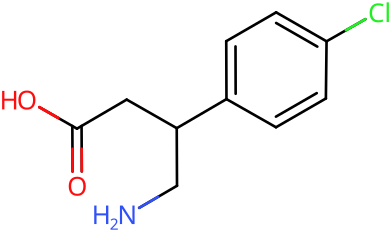
Baclofen Stats & Data
NCC(CC(=O)[O-])c1ccc(Cl)cc1.[H+]KPYSYYIEGFHWSV-UHFFFAOYSA-NPharmacology
DrugBankDescription
Baclofen is a gamma-aminobutyric acid (GABA) agonist used as a skeletal muscle relaxant used for the relief of painful and uncomfortable muscle spasms caused by a variety of conditions. It is particularly useful in treating muscle spasticity associated with spinal cord injury. This drug has recently been studied for the management of alcohol withdrawal, however, a conclusion has not been made regarding baclofen efficacy in this condition. This drug was first approved by the FDA in 1992.
Mechanism of Action
The exact mechanism of action of baclofen is not fully understood at this time , . Many studies indicate that baclofen is a GABA-B receptor agonist , , , , . Despite this, there is no conclusive evidence that the effects of baclofen on GABA systems are involved in the production of its clinical effects . Baclofen is an effective and widely used antispastic agent with a spinal site of action. Its mechanism of action and pharmacological properties are different from the effects of other antispastic agents. In addition, baclofen has central sites of action, shown by its adverse event profile and general CNS depressant properties . GABA-B receptors interact with signal transduction pathways and neurotransmitter systems. Baclofen exerts an antinociceptive effect. The clinical significance of this warrants further research data for clarification. Baclofen depresses monosynaptic and polysynaptic reflex transmission, by various actions, and possibly including the stimulation of GABAβ-receptors. This stimulation results in the inhibition of excitatory neurotransmitter (glutamate and aspartate) release, which may normally contribute to pain and spasticity. Although baclofen is an analog of the inhibitory neurotransmitter gamma-amino-butyric acid (GABA), there are no conclusive data indicating GABA systems are involved in its clinical effects .
Pharmacodynamics
In neurological diseases associated with spasm of the skeletal muscles, the clinical effects of baclofen occur due to baclofen action on reflex muscle contractions and of significant relief from painful spasm, automatism, as well as clonus. Baclofen, when used as indicated, improves mobility, increasing levels of independence, and facilitates both passive and active physiotherapy. Baclofen also stimulates gastric acid secretion . GABA-B receptor activation by baclofen may produce protective neurological effects. Baclofen also possesses anti-inflammatory properties that may be of interest in the study of addiction treatment . Preclinical studies have shown that GABA-B receptors have roles in memory storage and retrieval, reward, motivation, mood, as well as anxiety. Neuroimaging studies in humans indicate that baclofen produces region-specific alterations in brain activity.
Metabolism
Approximately 15% of the dose is metabolized in the liver, mainly by deamination . In a clinical study with radiolabeled baclofen, approximately 85% of the dose was excreted unchanged in the urine and feces. The γ-hydroxy metabolite, 3-(p-chlorophenyl)-4-hydroxybutyric acid, is formed by the deamination of baclofen . Because baclofen is partially metabolized in the liver, patients with impaired liver function should be regularly monitored with liver function tests .
Absorption
Rapidly and almost completely absorbed from the gastrointestinal tract. Absorption may be dose-dependent, being reduced with increased doses . Baclofen, when introduced directly into the intrathecal space, allows for effective CSF concentrations to be achieved with resulting plasma concentrations 100 times less than concentrations occurring with oral administration , .
Indication
Baclofen is indicated for the treatment of spasticity resulting from multiple sclerosis and is particularly useful for the relief of flexor spasms and concomitant pain, clonus, and muscular rigidity. It may also be of value in the treatment of patients with spinal cord injuries or diseases. Baclofen is also indicated as an intrathecal injection for the management of severe spasticity of cerebral or spinal original in patients 4 years of age and older. Patients who respond to bolus intrathecal doses of baclofen, and who require chronic therapy, can use an implantable intrathecal pump to administer baclofen via long-term infusion.
Half-life
Elimination half-life: Approximately 5.5 hours .
Elimination
Baclofen is rapidly and extensively eliminated from the body. There is significant intersubject variation in elimination rates. Baclofen is excreted mainly by the kidney as unchanged drug. Seventy to eighty (70 - 80%) of a dose is measured in the urine as unchanged drug. The remainder of the dose is excreted as unchanged drug in the feces or as metabolites in the urine and feces. Excretion is complete within 72 hours after administration .
Volume of Distribution
**Apparent volume of distribution**: 59 liters . Baclofen does not readily cross the blood-brain barrier .
Clearance
**Total systemic clearance**: 180 mL/min **Renal clearance**: 103 mL/min Baclofen is primarily excreted unchanged by the kidneys. It should be administered cautiously, and it may be necessary to reduce the dosage in patients with reduced renal function .
Receptor Profile
Receptor Actions
Receptor Binding
Measured Affinities
Guide to PHARMACOLOGYMeasured binding and functional data for baclofen, curated by the IUPHAR/BPS Guide to PHARMACOLOGY. Each row cites the paper it came from. Lower concentrations mean tighter binding — a value in the sub-nanomolar range indicates a very potent interaction.
| Target | Action | Measure | Value | Concentration | Species | Source |
|---|---|---|---|---|---|---|
| GABAB receptor GABBR1|GABBR2|KCTD8|KCTD12|KCTD16 | Full agonist | pKi | — | — | Human | — |
Reading this. pKi, pEC50 and pIC50 are negative log molar values, so a higher number means a tighter interaction; the concentration column converts them for you. Values from non-human species are laboratory measurements and do not translate directly to human effect. Receptor affinity is not a dose — it describes what a molecule binds, not how much of it is safe to take.
Receptor data from the IUPHAR/BPS Guide to PHARMACOLOGY (v2026.2), licensed CC BY-SA 4.0. Matched to this substance by InChIKey.
History & Culture
1962–1984
Baclofen was first synthesized in 1962 by Swiss chemist Heinrich Keberle at Ciba-Geigy in Basel, Switzerland. The compound was designed with the intention of enhancing the lipophilicity of gamma-aminobutyric acid (GABA) to enable penetration of the blood-brain barrier, with epilepsy treatment as the primary therapeutic goal. Although the drug proved ineffective for epilepsy, researchers discovered that it reduced spasticity in certain patients. This finding led to its reintroduction in 1971 as a treatment for spasticity conditions. The following year, it was marketed under the brand name Lioresal. The United States Food and Drug Administration subsequently granted approval in 1977. Development continued with the introduction of intrathecal administration in 1984, enabling direct delivery into the spinal canal for the treatment of severe spinal spasticity.
2004–2018
Interest in baclofen as a treatment for alcohol dependence emerged in the early 2000s, driven largely by French-American cardiologist Olivier Ameisen. Beginning in 2004, Ameisen advocated for clinical trials investigating high-dose baclofen for alcoholism. In 2008, he published "Le Dernier Verre" (translated as "The Last Glass" or "The End of My Addiction"), documenting his self-treatment of alcohol dependence using the medication. The book generated significant interest within the medical community and among potential benefactors. An anonymous donor contributed $750,000 to the University of Amsterdam to initiate clinical trials examining high-dose baclofen for alcohol use disorder. Regulatory acceptance followed in France, where the drug received temporary authorization in 2014 and formal approval for alcoholism treatment in 2018 for cases where other therapies have proven ineffective.
Baclofen has a low toxicity relative to dose. However, it is potentially lethal when mixed with depressants like alcohol, benzodiazepines or opioids. It is strongly recommended that one use harm reduction practices when using this substance.
LD50
LD50: 45 mg/kg (Intravenous, Mouse) (A308)LD50: 78 mg/kg (Intravenous, Rat) (A308)
Carcinogenicity
No indication of carcinogenicity to humans (not listed by IARC).
Liver injury risk
Low concern (rare serious cases reported)
Addiction & dependence
Baclofen is moderately physically and psychologically addictive. Discontinuation of baclofen can be associated with a withdrawal syndrome which resembles benzodiazepine withdrawal and alcohol withdrawal. Withdrawal symptoms are more likely if baclofen is used for long periods of time (more than a couple of weeks) and can occur from low or high doses.
Tolerance & Pharmacokinetics
drugs.wikiNo tolerance chart. Our decay curves for these drugs were estimates, and a curve can make tolerance look longer-lasting than it is, which is the dangerous direction.
How fast tolerance to these drugs fades after a break has not been measured well enough to draw, so don't count on a dose you used to take still being safe: after time off, start with a much smaller amount and don't use alone. Mixing sedatives with each other, with alcohol or with opioids sharply raises the risk of a fatal overdose. If you've been using regularly, don't stop suddenly: withdrawal from benzodiazepines, alcohol or GHB/GBL can cause seizures or delirium, so get medical help to cut down gradually.
Sources: FRANK: benzodiazepines · Alcohol and Drug Foundation: GHB · FDA 2020: benzodiazepine boxed warning · FDA 2019: gabapentinoids and breathing · NHS: alcohol use disorder
Cross-Tolerances
Demographics
Gender Distribution
Age Distribution
Reports Over Time
Effect Analysis
Erowid + BluelightEffects aggregated from 17 experience reports (12 single-substance Erowid + 5 Bluelight)
Effect Sentiment Distribution
Confidence Distribution
Each bar is the share of reports mentioning the effect; its whisker, and the band on the rows below, is the 95% interval: where the share could plausibly be with other reports of the same kind.
Too few reports for bars: these effects come from 12 single-substance Erowid and 5 analyzed Bluelight reports, and a bar is drawn only from 20 reports or more. With fewer, a percentage cannot tell a common effect from a rare one. Counts are shown instead. Why 20?
Positive Effects 13
Adverse Effects 15
Show 3 neutral or unclassified mentions
Also reported in combinations. In the 8 Baclofen reports where another drug was taken too, 3 mention hospital, emergency services or an overdose, 0 a seizure and 1 psychosis (too few reports for percentages). In the 12 single-substance reports: 0, 1 and 0. These are not in the figures above: they cannot be put down to Baclofen alone, and a mention is not always something that happened to the writer.
Real-World Dose Distribution
ErowidFrom 33 of 36 recorded dose entries: those that state a weight (mg, g or µg), in routes with at least five of them. Values above Q3 + 3×IQR, far above what people typically take, are left out; they can include real heavy doses and overdoses, not only mistakes.
Oral (n=33)
Form / Preparation
Most common forms and preparations, as a share of the 9 reports that give one
Too few reports for bars: these forms come from 9 reports, and a bar is drawn only from 20 reports or more. With fewer, a percentage cannot tell a common effect from a rare one. Counts are shown instead. Why 20?
- Pill / Tablet 8 of 9
Redose Patterns
Redosing behavior across 12 reports
Too few reports for a chart: redosing is known from 12 reports, and a split is drawn only from 20 reports or more. Counts are shown instead. Why 20?
- Single dose 8 of 12
- Redosed 4 of 12
Legal Status
| Country | Status | Notes |
|---|---|---|
| France | Prescription only | In 2014, the French drug agency ANSM issued a temporary recommendation permitting baclofen's use in treating alcohol dependence. In 2018, the substance received formal Marketing Authorization for alcoholism treatment when other therapies have proven ineffective. |
| Germany | Prescription only | Classified as a prescription medicine under Anlage 1 AMVV (Arzneimittelverschreibungsverordnung). Available through pharmacies with a valid medical prescription. |
| Russia | Prescription only | Regulated as a prescription medication. Storing or transporting baclofen without a valid prescription may constitute a criminal offense and could result in prosecution. |
| Sweden | Prescription only | Regulated as a prescription medication. Available through pharmacies with a valid prescription from a licensed healthcare provider. |
| Turkey | Available without prescription | Can be obtained at pharmacies without requiring a prescription, making it more accessible than in most other countries. |
| United States | Prescription only (Unscheduled) | Not a controlled substance under the Controlled Substances Act. Approved by the FDA in 1977 and available only with a valid prescription. As of 2023, it ranked among the most commonly prescribed medications in the country with over 7 million prescriptions. |
References
Data Sources
Cited References
- Agarwal et al. 2015 - Pharmacokinetics and Tolerability Study
- DrugBank: Baclofen Biointeractions
- DrugBank: Baclofen Salt
- Erowid Experience Vaults: Baclofen
- Froestl 2010 - Chemistry and Pharmacology of GABAB Receptor Ligands
- TripSit Factsheet: Baclofen
- Zvejniece et al. 2015 - R-phenibut and α2δ Calcium Channels
- DrugBank: Baclofen Clinical Article