
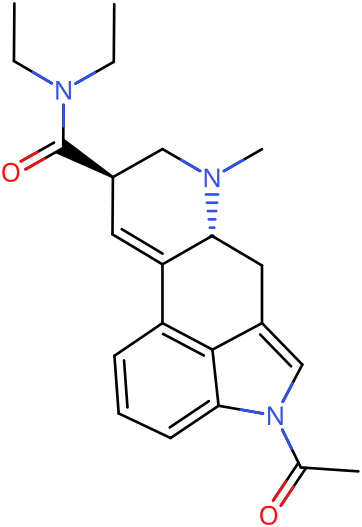
ALD-52 Stats & Data
CCN(CC)C(=O)C1CN(C)C2Cc3cn(C(C)=O)c4cccc(C2=C1)c34FJOWXGYLIWJFCH-OXQOHEQNSA-NReceptor Profile
Receptor Actions
Subjective Effects
Cognitive
- Analysis enhancement
- Conceptual thinking
- Delusions
- Déjà vu
- Emotion enhancement
- Immersion enhancement
- Laughter
- Memory suppression
- Ego death
- Novelty enhancement
- Personal bias suppression
- Spirituality enhancement
- Thought acceleration
- Thought disorganization
- Thought loops
- Time distortion
- Unity and interconnectedness
- Wakefulness
Sensory
- Enhancements
- Distortions
- Hallucinations
- Drifting: (melting, breathing, morphing and flowing) - In comparison to other psychedelics such as LSD, the distortions produced by ALD-52 can appear much more sharp and life-like.
- After images
- Colour shifting
- Depth perception distortions
- Perspective distortions
- Scenery slicing
- Symmetrical texture repetition
- Tracers
- Colour enhancement
- Pattern recognition enhancement
- Visual acuity enhancement
- Transformations
- Internal hallucinations: (autonomous entities; settings, sceneries, and landscapes; alterations in perspective and scenarios and plots)
Forked from Subjective Effect Documentation work by Josie Kins, August 2016. Via dose.wiki (CC0).
Toxicity
PsychonautWikiThe toxicity and long-term health effects of recreational ALD-52 use do not appear to have been studied in any scientific context and the exact toxic dose is unknown. This is because ALD-52 is a research chemical with a very limited history of human use. Anecdotal evidence from people within the community who have tried ALD-52 suggests that there are no negative health effects attributed to simply trying the drug by itself at low to moderate doses and using it very sparingly (although nothing can be completely guaranteed). Independent research should always be conducted to ensure that a combination of two or more substances is safe before consumption. As with other psychedelic substances, there are relatively few physical side effects that have been reported associated with acute ALD-52 exposure.
Overdose
The LD50 of ALD-52 is unknown. Adverse psychological reactions are common especially at higher doses. Some of these include anxiety, delusions, panic attacks and more rarely seizures.
Effect Profile
Curated + 18 ReportsStrong visuals, headspace, and auditory effects with mild body load
Community Effects
TripSitTolerance & Pharmacokinetics
drugs.wikiTolerance Decay
Cross-Tolerances
Demographics
Gender Distribution
Age Distribution
Reports Over Time
Effect Analysis
Erowid + BluelightEffects aggregated from 18 experience reports (13 single-substance Erowid + 5 Bluelight)
Effect Sentiment Distribution
Confidence Distribution
Each bar is the share of reports mentioning the effect; its whisker, and the band on the rows below, is the 95% interval: where the share could plausibly be with other reports of the same kind.
Too few reports for bars: these effects come from 13 single-substance Erowid and 5 analyzed Bluelight reports, and a bar is drawn only from 20 reports or more. With fewer, a percentage cannot tell a common effect from a rare one. Counts are shown instead. Why 20?
Positive Effects 20
Adverse Effects 17
Show 6 neutral or unclassified mentions
Also reported in combinations. In the 18 ALD-52 reports where another drug was taken too, 4 mention hospital, emergency services or an overdose, 0 a seizure and 1 psychosis (too few reports for percentages). In the 13 single-substance reports: 4, 0 and 1. These are not in the figures above: they cannot be put down to ALD-52 alone, and a mention is not always something that happened to the writer.
Dosage Distribution
Dose distribution from experience reports, one dose per report (the first listed). Doses above Q3 + 3×IQR, far above what people typically take, are left out of the median and range and listed under each route: most are real heavy doses or overdoses, not mistakes.
1 dose more than 50 times the median may be a typing or unit error and is not in the figures either: check the report.
Real-World Dose Distribution
ErowidFrom 32 of 36 recorded dose entries: those that state a weight (mg, g or µg), in routes with at least five of them. Values above Q3 + 3×IQR, far above what people typically take, are left out; they can include real heavy doses and overdoses, not only mistakes.
Oral (n=18)
Sublingual (n=12)
Common Combinations
Most co-occurring substances, as a share of all 31 reports filed under ALD-52; whiskers are 95% intervals
Form / Preparation
Most common forms and preparations, as a share of the 23 reports that give one; whiskers are 95% intervals
Body-Weight Dosing
Dose per kg of body weight, one dose per report (the first listed), from reports giving a weight of 30–250 kg. Doses above Q3 + 3×IQR, far above what people typically take, are left out of the median and range and listed under each route.
Oral
1 dose more than 50 times the median may be a typing or unit error and is not in the figures either: check the report.
Sublingual
Redose Patterns
Redosing behavior across 27 reports
Legal Status
| Country | Status | Notes |
|---|---|---|
| Austria | ALD-52 is technically not illegal but it may fall in the NPSG (Neue-Psychoaktive-Substanzen-Gesetz Österreich) as an analogue of LSD. | |
| Denmark | ALD-52 is not listed as an illegal substance in Denmark as of April 2019, and its chemical class 'lysergamide' is not banned under the Analogue Act (some LSD analogues are, however, prohibited). | |
| Finland | ALD-52 is labeled a controlled psychoactive substance in Finland as of 2014. | |
| Germany | ALD-52 is controlled under the NpSG as of July 18, 2019. | Production and import with the aim to place it on the market, administration to another person and trading is punishable. Possession is illegal but not penalized. |
| Latvia | ALD-52 is illegal in Latvia. | Although it is not officially scheduled, it is controlled as an LSD structural analog due to an amendment made on June 1, 2015. |
| Poland | ALD-52 is a NPS class drug in Poland, making it illegal to possess or distribute. | |
| Romania | ALD-52 is illegal to produce or sell in Romania. | It is not included directly in the list of controlled substances, but it is included in an analogue act. However, it is not, as of yet, classified as illegal to use. |
| Singapore | ALD-52 is a class A controlled drug, and is illegal to traffic, manufacture, import, export, possess, or consume in Singapore as of December 1, 2019, punishable with a minimum of five years' imprisonment and five strokes of the cane. | |
| Switzerland | Since March 2018, ALD-52 is illegal in Switzerland and has been put in the RS 812.121.11. | |
| United Kingdom | On June 10, 2014, the UK Advisory Council on the Misuse of Drugs (ACMD) recommended that ALD-52 be specifically named in the UK Misuse of Drugs Act as a class A drug despite not identifying it as ever having been sold or any harm associated with its use. | The UK Home office accepted this advice and announced a ban of the substance to be enacted on 6 January 2015 as part of The Misuse of Drugs Act 1971 (Amendment) (No. 2) Order 2014. |
| United States | ALD-52 is unscheduled in the United States. | It may be considered an analogue of LSD, a Schedule I drug under the Controlled Substances Act. As such, the sale for human consumption or the use for illicit non-medical or scientific use could be prosecuted as crimes under the Federal Analogue Act however could be legal for medical and research uses like a research chemical. |
References
Cited References
- Erowid: ALD-52 Vault
- Isomer Design TiHKAL Entry 26 (LSD)
- Nichols (2016) Psychedelics - Pharmacological Reviews
- Passie et al. (2008) The Pharmacology of Lysergic Acid Diethylamide
- The Big & Dandy ALD-52 Thread (Bluelight)
- TripSit: Drug Combination Chart
- Troxler & Hofmann (1957) Substitutionen am Ringsystem der Lysergsäure
- Wagmann et al. (2019) In vitro metabolic fate of nine LSD-based new psychoactive substances