
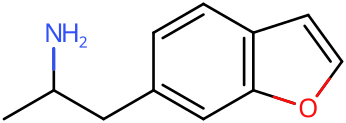
6-APB Stats & Data
FQDAMYLMQQKPRX-UHFFFAOYSA-NPharmacology
Metabolites
History & Culture
1993–2000
The benzofuran entactogens emerged from academic research into the structure-activity relationships of MDMA and related compounds. In 1993, medicinal chemist David E. Nichols and colleagues at Purdue University investigated 5-APDB and 6-APDB as serotonin releasing agents and entactogens, examining the role of the MDA dioxole ring structure in serotonergic neuron interactions.[cite:doi-10-1021-jm00075a027] This research was partly motivated by efforts to identify potential non-neurotoxic alternatives to MDMA, which was gaining recognition as a potentially useful adjunct in psychotherapy while simultaneously being linked to neurotoxic effects. Following this foundational work, 6-APB and its structural relative 5-APB were first described in the scientific literature in 2000 by Karin Briner and colleagues at Eli Lilly and Company in a patent application.[cite:url-patents-google-com-us7045545b1] At this time, the compounds were specifically studied as serotonin 5-HT2C receptor agonists for potential medical applications rather than as recreational substances.[cite:url-patents-google-com-us7045545b1]
2010–2014
Despite being characterized in the scientific literature a decade earlier, human recreational use of 6-APB was not documented until 2010, when the compound emerged for sale on the global research chemical market.[cite:doi-10-1007-s00213-020-05648-z] It became particularly prominent in the United Kingdom's "legal highs" market, where it was sold under the brand name "Benzofury" in distinctive bright orange packaging that became instantly recognizable.[cite:uk-ho-circular-008-2013] The compound's conspicuous branding attracted significant media attention during this period. 6-APB became one of the most frequently cited research chemicals in media coverage critical of legal highs, contributing to calls for regulatory action. This ultimately led to classification as a Temporary Class Drug in June 2013,[cite:uk-si-2013-1294] followed by permanent scheduling as a Class B substance alongside all other benzofuran entactogens in June 2014,[cite:url-legislation-gov-uk-made] effectively ending its presence in the legal market.
Effect Profile
Curated + 95 ReportsStrong visuals and auditory effects with strong body load, moderate headspace
Strong empathy, euphoria, stimulation, and sensory enhancement
Strong stimulation, euphoria, and focus with strong anxiety/jitters
Empirical Duration
Erowid ReportsMedian times after the dose that Erowid reports state. A curve is drawn only when reports state all four points (onset, peak begins, comedown begins, back to baseline) and the medians fall in that order. No point is estimated from another.
No curve: fewer than 5 reports state the return to baseline, and no point is estimated from another.
Tolerance & Pharmacokinetics
drugs.wikiNo tolerance chart. No study has measured how long tolerance to it lasts, so this page shows what is known instead of a curve.
No study has measured tolerance to 6-APB. PsychonautWiki estimates that tolerance halves in 3-4 weeks and is gone in 6-8 weeks, without citing a source. Lab tests show 6-APB activates the 5-HT2B receptor, which is linked to heart-valve damage, so regular use carries a risk of its own.
Sources: Iversen et al. 2013 · Rickli et al. 2015 · PsychonautWiki: 6-APB
Cross-Tolerances
Demographics
Gender Distribution
Age Distribution
Reports Over Time
Effect Analysis
Erowid + BluelightEffects aggregated from 88 experience reports (38 single-substance Erowid + 57 Bluelight)
Effect Sentiment Distribution
Confidence Distribution
Each bar is the share of reports mentioning the effect; its whisker, and the band on the rows below, is the 95% interval: where the share could plausibly be with other reports of the same kind.
Positive Effects 52
Adverse Effects 48
Show 28 more adverse effects
Show 23 neutral or unclassified mentions
Also reported in combinations. In the 42 6-APB reports where another drug was taken too, 4 (9.5%) mention hospital, emergency services or an overdose, 3 (7.1%) a seizure and 2 (4.8%) psychosis. In the 38 single-substance reports: 5.3%, 2.6% and 2.6%. These are not in the figures above: they cannot be put down to 6-APB alone, and a mention is not always something that happened to the writer.
Dose-Response Correlation
How effect frequency changes across dose levels. Whiskers, and the numbers' hover text, give each figure's 95% interval.
Not drawn, too few reports (a dose tier needs 20): Oral Heavy (n=12). Why 20?
Dosage Distribution
Dose distribution from experience reports, one dose per report (the first listed). Doses above Q3 + 3×IQR, far above what people typically take, are left out of the median and range and listed under each route: most are real heavy doses or overdoses, not mistakes.
Common Combinations
Most co-occurring substances, as a share of all 80 reports filed under 6-APB; whiskers are 95% intervals
Form / Preparation
Most common forms and preparations, as a share of the 62 reports that give one; whiskers are 95% intervals
Body-Weight Dosing
Dose per kg of body weight, one dose per report (the first listed), from reports giving a weight of 30–250 kg. Doses above Q3 + 3×IQR, far above what people typically take, are left out of the median and range and listed under each route.
Redose Patterns
Redosing behavior across 65 reports
Harm Reduction
drugs.wiki- Onset is slow (often 60–120 min oral). Premature redosing is a leading cause of unexpectedly high total intake; wait at least 2 hours before considering any booster.
- Intranasal use is discouraged due to strong nasal irritation and variable absorption; oral is the safer, more predictable ROA.
- Salt form matters. By weight, pure 6‑APB succinate delivers about 72% of the active base compared with HCl; many commercial succinate batches contain substantial excess succinic acid, further lowering potency. Calibrate doses conservatively and test new batches.
- Product variability and mislabeling are common; recent Swiss and Dutch drug‑checking alerts continue to find 6‑APB in place of MDMA in pills and, in rare cases, mixtures or adulterants. Use reagent testing and, where available, lab‑based drug checking before consumption.
- Duration is longer than MDMA; plan dosing early in the day if sleep is needed the same night, and expect residual stimulation into the following day.
- Hydration and temperature: during dancing/heat, sip isotonic fluids (~300 mL/hour), take cool‑down breaks, and avoid overhydration; isotonic drinks reduce hyponatremia risk compared with plain water.
- Serotonin‑toxicity risk increases with MAOIs, SSRIs/SNRIs, tramadol/DXM, or other serotonergic releasers; avoid such combinations and seek urgent care if confusion, hyperthermia, rigidity, or clonus occur.
- 5‑HT2B receptor agonists (e.g., fenfluramine metabolite norfenfluramine) are linked to valvular heart disease with chronic exposure. Because benzofurans can activate 5‑HT2B in vitro, frequent or high‑dose 6‑APB use may plausibly elevate long‑term valvulopathy risk; spacing use and avoiding chronic patterns is prudent.
- Polydrug stimulant combinations (e.g., with amphetamine) amplify cardiovascular strain and should be avoided; if undertaken, significantly reduce doses and do not redose during the peak.
- Recent market reviews indicate 6‑APB continues to circulate as an NPS in parts of Europe; quality and composition vary year‑to‑year—further reason to test batches and titrate cautiously.
References
Data Sources
Cited References
- Iversen et al. (2013) - Neurochemical profiles of novel psychoactive substances
- Monte et al. (1993) - Synthesis and pharmacological examination of benzofuran analogs
- Pharmacological profile of benzofurans
- Psychopharmacology (2020) rat monoamine study
- Rickli et al. (2015) - Pharmacological profile of novel psychoactive benzofurans
- UNODC: I-TREND technical briefing on 6-APB
Additional references
- Erowid 6‑APB: Dosage & Effects/Durations
- Erowid 6‑APB: Effects page
- Saferparty.ch – 6‑APB substance page (Wirkung/Dauer/Dosierung/Mischkonsum)
- Saferparty.ch – MDMA pills found containing 6‑APB / mislabel examples
- Saferparty.ch – 6‑APB adulteration warning (example with heroin/caffeine)
- DrugWise factsheet – Benzo Fury (6‑APB/5‑APB) background
- StatPearls – Drug‑Induced Valvular Heart Disease (5‑HT2B agonists)
- DrugBank article – 5‑HT2B activation implicated in valvulopathy (fenfluramine/norfenfluramine)
- Bluelight – 6‑APB succinate vs HCl potency discussion
- Reddit – multiple vendor lab analyses and succinate dilution discussions