
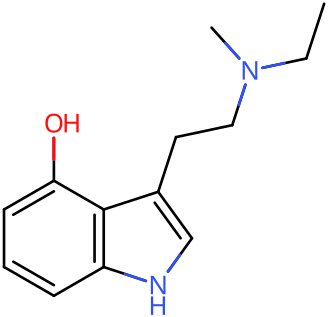
4-HO-MET Stats & Data
CCN(C)CCc1cnc2cccc(O)c12ORWQBKPSGDRPPA-UHFFFAOYSA-NReceptor Profile
Receptor Actions
Subjective Effects
Physical
- Spontaneous tactile sensations: The "body high" of 4-HO-MET can be described as a pleasurable, warm, soft and all-encompassing tingling sensation. This maintains a consistent presence that steadily rises with the onset and hits its limit once the peak has been reached.
- Sedation: In terms of its effects on the physical energy levels of the tripper, 4-HO-MET is considered by most to be relaxing, stoning and mildly sedating. This sense of sedation is often accompanied by compulsive yawning.
- Nausea
- Pupil dilation
Cognitive
- Current mind state enhancement
- Thought connectivity
- Thought acceleration
- Novelty enhancement
- Immersion enhancement
- Time distortion
- Analysis enhancement
- Thought loops
- Personal bias suppression
- Conceptual thinking
- Direct communication with the subconscious
- Memory suppression
- Ego death
- Feelings of interdependent opposites
- Delusions
- Unity and interconnectedness
- Wakefulness
Sensory
- Enhancements
- Distortions
- Hallucinations
As for visual distortions and alterations, the effects experienced are detailed below:
- drifting: (melting, flowing, breathing and morphing) - In comparison to other psychedelics, this effect can be described as highly detailed, cartooon-like in style, slow and smooth in motion and static in appearance.
- Tracers
- After images
- Symmetrical texture repetition
- Colour shifting
- Scenery slicing
4-HO-MET presents a full and complete array of possible visual enhancements which generally includes:
- Acuity enhancement
- Colour enhancement
- Pattern recognition enhancement
4-HO-MET and its various other forms produce a full range of high level hallucinatory states in a fashion that is more consistent and reproducible than that of many other commonly used psychedelics. These effects generally include:
- Transformations
- Internal hallucinations: (autonomous entities; settings, sceneries, and landscapes; alterations in perspective and scenarios and plots) - This effect is very consistent in dark environments at appropriately high doses. They can be comprehensively described through their variations as lucid in believability, interactive in style, new experiences in content, autonomous in controllability, geometry-based in style and almost exclusively of a religious, spiritual, mystical, science fiction or transcendental nature in overall theme.
Forked from Subjective Effect Documentation work by Josie Kins, September 2015. Via dose.wiki (CC0).
Toxicity
PsychonautWikiThe toxicity and long-term health effects of recreational 4-HO-MET use do not seem to have been studied in any scientific context and the exact toxic dose is unknown. This is because 4-HO-MET is a research chemical with very little history of human usage. However, there are reports of very high doses leading to drug induced psychosis. Anecdotal evidence from those who have tried 4-HO-MET suggests that there are no negative health effects attributed to simply trying the substance by itself at low to moderate doses and using it very sparingly (but nothing can be completely guaranteed). Independent research should always be done to ensure that a combination of two or more substances is safe before consumption.
Effect Profile
Curated + 88 ReportsStrong visuals, auditory effects, and headspace with strong body load
Duration Timeline
BluelightCommunity Effects
TripSitTolerance & Pharmacokinetics
drugs.wikiTolerance Decay
Estimates reflect typical serotonergic psychedelic patterns; individual variability is high and data are anecdotal/community-derived. Redosing within the same day produces diminishing returns.
Cross-Tolerances
Demographics
Gender Distribution
Age Distribution
Reports Over Time
Effect Analysis
Erowid + BluelightEffects aggregated from 88 experience reports (60 single-substance Erowid + 28 Bluelight)
Effect Sentiment Distribution
Confidence Distribution
Each bar is the share of reports mentioning the effect; its whisker, and the band on the rows below, is the 95% interval: where the share could plausibly be with other reports of the same kind.
Positive Effects 67
Adverse Effects 41
Show 20 more adverse effects
Show 27 neutral or unclassified mentions
Also reported in combinations. In the 44 4-HO-MET reports where another drug was taken too, 5 (11.4%) mention hospital, emergency services or an overdose, 1 (2.3%) a seizure and 4 (9.1%) psychosis. In the 60 single-substance reports: 5.0%, 0.0% and 5.0%. These are not in the figures above: they cannot be put down to 4-HO-MET alone, and a mention is not always something that happened to the writer.
Dose-Response Correlation
How effect frequency changes across dose levels. Whiskers, and the numbers' hover text, give each figure's 95% interval.
Not drawn, too few reports (a dose tier needs 20): Oral Strong (n=11). Why 20?
Dosage Distribution
Dose distribution from experience reports, one dose per report (the first listed). Doses above Q3 + 3×IQR, far above what people typically take, are left out of the median and range and listed under each route: most are real heavy doses or overdoses, not mistakes.
Real-World Dose Distribution
ErowidFrom 127 of 137 recorded dose entries: those that state a weight (mg, g or µg), in routes with at least five of them. Values above Q3 + 3×IQR, far above what people typically take, are left out; they can include real heavy doses and overdoses, not only mistakes.
Oral (n=108)
Insufflated (n=6)
Intramuscular (n=5)
Sublingual (n=5)
Common Combinations
Most co-occurring substances, as a share of all 104 reports filed under 4-HO-MET; whiskers are 95% intervals
Form / Preparation
Most common forms and preparations, as a share of the 65 reports that give one; whiskers are 95% intervals
Body-Weight Dosing
Dose per kg of body weight, one dose per report (the first listed), from reports giving a weight of 30–250 kg. Doses above Q3 + 3×IQR, far above what people typically take, are left out of the median and range and listed under each route.
3 reports gave a dose above the typical range (1.029–5 mg/kg), so they are not in the figures above. Listing a dose here does not mean it is safe.
Show the reports
- 5 mg/kg
- 1.824 mg/kg · another drug taken too
- 1.029 mg/kg · another drug taken too
Redose Patterns
Redosing behavior across 69 reports
Legal Status
| Country | Status | Notes |
|---|---|---|
| Austria | 4-HO-MET is illegal to possess, produce and sell under the NPSG (Neue-Psychoaktive-Substanzen-Gesetz Österreich). | |
| Canada | 4-HO-MET is unscheduled in Canada. | |
| Finland | Scheduled in the "government decree on psychoactive substances banned from the consumer market". | |
| Germany | 4-HO-MET is ruled under the Neue-psychoaktive-Stoffe-Gesetz (NpSG) since July 18, 2019. | Production and Import with intent to distribute is punishable. Possession is forbidden but not punishable, although ordering it in small quantities can still be seen as an intent to distribute it and be punished. 4-Propionoxy-N-methyl-N-ethyltryptamine (also referred to as 4-PrO-MET) is the ester prodrug of 4-HO-MET. Unlike many other tryptamine derivatives, it is currently not explicitly listed under the German Neue-psychoaktive-Stoffe-Gesetz (NpSG). This means that, while its use as a recreational substance is not legally permitted, the compound may be obtained and handled for legitimate research purposes, provided all other relevant legal requirements and safety regulations are observed. |
| Japan | 4-HO-MET is a controlled substance in Japan effective March 25th, 2015. | |
| Sweden | The Swedish Riksdag added 4-HO-MET to Schedule I ("substances, plant materials and fungi which normally do not have medical use") as narcotics in Sweden as of May 1, 2012, published by Medical Products Agency in their regulation LVFS 2012:6. | |
| Switzerland | 4-HO-MET is a controlled substance specifically named under Verzeichnis E. | |
| United Kingdom | 4-HO-MET is a class A drug in the United Kingdom, as a result of the tryptamine catch-all clause. | |
| United States | 4-HO-MET is not scheduled at the federal level in the United States, but it is possible that it could be considered an analogue of psilocin, in which case purchase, sale, or possession could be prosecuted under the Federal Analogue Act. | It is a schedule I substance in some states, such as South Dakota and West Virginia. |
Harm Reduction
drugs.wiki4-HO-MET is a 4-hydroxylated tryptamine analogous to psilocin; community and Shulgin/TiHKAL notes place oral activity around 10–20 mg with 4–6 h total duration, but sensitivity varies widely—always titrate from low doses with an accurate milligram scale or volumetric dosing. Research chemicals are frequently misrepresented; use drug checking: Ehrlich reagent should turn positive for indoles but only confirms an indole, not identity—use multiple reagents (e.g., Hofmann/Marquis/Mecke) and prefer lab testing when available. Most retail 4-HO-MET is the fumarate salt due to better stability; keep airtight, dry, opaque, and cold (freezer with desiccant) to slow oxidation/darkening; color change does not reliably indicate potency loss, but degradation is possible over time. Avoid vaporizing/smoking salts; 4-substituted tryptamines tend to thermally degrade and give unreliable effects; oral is most characterized and predictable. Insufflation has a faster onset and shorter duration but is irritating and moreish; nasal care (saline rinse) helps, and redosing is often less efficient due to rapid tachyphylaxis. Dangerous interactions include MAOIs (potentiate/instability), lithium (documented seizures with serotonergic psychedelics), and tramadol (seizure and serotonin toxicity risk); avoid triptans near dosing windows for added serotonergic/vasoconstrictive risk. SSRIs/SNRIs commonly blunt psychedelic effects and make dose-response unpredictable; do not increase dose to compensate without caution. Combining with stimulants or empathogens can markedly increase cardiovascular load and anxiety; if combining at all, use lower doses than usual and cool environments. Cannabis can strongly amplify visuals and anxiety on 4-HO-MET; introduce late and gently if at all. Keep a calm, trusted sitter for first trials; if severe anxiety/overstimulation occurs, a measured benzodiazepine dose can de-escalate but impairs memory/coordination—avoid alcohol and other depressants concurrently. Tolerance to serotonergic psychedelics rises rapidly after a session and decays over about 7–14 days; cross-tolerance occurs with LSD/psilocybin/other tryptamines—spacing sessions reduces dose creep and preserves psychological integration.
References
Data Sources
Cited References
Additional references
- Erowid 4-HO-MET Vault (names, overview)
- Bluelight Big & Dandy 4-HO-MET thread (TiHKAL excerpt: 10–20 mg oral; 4–6 h)
- Drugs-Forum 4-HO-MET wiki (oral/insufflated ranges; duration; stability; salt forms)
- Bluelight 4-HO-MET Health & Safety and dosage discussions (range variability; onset/duration)
- Bluelight: TripSit Drug Combination Chart thread (general interaction framework)
- TripSit Wiki: Antidepressants (SSRIs often blunt psychedelics; MAOI cautions)
- Bluelight: Lithium + psychedelics risks (Erowid combo summary; seizures)
- TripSit Wiki: Research chemicals (misrepresentation risk; volumetric dosing guidance)
- TripSit Wiki: Test kits (Ehrlich for indoles; multi-reagent approach)
- Erowid: Tryptamine reacts purple with Ehrlich (indole-positive does not prove identity)
- Bluelight: Vaping 4-HO tryptamines discussion (thermal degradation; poor results)
- Bluelight Psychedelic Beginner FAQ (tolerance ~1–2 weeks; cross-tolerance)