
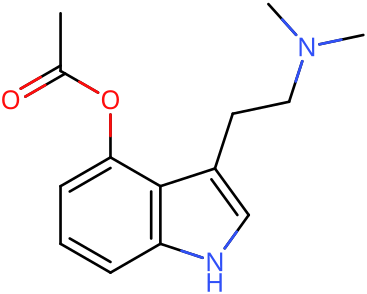
4-AcO-DMT Stats & Data
CC(=O)OC1=CC=CC2=C1C(=CN2)CCN(C)CRTLRUOSYLFOFHV-UHFFFAOYSA-NReceptor Profile
Receptor Actions
History & Culture
1963–1999
4-AcO-DMT was first synthesized in 1963 by the Swiss chemists Albert Hofmann and Franz Troxler during systematic investigations into psilocin analogs conducted at Sandoz Laboratories. The compound, along with several other psilocin esters, was patented by Sandoz Ltd on January 16, 1963. Notably, despite its structural relationship to known psychoactive tryptamines, 4-AcO-DMT was not evaluated for psychoactivity at the time of its synthesis, and it remains unknown when its effects in humans were first deliberately explored. The compound received renewed scientific attention in 1999 when David E. Nichols and colleagues published improvements to its chemical synthesis. Nichols proposed 4-AcO-DMT as a potentially more accessible alternative to psilocybin for pharmacological research, noting that its synthesis is less technically demanding and that it exists outside the scheduling restrictions that complicate work with psilocybin itself.
2009–2019
4-AcO-DMT was first identified as a novel designer drug in Europe in 2009. Following its appearance on online research chemical vendor sites in the early 2010s, reports of recreational use began to accumulate in psychonaut communities. The compound rapidly gained popularity due to its accessibility, its unscheduled status in many jurisdictions, and user reports describing effects comparable to those of psilocybin-containing mushrooms. By the mid-2010s, 4-AcO-DMT had become the most commonly encountered novel tryptamine in the research chemical market.
2020–present
Throughout the 2020s, 4-AcO-DMT has become increasingly prevalent in the United States, particularly in the form of "mushroom edibles" marketed as alternatives to psilocybin products. This trend has led to the compound acquiring the colloquial name "synthetic shrooms." The proliferation of these edibles has raised harm reduction concerns, as products sold as mushroom chocolates or similar preparations may contain 4-AcO-DMT, constituents from Amanita muscaria mushrooms, or other substituted substances without accurate labeling, complicating dosing and informed consent for consumers.
Subjective Effects
Physical
The physical effects of 4-AcO-DMT can be broken down into two components all of which progressively intensify proportional to dosage.
- Spontaneous tactile sensations: The body high of 4-AcO-DMT can be described as a pleasurable, warm, soft and all-encompassing tingling sensation. This maintains a consistent presence that steadily rises with the onset and hits its limit once the peak has been reached.
- Sedation: In terms of its effects on the physical energy levels of the tripper, 4-AcO-DMT is considered by most to be relaxing, stoning and mildly sedating. This sense of sedation is often accompanied by compulsive yawning, a runny nose and watering eyes.
Cognitive
The head space of 4-AcO-DMT is described by many as extremely relaxing, profound and stoning in its style when compared to other commonly used psychedelics such as LSD or 2C-B which tend to be energetic and stimulating. It contains a large number of psychedelic typical and unique cognitive effects.
- Enhancement of current mind state
- Connectivity of thought
- Feelings of fascination, importance and awe
- Time distortion
- Outrospection
- Deja-Vu
- Removal of cultural filter
- Feelings of predeterminism
- Conceptual thinking
- Direct communication with the subconscious
- Ego suppression, loss and death
- Feelings of interdependent opposites
- Delusions
- States of unity and interconnectedness
- Enhancement and suppression cycles: This can be described as constant waves of extremely stimulated and profound thinking which are spontaneously surpassed in a cyclic fashion by waves of general thought suppression and mental intoxication. These two states seem to switch between each other in a consistent loop once every 20-60 minutes.
Sensory
- Enhancements
- Distortions
- Hallucinations
- Visual drifting: (Melting, flowing, breathing and morphing) - In comparison to other psychedelics, this effect can be described as highly detailed, slow and smooth in motion and static in its appearance.
- Tracers
- After images
- Texture repetition
- Colour shifting
- Scenery slicing
4-AcO-DMT presents a full and complete array of possible visual enhancements.
- Increased visual acuity
- Enhancement of colours
- Enhanced pattern recognition
4-AcO-DMT and its various other forms produce a full range of high level hallucinatory states in a fashion that is more consistent and reproducible than that of many other commonly used psychedelics.
- External hallucinations
- Internal hallucinations: This particular effect commonly contains hallucinations with scenarios, landscapes, settings, concepts and autonomous entity contact. They are more common within dark environments and can be described as internal in their manifestation, lucid in believability, interactive in style and almost exclusively of religious, spiritual, mystical or a transcendental nature in their overall theme.
Forked from Subjective Effect Documentation by Josie Kins, September 2013. Via dose.wiki (CC0).
Toxicity
PsychonautWikiThe toxicity and long-term health effects of 4-AcO-DMT have not been studied and the exact toxic dose is unknown. This is because 4-AcO-DMT is a research chemical with a very short history of human usage. 4-AcO-DMT is assumed to have a similar safety profile as psilocybin mushrooms due to their similar chemical structures, although there is currently no data to support this. Anecdotal evidence suggests that there are no negative health effects attributed to simply trying 4-AcO-DMT by itself at low to moderate doses and using it very sparingly (but nothing can be completely guaranteed). Independent research should always be done to ensure that a combination of two or more substances is safe before consumption.
Addiction & dependence
Like other psychedelics, 4-AcO-DMT is considered to be non-addictive with low potential for abuse. Tolerance to the effects of 4-AcO-DMT is built almost immediately after ingestion. After that, it takes about 7 days for tolerance to return to baseline (in the absence of further consumption).
Effect Profile
Curated + 201 ReportsStrong visuals, headspace, and auditory effects with strong body load
Duration Timeline
BluelightEmpirical Duration
Erowid ReportsMedian times after the dose that Erowid reports state. A curve is drawn only when reports state all four points (onset, peak begins, comedown begins, back to baseline) and the medians fall in that order. No point is estimated from another.
No curve: fewer than 5 reports state the return to baseline, and no point is estimated from another.
Community Effects
TripSitTolerance & Pharmacokinetics
drugs.wikiTolerance Decay
Empirical rules of thumb from community data: substantial tolerance is present for several days after a dose; near‑baseline returns in roughly 10–14 days. Repeated redosing within a session provides diminishing returns and more side‑effects. Data quality is anecdotal; no controlled human tolerance studies for 4‑AcO‑DMT specifically.
Cross-Tolerances
Demographics
Gender Distribution
Age Distribution
Reports Over Time
Effect Analysis
Erowid + BluelightEffects aggregated from 177 experience reports (127 single-substance Erowid + 74 Bluelight)
Effect Sentiment Distribution
Confidence Distribution
Each bar is the share of reports mentioning the effect; its whisker, and the band on the rows below, is the 95% interval: where the share could plausibly be with other reports of the same kind.
Positive Effects 74
Adverse Effects 48
Show 28 more adverse effects
Show 22 neutral or unclassified mentions
Also reported in combinations. In the 148 4-AcO-DMT reports where another drug was taken too, 14 (9.5%) mention hospital, emergency services or an overdose, 5 (3.4%) a seizure and 11 (7.4%) psychosis. In the 127 single-substance reports: 12.6%, 0.8% and 8.7%. These are not in the figures above: they cannot be put down to 4-AcO-DMT alone, and a mention is not always something that happened to the writer.
Dose-Response Correlation
How effect frequency changes across dose levels. Whiskers, and the numbers' hover text, give each figure's 95% interval.
Not drawn, too few reports (a dose tier needs 20): Oral Strong (n=12), Oral Heavy (n=18). Why 20?
View data table
| Effect | Common (n=25) |
|---|---|
| Visual Distortions | 88.0% (95% interval 70 to 96 percent) |
| Color Enhancement | 72.0% (95% interval 52 to 86 percent) |
| Music Enhancement | 68.0% (95% interval 48 to 83 percent) |
| Anxiety | 60.0% (95% interval 41 to 77 percent) |
| Empathy | 52.0% (95% interval 34 to 70 percent) |
| Nausea | 48.0% (95% interval 30 to 66 percent) |
| Auditory Effects | 48.0% (95% interval 30 to 66 percent) |
| Euphoria | 44.0% (95% interval 27 to 63 percent) |
| Closed-Eye Visuals | 44.0% (95% interval 27 to 63 percent) |
| Confusion | 40.0% (95% interval 23 to 59 percent) |
| Stimulation | 32.0% (95% interval 17 to 52 percent) |
| Sedation | 28.0% (95% interval 14 to 48 percent) |
| Dissociation | 24.0% (95% interval 12 to 43 percent) |
| Open-Eye Visuals | 20.0% (95% interval 9 to 39 percent) |
| Time Distortion | 20.0% (95% interval 9 to 39 percent) |
Subjective Effect Ontology
Experience ReportsStructured effect tags extracted from 325 Erowid & Bluelight experience reports using a controlled vocabulary of 220+ canonical effects across 15 domains.
Auditory
Cognitive
Emotional
Gastrointestinal
Motor
Visual
Dose–Effect Mapping
Experience ReportsHow reported effects shift across dose tiers, based on 127 single-substance experience reports. The shaded band on each bar is its 95% interval. An arrow (↑ ↓) marks a change between the lowest and highest tier that count an effect only when the gap is bigger than chance would explain; ~ means no clear change. How changes are called
Not drawn, too few reports (a dose tier needs 20): Oral Strong (n=12), Oral Heavy (n=18). Why 20?
Limited tier coverage — most reports fall within the Common range. Effects at other dose levels may not be represented.
| Effect | Common (n=25) | Change with dose |
|---|---|---|
| visual distortions | ||
| color enhancement | ||
| music enhancement | ||
| anxiety | ||
| empathy | ||
| nausea | ||
| auditory effects | ||
| euphoria | ||
| closed-eye visuals | ||
| confusion | ||
| stimulation | ||
| sedation | ||
| dissociation | ||
| open-eye visuals | ||
| time distortion | ||
| ego dissolution | ||
| introspection | ||
| muscle tension | ||
| focus enhancement | ||
| body high |
Showing top 20 of 26 effects
Dosage Distribution
Dose distribution from experience reports, one dose per report (the first listed). Doses above Q3 + 3×IQR, far above what people typically take, are left out of the median and range and listed under each route: most are real heavy doses or overdoses, not mistakes.
Oral
4 reports gave a dose above the typical range (125–290 mg), so they are not in the figures above. 1 of them mentions hospital, emergency services or an overdose. Listing a dose here does not mean it is safe.
Insufflated
1 report gave a dose above the typical range (150 mg), so it is not in the figures above. It mentions hospital, emergency services or an overdose. Listing a dose here does not mean it is safe.
Show the report
- 150 mg · mentions hospital, emergency services or an overdose
Real-World Dose Distribution
ErowidFrom 304 of 328 recorded dose entries: those that state a weight (mg, g or µg), in routes with at least five of them. Values above Q3 + 3×IQR, far above what people typically take, are left out; they can include real heavy doses and overdoses, not only mistakes.
Oral (n=249)
Intramuscular (n=6)
Insufflated (n=20)
Intravenous (n=11)
Rectal (n=5)
Common Combinations
Most co-occurring substances, as a share of all 275 reports filed under 4-AcO-DMT; whiskers are 95% intervals
Form / Preparation
Most common forms and preparations, as a share of the 189 reports that give one; whiskers are 95% intervals
Body-Weight Dosing
Dose per kg of body weight, one dose per report (the first listed), from reports giving a weight of 30–250 kg. Doses above Q3 + 3×IQR, far above what people typically take, are left out of the median and range and listed under each route.
Oral
5 reports gave a dose above the typical range (1.26–2.32 mg/kg), so they are not in the figures above. 2 of them mention hospital, emergency services or an overdose. Listing a dose here does not mean it is safe.
Show the reports
- 2.32 mg/kg · another drug taken too
- 1.739 mg/kg · another drug taken too · mentions hospital, emergency services or an overdose
- 1.6 mg/kg · another drug taken too
- 1.49 mg/kg · another drug taken too
- 1.26 mg/kg · mentions hospital, emergency services or an overdose
Intravenous
Insufflated
1 report gave a dose above the typical range (2.066 mg/kg), so it is not in the figures above. It mentions hospital, emergency services or an overdose. Listing a dose here does not mean it is safe.
Show the report
- 2.066 mg/kg · mentions hospital, emergency services or an overdose
Redose Patterns
Redosing behavior across 208 reports
Legal Status
| Country | Status | Notes |
|---|---|---|
| Australia | Schedule 9 | Classified as a Schedule 9 prohibited substance under the Poisons Standard (October 2015) as an analog of psilocin. This classification restricts manufacture, possession, sale, or use except for approved medical or scientific research purposes. |
| Belgium | Import prohibited | Importation of 4-AcO-DMT is illegal in Belgium under national drug control legislation. |
| Brazil | Illegal | Listed as a controlled substance under Portaria SVS/MS nº 344. Possession, production, and sale are prohibited. |
| Czech Republic | Prohibited | Banned under national drug legislation except for strictly limited research and therapeutic purposes with appropriate authorization. |
| Germany | Anlage I BtMG | Controlled under Anlage I of the Betäubungsmittelgesetz (Narcotics Act) since January 24, 1974, as it is classified as an ester of DMT. Manufacturing, possession, importation, exportation, purchase, sale, procurement, and dispensing without a license are illegal. |
| Israel | Illegal | Classified as a controlled substance by virtue of being a derivative of DMT under national drug control legislation. |
| Italy | Illegal | Prohibited under Italian drug law as an ester of a controlled substance (psilocin). Possession, production, and distribution are criminal offenses. |
| Japan | Controlled substance | Designated as a controlled substance effective July 29, 2015, under national drug control legislation. |
| Sweden | Schedule I | Added to the Narcotic Drugs Punishments Act as a Schedule I substance (classified as substances without accepted medical use) on January 25, 2017. Listed as '4-acetoxi-N,N-dimetyltryptamin' in Medical Products Agency regulation HSLF-FS 2017:1. |
| Switzerland | Potentially illegal | May be considered illegal under Buchstabe B of Swiss narcotics legislation as an ester analog of psilocin. Legal status is interpreted rather than explicitly scheduled. |
| Turkey | Illegal | Classified as a controlled drug. Possession, production, supply, and importation are prohibited under national drug legislation. |
| United Kingdom | Class A | Controlled as a Class A substance under the Misuse of Drugs Act 1971 because it is an ester of the Class A drug psilocin. Class A offenses carry the most severe penalties in UK drug law. |
| United States | Unscheduled (Federal Analogue Act applies) | Not explicitly scheduled under federal law, but possession or sale for human consumption may be prosecuted under the Federal Analogue Act of 1986, as it is considered an analog of the Schedule I substance psilocin. Can be legally possessed for research purposes when labeled 'not for human consumption.' Additionally, 4-AcO-DMT is listed as a Schedule I controlled substance at the state level in several states, including Alabama (since March 18, 2014). |
Harm Reduction
drugs.wiki4‑AcO‑DMT is a semisynthetic 4‑substituted tryptamine likely acting as a prodrug of psilocin; effects and durations are broadly similar to psilocybin/psilocin, though some users perceive a “warmer/more euphoric” tone. Insufflation produces a faster, sharper onset and is commonly described as painful/irritating; oral use is easier to titrate. Product stability varies: exposure to heat, moisture, and oxygen can darken material over time (often towards tan/brown) and partial hydrolysis to psilocin may occur; potency may drift and batches may co‑contain psilocin—test and start low with new supplies. Salt form differences (fumarate vs HCl) change mass‑by‑mass potency only modestly; Erowid’s chemistry notes suggest the typical fumarate is diprotic, making the practical potency gap just a few percent rather than ~25% as sometimes claimed. Community drug‑checking data and reports have found some samples containing both 4‑AcO‑DMT and psilocin, consistent with hydrolysis or co‑formulation. Store airtight, dry, and cold (freezer, desiccant, light‑protected) to slow degradation; avoid long‑term aqueous solutions. Test with Ehrlich’s (indole positive but non‑specific); reagent testing cannot reliably confirm identity—lab analysis is required. Avoid use if you or close family have psychotic or bipolar spectrum disorders; psychedelics can precipitate mania/psychosis in susceptible individuals. Use a sitter, sober environment, and avoid driving for the rest of the day. Because delayed onsets (up to ~2 h) are occasionally reported, do not redose early.
References
Data Sources
Cited References
- DoubleBlind: 4-AcO-DMT Complete Guide
- Frontiers in Psychiatry: Psilacetin as Prodrug (2023)
- Glatfelter et al. (2022): Pharmacologic Activity of Substituted Tryptamines
- Hofmann and Troxler (1963): Original Patent
- Nichols and Frescas (1999): Improvements to Psilocybin Synthesis
- Palamar et al. (2019): Qualitative Analysis of Tryptamine Effects
- TripSit Factsheet: 4-AcO-DMT
- Wikipedia: 4-AcO-DMT
- Zhai et al. (2022): Metabolite Identification Study
- Erowid: 4-AcO-DMT Basics
- TripSit Factsheet: 4-AcO-DMT
- Drug Users Bible: 4-AcO-DMT
- TripSit Wiki: 4-AcO-DMT
Additional references
- Erowid 4‑Acetoxy‑DMT Vault (main)
- Erowid 4‑Acetoxy‑DMT Basics
- Erowid Crew Blog – 4‑AcO‑DMT salts & potency notes
- Bluelight thread – 4‑AcO‑DMT dosage/onset and ROA experiences
- Bluelight ‘4‑AcO‑DMT thoughts’ (ROA potency; SSRI discussion)
- Erowid Experience Vaults – 4‑AcO‑DMT combinations index
- Erowid Experiences – reports including LSD + Lithium issues (for serotonergic psychedelics)
- TripSit Drug Combinations (general guidance incl. serotonergic + tramadol/DXM caution)
- Drug Users Bible – 4‑AcO‑DMT page (dose references)
- Reddit r/4acodmt – discussion of DrugsData tests showing 4‑AcO‑DMT with psilocin
- Bluelight – ‘Has anyone seen any real 4‑AcO‑DMT?’ (stability/batch variability discussion)
- Bluelight – Biology/Pharmacology 101 (psilocin half‑life note)