
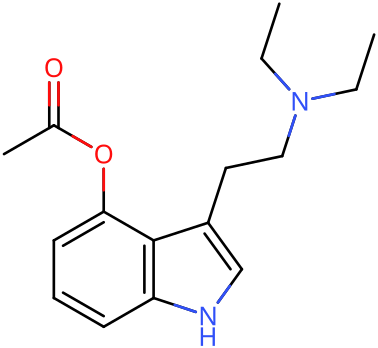
4-AcO-DET Stats & Data
CCN(CC)CCc1cnc2cccc(OC(C)=O)c12WYEVVQJLTXBMPM-UHFFFAOYSA-NReceptor Profile
Receptor Actions
History & Culture
4-AcO-DET was first synthesized in 1958 by Albert Hofmann at the Sandoz laboratories in Switzerland. Despite this early synthesis, the compound remained largely unexplored for decades and has accumulated very little documented history of human usage. In the contemporary era, 4-AcO-DET has found limited use as both a recreational designer drug and an entheogenic compound, with most users acquiring it through online research chemical vendors. It remains relatively rare compared to more widely documented psychedelics in the tryptamine class.
Toxicity
PsychonautWikiThe toxicity and long-term health effects of recreational 4-AcO-DET has not been studied in any scientific context and the exact toxic dose is unknown. This is because 4-AcO-DET is a research chemical with a very limited history of human usage. However, it is assumed to have a similar toxicity profile as psilocybin due to their structural similarity. Anecdotal reports from those who have tried 4-AcO-DET suggests that there are no negative health effects attributed to simply trying the substance by itself at low to moderate doses and using it very sparingly (but nothing can be completely guaranteed). Independent research should always be done to ensure that a combination of two or more substances is safe before consumption.
Effect Profile
Curated + 30 ReportsStrong visuals, headspace, and auditory effects with strong body load
Duration Timeline
BluelightTolerance & Pharmacokinetics
drugs.wikiTolerance Decay
Estimates inferred from classical psychedelic patterns (psilocybin/LSD) and user reports; quality anecdotal. Avoid redosing to chase effects during the same session due to tolerance spikes and unpredictability.
Cross-Tolerances
Experience Report Analysis
ErowidDemographics
Gender Distribution
Age Distribution
Reports Over Time
Effect Analysis
ErowidEffects aggregated from 30 experience reports (30 single-substance Erowid)
Effect Sentiment Distribution
Confidence Distribution
Each bar is the share of reports mentioning the effect; its whisker, and the band on the rows below, is the 95% interval: where the share could plausibly be with other reports of the same kind.
Positive Effects 12
Adverse Effects 5
Show 4 neutral or unclassified mentions
Also reported in combinations. In the 20 4-AcO-DET reports where another drug was taken too, 0 (0.0%) mention hospital, emergency services or an overdose, 0 (0.0%) a seizure and 1 (5.0%) psychosis. In the 30 single-substance reports: 0.0%, 0.0% and 0.0%. These are not in the figures above: they cannot be put down to 4-AcO-DET alone, and a mention is not always something that happened to the writer.
Dosage Distribution
Dose distribution from experience reports, one dose per report (the first listed). Doses above Q3 + 3×IQR, far above what people typically take, are left out of the median and range and listed under each route: most are real heavy doses or overdoses, not mistakes.
Real-World Dose Distribution
ErowidFrom 66 of 75 recorded dose entries: those that state a weight (mg, g or µg), in routes with at least five of them. Values above Q3 + 3×IQR, far above what people typically take, are left out; they can include real heavy doses and overdoses, not only mistakes.
Oral (n=60)
Insufflated (n=6)
Common Combinations
Most co-occurring substances, as a share of all 50 reports filed under 4-AcO-DET; whiskers are 95% intervals
Form / Preparation
Most common forms and preparations, as a share of the 36 reports that give one; whiskers are 95% intervals
Body-Weight Dosing
Dose per kg of body weight, one dose per report (the first listed), from reports giving a weight of 30–250 kg. Doses above Q3 + 3×IQR, far above what people typically take, are left out of the median and range and listed under each route.
Redose Patterns
Redosing behavior across 39 reports
Legal Status
| Country | Status | Notes |
|---|---|---|
| Germany | Anlage I BtMG | Controlled under Anlage I of the Betäubungsmittelgesetz (Narcotics Act) since January 24, 1974, as it is classified as an ester of DET. Manufacturing, possession, importation, exportation, purchase, sale, and distribution are prohibited without a license. |
| Japan | Controlled | Designated as a controlled substance effective July 29, 2015, under national drug control legislation. |
| Sweden | Controlled | Classified as a health hazard under Lagen om förbud mot vissa hälsofarliga varor (Act on the Prohibition of Certain Goods Dangerous to Health) effective November 1, 2005, under regulation SFS 2005:733. Possession and sale are illegal. |
| Switzerland | Controlled (Verzeichnis E) | Specifically named as a controlled substance under Verzeichnis E since November 1, 2005, pursuant to the Act on the Prohibition of Certain Goods Dangerous to Health. |
| Turkey | Illegal | Classified as a controlled drug. Possession, production, supply, and importation are prohibited under Turkish drug law. |
| United Kingdom | Class A | Controlled as a Class A substance due to its status as an ester of 4-HO-DET, which falls under the tryptamine catch-all clause of the Misuse of Drugs Act 1971. Carries the most severe penalties for possession, production, and supply. |
| United States | Unscheduled | Not federally scheduled under the Controlled Substances Act. However, as a structural analogue of psilocin (4-HO-DMT), which is a Schedule I substance, sale for human consumption or use for illicit purposes could potentially be prosecuted under the Federal Analogue Act. |
Harm Reduction
drugs.wiki4-AcO-DET likely deacetylates in vivo to 4-HO-DET (ethocin), so potency, onset, and duration can vary with metabolism; users report both short (2–4 h) and longer (6–8 h) courses. Anecdotal reports describe stronger, shorter effects via intranasal or smoked routes, but these also carry more irritation and unpredictability; oral is the most characterized and generally lowest risk ROA. Like other 4-substituted tryptamines, nausea and GI unease can occur, particularly on the come-up; fasting 3–4 h and using ginger/antiemetic strategies may help. Avoid mixing with MAOIs, tramadol, DXM, or linezolid due to serotonin toxicity risk; lithium with psychedelics has repeatedly been linked with seizures and severe adverse reactions in community reports. SSRIs/SNRIs and some antipsychotics may attenuate psychedelic effects, but they can still contribute to serotonergic burden; effects can be unpredictable. Misrepresentation in the gray/illicit market is a documented risk (e.g., tryptamines sold as psilocybin or vice versa); reagent testing (Ehrlich for indoles) and lab drug checking reduce this risk, although reagents cannot confirm exact identity. Store away from heat, moisture, and light; 4-AcO esters can hydrolyze over time to 4-HO analogs—color changes (tanning/darkening) have been reported alongside retained potency, but degradation is formulation- and storage-dependent. Tolerance builds rapidly after a single session and decays over about 1–2 weeks; cross-tolerance exists with other classical psychedelics (psilocin/psilocybin, LSD, other 4-sub tryptamines). Set and setting strongly influence outcomes; a trusted sober sitter, safe environment, and clear intentions reduce risk of panic and dangerous behavior. Seek urgent medical help for signs of serotonin toxicity (agitation, hyperthermia, tremor/clonus, confusion), chest pain, persistent vomiting, seizures, or severe confusion; disclose all substances to responders.
References
Cited References
Additional references
- Bluelight: The Big & Dandy 4-AcO-DET Thread (ROAs, duration variability)
- Bluelight: 4-AcO-DET vs 4-HO-MET (dosage examples incl. oral/plug/IM)
- Bluelight: Smoked 4-AcO-DET—short duration report
- Reddit: 4-ACO-DET (Ethacetin) notes (duration, body load, come-up)
- TripSit guide to drug combinations (general MAOI/serotonergic cautions)
- Bluelight: Opiates and MAOIs (linezolid noted as MAOI; serotonergic opioid risks)
- Saferparty (Zurich): Alert on 4-AcO-DMT/4-HO-MET sold as psilocybin (misrepresentation risk)
- Toronto Drug Checking Service: about and reports (lab drug checking context)
- Erowid DrugsData project (lab testing overview)
- Reddit: Lithium + psychedelics caution (community seizure/adverse reports)