
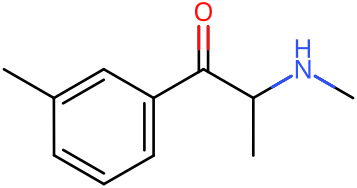
3-MMC Stats & Data
[Cl-].CNC(C)C(=O)c1cccc(C)c1.[H+]Interaction Warnings
The neurotoxic effects of MDMA may be increased when combined with other stimulants.
This combination may increase strain on the heart.
Receptor Profile
Receptor Actions
History & Culture
2012–present
3-MMC was first encountered in Sweden in 2012, emerging on the online research chemical market shortly after the banning of mephedrone in numerous countries. It was created as a designer drug specifically chosen to mimic and replace the functional and structural features of its recently-controlled predecessor. The compound was sold as a research chemical, typically in powdered form, and quickly became a prominent example of contemporary designer drug development in response to prohibition. There is no known or reported medical use of 3-MMC; since its emergence it has been used primarily for recreational purposes.
2016–2023
In 2016, the United Nations Office on Drugs and Crime conducted a critical review of 3-MMC but ultimately decided not to recommend international control. However, following a subsequent period of increased abuse beginning around 2019, this decision was revisited. The earlier assessment was overturned and 3-MMC was placed into Schedule II of the United Nations Convention on Psychotropic Substances 1971 in March 2023, prompting many member nations to implement or strengthen domestic controls.
2023–present
Despite its prohibition as a recreational substance, 3-MMC has attracted interest as a potential pharmaceutical compound. The biotechnology company Clearmind Medicine has been developing 3-MMC for the potential treatment of dyskinesias, with the compound in preclinical research as of August 2023. American biotech company MindMed has filed patents to use 3-MMC for conditions including social anxiety disorder, post-traumatic stress disorder, and as an adjunct in couples therapy. Additionally, the Dutch company Period Pill has been conducting clinical trials investigating 3-MMC for the treatment of menstrual symptoms, with a successful trial completed at the University of Maastricht. The company has sought patent coverage in multiple jurisdictions. The first in-human clinical safety study of 3-MMC was published in December 2024, marking a significant milestone in the compound's transition from unregulated research chemical to potential therapeutic agent.
Subjective Effects
Physical
- Spontaneous tactile sensations
- Pupil dilation
- Perception of decreased weight
- Increased perspiration
- Teeth grinding: This component can be considered to be less intense when compared with that of MDMA.
Cognitive
- Euphoria
- Empathy, love and sociability enhancement
- Motivation enhancement
- Anxiety suppression
Sensory
- Auditory enhancement
Forked from Subjective Effect Documentation work by Josie Kins, August 2016. Via dose.wiki (CC0).
Toxicity
PsychonautWikiAs with most research chemicals, the long-term effects of 3-MMC have not been researched extensively enough to provide accurate information of its risks and harm. It is strongly recommended that one use harm reduction practices when using this substance.
Addiction & dependence
As with other stimulants, the chronic use of 3-MMC can be considered extremely addictive with a high potential for abuse and is capable of causing psychological dependence among certain users. When addiction has developed, cravings and withdrawal effects may occur if a person suddenly stops their usage. It is said that this compound is considerably more addictive than that of mephedrone.
Effect Profile
Curated + 16 ReportsStrong empathy, euphoria, and sensory enhancement with moderate stimulation
Strong euphoria with strong anxiety/jitters, mild stimulation, low focus
Tolerance & Pharmacokinetics
drugs.wikiTolerance Decay
Demographics
Gender Distribution
Too few reports for a chart: gender is known from 17 reports, and a split is drawn only from 20 reports or more. Counts are shown instead. Why 20?
- Male 15 of 17
- Female 1 of 17
- Not Specified 1 of 17
Age Distribution
Reports Over Time
Effect Analysis
Erowid + BluelightEffects aggregated from 16 experience reports (7 single-substance Erowid + 9 Bluelight)
Effect Sentiment Distribution
Confidence Distribution
Each bar is the share of reports mentioning the effect; its whisker, and the band on the rows below, is the 95% interval: where the share could plausibly be with other reports of the same kind.
Too few reports for bars: these effects come from 7 single-substance Erowid and 9 analyzed Bluelight reports, and a bar is drawn only from 20 reports or more. With fewer, a percentage cannot tell a common effect from a rare one. Counts are shown instead. Why 20?
Positive Effects 14
Adverse Effects 20
Show 9 neutral or unclassified mentions
Also reported in combinations. In the 10 3-MMC reports where another drug was taken too, 0 mention hospital, emergency services or an overdose, 0 a seizure and 1 psychosis (too few reports for percentages). In the 7 single-substance reports: 1, 1 and 0. These are not in the figures above: they cannot be put down to 3-MMC alone, and a mention is not always something that happened to the writer.
Real-World Dose Distribution
ErowidFrom 16 of 28 recorded dose entries: those that state a weight (mg, g or µg), in routes with at least five of them. Values above Q3 + 3×IQR, far above what people typically take, are left out; they can include real heavy doses and overdoses, not only mistakes.
Oral (n=15)
Form / Preparation
Most common forms and preparations, as a share of the 11 reports that give one
Too few reports for bars: these forms come from 11 reports, and a bar is drawn only from 20 reports or more. With fewer, a percentage cannot tell a common effect from a rare one. Counts are shown instead. Why 20?
- Powder / Crystals 10 of 11
Redose Patterns
Redosing behavior across 13 reports
Too few reports for a chart: redosing is known from 13 reports, and a split is drawn only from 20 reports or more. Counts are shown instead. Why 20?
- Single dose 6 of 13
- Redosed 7 of 13
Legal Status
| Country | Status | Notes |
|---|---|---|
| Austria | Illegal (NPSG) | Prohibited under the Neue-Psychoaktive-Substanzen-Gesetz (New Psychoactive Substances Act). Possession, production, and sale are illegal. |
| Brazil | Illegal | Listed on Portaria SVS/MS nº 344. Possession, production, and sale are prohibited under this regulation. |
| China | Controlled | Banned since October 2015 along with numerous other synthetic compounds. This ban significantly impacted global availability as Chinese chemical companies were primary manufacturers. |
| Czech Republic | Illegal | Banned substance under national drug control legislation. |
| Germany | Anlage I BtMG | Controlled under Anlage I of the Betäubungsmittelgesetz (Narcotics Act, Schedule I) since December 13, 2014. Manufacturing, possession, import, export, purchase, sale, procurement, and dispensing without license are prohibited. |
| India | Narcotic | Designated as a narcotic substance on February 8, 2024, making possession, production, and distribution illegal. |
| Netherlands | List I (Opiumwet) | Initially classified as a List II (soft drug) substance effective October 28, 2021. Subsequently reclassified to List I (hard drug) in April 2024, carrying more severe penalties for possession and distribution. |
| Poland | II-P Category Drug | Classified as a II-P category controlled substance since April 25, 2024, making possession, production, and distribution illegal. |
| Sweden | Narcotic | Classified as a narcotic substance under Swedish drug control legislation. |
| Switzerland | Controlled (Verzeichnis E) | Regulated as a defined derivative of cathinone under Verzeichnis E point 1. Use is permitted for legitimate scientific or industrial purposes only. |
| Turkey | Illegal | Classified as a controlled drug. Possession, production, supply, and importation are prohibited. |
| United Kingdom | Class B | Controlled as a Class B substance under the Misuse of Drugs Act 1971 through the cathinone catch-all clause, which covers structurally related compounds. |
| United States | Schedule I | Illegal as a positional isomer of the controlled substance mephedrone. Explicitly designated as a controlled substance on December 13, 2023, and categorized by the DEA as a Schedule I positional isomer. |
References
Data Sources
Cited References
- Adamowicz et al. 2016 - Blood Concentrations Study
- Aknouche et al. 2022 - Fatal Rectal Injection Case
- Drug Users Bible - 3-MMC
- EMCDDA: Initial Report 2022
- Erowid Experience Vaults: 3-MMC
- Isomer Design - 3-MMC
- Jellinek - 3-MMC Information
- Luethi et al. 2018 - Monoamine Transporter Study
- Margasinska-Olejak et al. 2024 - Pharmacological Profile Review
- Ramaekers et al. 2024 - First Human Safety Study
- Shimshoni et al. - Pharmacokinetic Profile Study
- TripSit Factsheet: 3-MMC
- WHO Critical Review Report 2022
- TripSit Factsheet: 3-MMC