
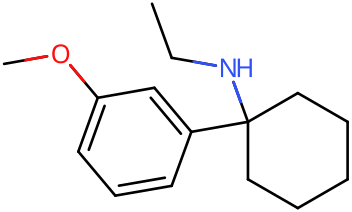
3-MeO-PCE Stats & Data
CCNC1(CCCCC1)c1cccc(OC)c1OFGOOZLOGUNDFS-UHFFFAOYSA-NReceptor Profile
Receptor Actions
Receptor Binding
History & Culture
3-MeO-PCE emerged on the online research chemical market around 2010, where it was marketed as a grey-area legal alternative to controlled dissociatives such as PCP and ketamine. The compound represents part of the broader wave of designer arylcyclohexylamines that became available through online vendors during this period. Very little formal research exists regarding this substance, and it has a notably brief history of documented human usage. Its emergence drew regulatory attention alongside related compounds, with the UK's Advisory Council on the Misuse of Drugs specifically mentioning 3-MeO-PCE in their October 2012 report on methoxetamine, which recommended control of analogous arylcyclohexylamines.
Toxicity
PsychonautWikiThe toxicity and long-term health effects of recreational 3-MeO-PCE use do not seem to have been studied in any scientific context and the exact toxic dosage is unknown. This is because 3-MeO-PCE has very little history of human usage.
Effect Profile
Curated + 11 ReportsStrong dissociative depth with strong mania and motor impairment, moderate insight
Duration Timeline
BluelightTolerance & Pharmacokinetics
drugs.wikiTolerance Decay
Anecdotal pattern: rapid tolerance build with consecutive-day use; partial recovery over 1–2 weeks, baseline in ~2–4 weeks. Cross-tolerance across arylcyclohexylamines is commonly reported. Data quality: anecdotal.
Cross-Tolerances
Experience Report Analysis
ErowidDemographics
Gender Distribution
Age Distribution
Reports Over Time
Effect Analysis
ErowidEffects aggregated from 11 experience reports (11 single-substance Erowid)
Effect Sentiment Distribution
Confidence Distribution
Each bar is the share of reports mentioning the effect; its whisker, and the band on the rows below, is the 95% interval: where the share could plausibly be with other reports of the same kind.
Too few reports for bars: these effects come from 11 single-substance Erowid reports, and a bar is drawn only from 20 reports or more. With fewer, a percentage cannot tell a common effect from a rare one. Counts are shown instead. Why 20?
Positive Effects 7
Adverse Effects 5
Show 5 neutral or unclassified mentions
Also reported in combinations. In the 13 3-MeO-PCE reports where another drug was taken too, 3 mention hospital, emergency services or an overdose, 1 a seizure and 4 psychosis (too few reports for percentages). In the 11 single-substance reports: 0, 0 and 3. These are not in the figures above: they cannot be put down to 3-MeO-PCE alone, and a mention is not always something that happened to the writer.
Real-World Dose Distribution
ErowidFrom 75 of 78 recorded dose entries: those that state a weight (mg, g or µg), in routes with at least five of them. Values above Q3 + 3×IQR, far above what people typically take, are left out; they can include real heavy doses and overdoses, not only mistakes.
Rectal (n=29)
Oral (n=18)
Insufflated (n=26)
Common Combinations
Most co-occurring substances, as a share of all 24 reports filed under 3-MeO-PCE; whiskers are 95% intervals
Form / Preparation
Most common forms and preparations, as a share of the 20 reports that give one; whiskers are 95% intervals
Body-Weight Dosing
Dose per kg of body weight, one dose per report (the first listed), from reports giving a weight of 30–250 kg. Doses above Q3 + 3×IQR, far above what people typically take, are left out of the median and range and listed under each route.
Redose Patterns
Redosing behavior across 21 reports
Legal Status
| Country | Status | Notes |
|---|---|---|
| Chile | Illegal | Controlled under Ley de drogas (Ley 20000). As an ether of PCE, 3-MeO-PCE falls under the law's prohibition of all esters and ethers of PCE. |
| Germany | NpSG (Controlled) | Controlled under the Neue-psychoaktive-Stoffe-Gesetz (New Psychoactive Substances Act) since July 18, 2019. Production, import for market distribution, administration to others, and trading are punishable offenses. Possession is prohibited but not subject to criminal penalty. |
| Sweden | Illegal | Classified as a controlled substance. Possession, production, and distribution are prohibited under national drug legislation. |
| Switzerland | Verzeichnis E | Specifically named as a controlled substance under Verzeichnis E of Swiss narcotics legislation. |
| Turkey | Illegal | Classified as an illegal drug under national legislation. Possession, production, supply, and import are prohibited offenses. |
| United Kingdom | Class B | Controlled under the Misuse of Drugs Act 1971. Covered by the arylcyclohexylamine generic clause added via S.I. 2013/239, effective February 26, 2013. This clause encompasses N-alkyl derivatives of 1-phenylcyclohexylamine with alkoxy substitution in the phenyl ring. Possession, production, supply, and import are illegal. |
Harm Reduction
drugs.wiki3-MeO-PCE is a potent arylcyclohexylamine NMDA antagonist with stimulating dissociation; onset is faster and intranasal effects are steeper than oral, which raises the risk of overdoing early redoses. Multi-day or high-dose use has been repeatedly associated (anecdotally and in community reports) with hypomania/mania, paranoia, and psychosis; avoid consecutive-day use and keep doses spaced by at least several days. Combining with central nervous system depressants—especially alcohol, opioids, or GHB—markedly raises risks of dangerous sedation, impaired airway reflexes, and accidents; many emergency data show alcohol+benzo/opioid synergy and dissociatives independently impair coordination. Benzodiazepines are sometimes used medically to manage agitation in emergencies, but using them recreationally with dissociatives increases blackout, fall, and respiratory risks; avoid this mix. Stimulants (including prescription ADHD meds) can aggravate cardiovascular strain and manic thinking during dissociatives; if already on stimulants, avoid redosing/stacking. Chronic heavy dissociative use (best-characterized with ketamine) is linked to cystitis-like urinary and biliary complications; though specific 3-MeO-PCE data are limited, monitor for urinary urgency, pain, or hematuria and reduce/stop use if they appear. Strongly consider drug checking (FTIR/GC–MS) when available; dissociatives are frequently mis-sold or misidentified in the unregulated market, and mislabeled ketamine-class powders are documented. Because of high potency and batch variability, perform an allergy test (1–2 mg), use precise measurement, and consider volumetric dosing. For nasal use, grind finely, use small test lines, and rinse with isotonic saline before/after to reduce mucosal irritation. Do not drive or engage in hazardous tasks for at least the rest of the day after dosing; residual impairment may persist. People with a personal or family history of psychosis or bipolar spectrum conditions should be particularly cautious or avoid use.
References
Cited References
- Bluelight: The Big & Dandy 3-MeO-PCE Thread
- Bluelight: The Small and Handy 3-Me-PCE Thread
- De Paoli et al. 2013: Analytical Profiles of Methoxetamine and Related Compounds
- IsomerDesign: 3-MeO-PCE
- Morris & Wallach 2014: Comprehensive Review of Dissociative Drugs
- Roth et al. 2018: Receptor Binding Profile of Methoxetamine and Related Compounds
- Substance Search: 3-MeO-PCE
- Wallach et al. 2016: Syntheses and Analytical Characterizations of N-alkyl-arylcyclohexylamines
- TripSit Factsheet: 3-MeO-PCE
Additional references
- Erowid: 3-MeO-PCE Experience Vaults (General)
- Erowid: 3-MeO-PCE Experience Vaults (Difficult Experiences)
- Erowid: 3-MeO-PCP Vault (background/risks akin to 3-MeO class)
- SubstanceSearch: 3-MeO-PCE summary
- TripSit Wiki: Quick Guide to Volumetric Dosing
- TripSit Wiki: Reducing Pain Caused by Insufflation
- NIAAA: Alcohol–Medication Interactions (benzodiazepines/opioids synergy)
- StatPearls (NCBI): Ketamine Toxicity – adverse effects, impairment, urogenital risk
- LiverTox (NCBI): Ketamine – chronic use linked to cystitis and biliary injury
- DrugChecking.community – Toronto Drug Checking Service (3-MeO-PCE appears among expected drugs)
- Saferparty.ch: Dissociatives mis-sold (MXE sold as ketamine) – misrepresentation risk
- Bluelight: How safe is dosing 3-MeO-PCE? (mania/psychosis caution)