
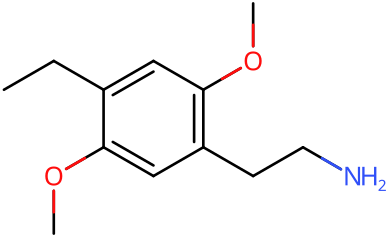
2C-E Stats & Data
NCCc1cc(OC)c(CC)cc1OCVDRGNAMREYBIHA-UHFFFAOYSA-NReceptor Profile
Receptor Actions
History & Culture
1977–1991
2C-E was first synthesized by Alexander Shulgin in 1977. His findings were documented in detail in the 1991 book PiHKAL (Phenethylamines I Have Known and Loved), co-authored with Ann Shulgin. This influential work contained synthesis instructions, bioassays, dosages, and commentary for over 200 psychedelic compounds, most of which Shulgin had developed himself. Shulgin considered 2C-E one of his most significant discoveries, including it among his "magical half-dozen" - a personal ranking of the most important phenethylamine compounds he had encountered. This group comprised mescaline alongside five of Shulgin's own inventions: DOM, 2C-B, 2C-E, 2C-T-2, and 2C-T-7.
2004–present
2C-E became increasingly popular in recreational contexts during the early 2000s, distributed primarily through online research chemical vendors. The compound began appearing in drug seizures around 2004. It has occasionally been sold on the street as "mescaline" or "synthetic mescaline," capitalizing on the structural relationship between phenethylamines and mescaline despite significant differences in pharmacology and subjective effects. The substance developed a reputation for producing deeply meaningful experiences, with references to this quality appearing across online discussion forums and in published literature. Myron J. Stolaroff's "Thanatos to Eros: 35 Years of Psychedelic Exploration" is among the works that discuss the compound's potential for profound introspective experiences.
Subjective Effects
Physical
- Spontaneous tactile sensations: The body high of 2C-E is manifested as one of the most proportionally intense in comparison to almost all of the classical psychedelics. This is something which is only beaten in terms of its overwhelming forcefulness by high dose AMT and 5-MeO-DMT experiences. The sensation itself can be described as an intense and slightly uncomfortable energetic pins and needles sensation that constantly encompasses a person's entire body. It is usually felt over every square inch of the skin but occasionally manifests itself in the form of a continuously shifting tingling sensation that travels up and down the body in spontaneous waves. Alongside of this, many users commonly report that the body high can be particularly uncomfortable and sometimes accompanied by urges to shift the position of one's body and prolonged tensing of unusual combinations of muscle groups.
- Stimulation: In terms of its effects on the physical energy levels of the tripper, 2C-E is usually considered to be very energetic and stimulating in a fashion that is quite comparable to that of MDMA.
- Increased bodily control
- Tactile enhancement
- Nausea: Mild to extreme nausea is consistently reported when consumed in moderate to high dosages and either passes once the tripper has vomited or gradually fades by itself as the peak sets in.
- Temperature regulation loss
Cognitive
The head space of 2C-E is described by many as one which is both insightful and relatively normal in its thought processes even at moderate to high dosages.
- Introspection: This component is consistently manifested only in the context of a non-social setting in which the user is alone.
- Empathy, love and sociability enhancement: This component is consistently manifested only in the context of social settings in which one is within the company of others. These feelings of sociability, love and empathy are a little weaker and less sharp than those found on substances such as MDMA and 2C-B but still prove strong enough to provide long lasting therapeutic effects.
- Thought acceleration
- Time distortion
- Feelings of fascination, importance and awe
- Sexual arousal
- Conceptual thinking
- Thought connectivity
- Current mind state enhancement
- Personal bias suppression
- Ego suppression, loss and death
Sensory
- Enhancements
- Distortions
- Hallucinations
- Visual drifting: (Melting, Flowing, Breathing and Morphing) - In comparison to other psychedelics, this effect can be described as highly detailed, slow and smooth in motion, static in appearance, and unrealistic/cartoon-like in style.
- Tracers
- After images
- Texture repetition
- Colour shifting
- Scenery slicing
- Increased visual acuity
- Enhancement of colours
- Enhanced pattern recognition
2C-E produces a full range of high level hallucinatory states in a fashion that is more consistent and reproducible than that of many other commonly used psychedelics, particularly in comparison to other substances within the phenethylamine family.
- External hallucinations
- Internal hallucinations: In comparison to other psychedelics such as LSD, 2C-E is extremely high in hallucinations embedded within visual geometry. This particular effect commonly contains hallucinations with scenarios, settings, concepts and autonomous entity contact. They are more common within dark environments and can be described as internal in their manifestation, lucid in believability, interactive in style and almost exclusively of religious, spiritual, mystical or transcendental nature in their overall theme.
Forked from Subjective Effect Documentation by Josie Kins, January 2013. Via dose.wiki (CC0).
Toxicity
PsychonautWikiThe toxicity and long-term health effects of recreational 2C-E use do not seem to have been studied in any scientific context and the exact toxic dose is unknown. This is because 2C-E is a research chemical with a limited history of human usage. Anecdotal reports suggest that there are no negative health effects attributed to simply trying this substance by itself at low to moderate doses and using it very sparingly (although nothing can be completely guaranteed). Independent research should always be conducted to ensure that a combination of two or more substances is safe before consumption. It is strongly recommended that one use harm reduction practices, such as volumetric dosing, when using this substance so as to ensure the accurate administration of the intended dose.
Effect Profile
Curated + 362 ReportsStrong visuals, headspace, and auditory effects with strong body load
Duration Timeline
BluelightEmpirical Duration
Erowid ReportsMedian times after the dose that Erowid reports state. A curve is drawn only when reports state all four points (onset, peak begins, comedown begins, back to baseline) and the medians fall in that order. No point is estimated from another.
Community Effects
TripSitTolerance & Pharmacokinetics
drugs.wikiTolerance Decay
Tolerance patterns for 5‑HT2A psychedelics are based on community reports and general HR guidance; high inter‑individual variability. Allow 1–2 weeks between sessions for best effect restoration.
Cross-Tolerances
Demographics
Gender Distribution
Age Distribution
Reports Over Time
Effect Analysis
Erowid + BluelightEffects aggregated from 285 experience reports (235 single-substance Erowid + 127 Bluelight)
Effect Sentiment Distribution
Confidence Distribution
Each bar is the share of reports mentioning the effect; its whisker, and the band on the rows below, is the 95% interval: where the share could plausibly be with other reports of the same kind.
Positive Effects 72
Adverse Effects 42
Show 20 more adverse effects
Show 19 neutral or unclassified mentions
Also reported in combinations. In the 161 2C-E reports where another drug was taken too, 9 (5.6%) mention hospital, emergency services or an overdose, 1 (0.6%) a seizure and 3 (1.9%) psychosis. In the 235 single-substance reports: 11.5%, 3.8% and 4.7%. These are not in the figures above: they cannot be put down to 2C-E alone, and a mention is not always something that happened to the writer.
Dose-Response Correlation
How effect frequency changes across dose levels. Whiskers, and the numbers' hover text, give each figure's 95% interval.
Not drawn, too few reports (a dose tier needs 20): Oral Heavy (n=14). Why 20?
View data table
| Effect | Common (n=24) | Strong (n=68) |
|---|---|---|
| Visual Distortions | 83.3% (95% interval 64 to 93 percent) | 91.2% (95% interval 82 to 96 percent) |
| Color Enhancement | 79.2% (95% interval 60 to 91 percent) | 61.8% (95% interval 50 to 72 percent) |
| Anxiety | 66.7% (95% interval 47 to 82 percent) | 51.5% (95% interval 40 to 63 percent) |
| Music Enhancement | 66.7% (95% interval 47 to 82 percent) | 42.6% (95% interval 32 to 54 percent) |
| Stimulation | 58.3% (95% interval 39 to 76 percent) | 45.6% (95% interval 34 to 57 percent) |
| Empathy | 54.2% (95% interval 35 to 72 percent) | 33.8% (95% interval 24 to 46 percent) |
| Nausea | 50.0% (95% interval 31 to 69 percent) | 51.5% (95% interval 40 to 63 percent) |
| Confusion | 37.5% (95% interval 21 to 57 percent) | 41.2% (95% interval 30 to 53 percent) |
| Ego Dissolution | 37.5% (95% interval 21 to 57 percent) | 19.1% (95% interval 12 to 30 percent) |
| Closed-Eye Visuals | 37.5% (95% interval 21 to 57 percent) | 25.0% (95% interval 16 to 36 percent) |
| Open-Eye Visuals | 37.5% (95% interval 21 to 57 percent) | 22.1% (95% interval 14 to 33 percent) |
| Euphoria | 29.2% (95% interval 15 to 49 percent) | 36.8% (95% interval 26 to 49 percent) |
| Sedation | 33.3% (95% interval 18 to 53 percent) | 19.1% (95% interval 12 to 30 percent) |
| Introspection | 33.3% (95% interval 18 to 53 percent) | 29.4% (95% interval 20 to 41 percent) |
| Muscle Tension | 33.3% (95% interval 18 to 53 percent) | 20.6% (95% interval 13 to 32 percent) |
Subjective Effect Ontology
Experience ReportsStructured effect tags extracted from 446 Erowid & Bluelight experience reports using a controlled vocabulary of 220+ canonical effects across 15 domains.
Auditory
Cognitive
Emotional
Gastrointestinal
Motor
Tactile
Visual
Dose–Effect Mapping
Experience ReportsHow reported effects shift across dose tiers, based on 235 single-substance experience reports. The shaded band on each bar is its 95% interval. An arrow (↑ ↓) marks a change between the lowest and highest tier that count an effect only when the gap is bigger than chance would explain; ~ means no clear change. How changes are called
Not drawn, too few reports (a dose tier needs 20): Oral Heavy (n=14). Why 20?
Limited tier coverage — most reports fall within the Common / Strong range. Effects at other dose levels may not be represented.
| Effect | Common (n=24) | Strong (n=68) | Change with dose |
|---|---|---|---|
| visual distortions | (no clear change: +8 points from Common to Strong, 95% interval −6 to +28) | ||
| color enhancement | (no clear change: −17 points from Common to Strong, 95% interval −34 to +5) | ||
| anxiety | (no clear change: −15 points from Common to Strong, 95% interval −34 to +8) | ||
| music enhancement | (−24 points from Common to Strong, 95% interval −43 to −1) | ||
| stimulation | (no clear change: −13 points from Common to Strong, 95% interval −33 to +10) | ||
| empathy | (no clear change: −20 points from Common to Strong, 95% interval −41 to +2) | ||
| nausea | (no clear change: +2 points from Common to Strong, 95% interval −20 to +23) | ||
| confusion | (no clear change: +4 points from Common to Strong, 95% interval −19 to +24) | ||
| ego dissolution | (no clear change: −18 points from Common to Strong, 95% interval −40 to +1) | ||
| closed-eye visuals | (no clear change: −12 points from Common to Strong, 95% interval −34 to +7) | ||
| open-eye visuals | (no clear change: −15 points from Common to Strong, 95% interval −37 to +4) | ||
| euphoria | (no clear change: +8 points from Common to Strong, 95% interval −15 to +26) | ||
| sedation | (no clear change: −14 points from Common to Strong, 95% interval −36 to +5) | ||
| introspection | (no clear change: −4 points from Common to Strong, 95% interval −26 to +15) | ||
| muscle tension | (no clear change: −13 points from Common to Strong, 95% interval −34 to +6) | ||
| auditory effects | (no clear change: +2 points from Common to Strong, 95% interval −20 to +20) | ||
| jaw clenching | (no clear change: −13 points from Common to Strong, 95% interval −34 to +3) | ||
| dissociation | (no clear change: −2 points from Common to Strong, 95% interval −23 to +16) | ||
| body high | — | counted in the Strong tier only | |
| time distortion | (no clear change: −9 points from Common to Strong, 95% interval −30 to +6) |
Showing top 20 of 31 effects
Risk Escalation
Sentiment AnalysisAverage frequency of positive vs adverse effects across dose tiers. A tier's average is the mean share of the effects counted in that tier, not a share of reports, and its range is a deliberately wide 95% interval. A tier with more reports also counts rarer effects, which pulls its average down, so compare single effects in the breakdown rather than these averages. There, the shaded band on each bar is its 95% interval, and Change is marked up or down only when the gap between two tiers is bigger than chance would explain. How changes are called
Not drawn, too few reports (a dose tier needs 20): Heavy (n=14). Why 20?
View effect breakdown
Adverse Effects
| Effect | Common (n=24) | Strong (n=68) | Change |
|---|---|---|---|
| Anxiety | no clear change (no clear change: −15 points from Common to Strong, 95% interval −34 to +8) | ||
| Nausea | no clear change (no clear change: +2 points from Common to Strong, 95% interval −20 to +23) | ||
| Confusion | no clear change (no clear change: +4 points from Common to Strong, 95% interval −19 to +24) | ||
| Muscle Tension | no clear change (no clear change: −13 points from Common to Strong, 95% interval −34 to +6) | ||
| Jaw Clenching | no clear change (no clear change: −13 points from Common to Strong, 95% interval −34 to +3) | ||
| Headache | no clear change (no clear change: −6 points from Common to Strong, 95% interval −26 to +7) | ||
| Pupil Dilation | no clear change (no clear change: +4 points from Common to Strong, 95% interval −16 to +17) | ||
| Motor Impairment | no clear change (no clear change: −1 points from Common to Strong, 95% interval −20 to +12) | ||
| Memory Suppression | no clear change (no clear change: +4 points from Common to Strong, 95% interval −15 to +15) | ||
| Sweating | no clear change (no clear change: −2 points from Common to Strong, 95% interval −20 to +8) | ||
| Increased Heart Rate | no clear change (no clear change: −1 points from Common to Strong, 95% interval −19 to +10) | ||
| Psychosis | — | — |
Positive Effects
| Effect | Common (n=24) | Strong (n=68) | Change |
|---|---|---|---|
| Visual Distortions | no clear change (no clear change: +8 points from Common to Strong, 95% interval −6 to +28) | ||
| Color Enhancement | no clear change (no clear change: −17 points from Common to Strong, 95% interval −34 to +5) | ||
| Music Enhancement | −24 pts (−24 points from Common to Strong, 95% interval −43 to −1) | ||
| Stimulation | no clear change (no clear change: −13 points from Common to Strong, 95% interval −33 to +10) | ||
| Empathy | no clear change (no clear change: −20 points from Common to Strong, 95% interval −41 to +2) | ||
| Closed-Eye Visuals | no clear change (no clear change: −12 points from Common to Strong, 95% interval −34 to +7) | ||
| Open-Eye Visuals | no clear change (no clear change: −15 points from Common to Strong, 95% interval −37 to +4) | ||
| Euphoria | no clear change (no clear change: +8 points from Common to Strong, 95% interval −15 to +26) | ||
| Introspection | no clear change (no clear change: −4 points from Common to Strong, 95% interval −26 to +15) | ||
| Body High | — | — | |
| Focus Enhancement | no clear change (no clear change: −5 points from Common to Strong, 95% interval −26 to +11) | ||
| Creativity Enhancement | no clear change (no clear change: −12 points from Common to Strong, 95% interval −32 to +0.4) | ||
| Tactile Enhancement | no clear change (no clear change: −2 points from Common to Strong, 95% interval −21 to +10) |
Dosage Distribution
Dose distribution from experience reports, one dose per report (the first listed). Doses above Q3 + 3×IQR, far above what people typically take, are left out of the median and range and listed under each route: most are real heavy doses or overdoses, not mistakes.
Oral
9 reports gave a dose above the typical range (42–180 mg), so they are not in the figures above. 1 of them mentions hospital, emergency services or an overdose. Listing a dose here does not mean it is safe.
Insufflated
1 report gave a dose above the typical range (50 mg), so it is not in the figures above. Listing a dose here does not mean it is safe.
Show the report
- 50 mg · another drug taken too
Real-World Dose Distribution
ErowidFrom 418 of 443 recorded dose entries: those that state a weight (mg, g or µg), in routes with at least five of them. Values above Q3 + 3×IQR, far above what people typically take, are left out; they can include real heavy doses and overdoses, not only mistakes.
Oral (n=318)
Insufflated (n=62)
Smoked (n=8)
Intramuscular (n=7)
Sublingual (n=6)
Common Combinations
Most co-occurring substances, as a share of all 396 reports filed under 2C-E; whiskers are 95% intervals
Form / Preparation
Most common forms and preparations, as a share of the 287 reports that give one; whiskers are 95% intervals
Body-Weight Dosing
Dose per kg of body weight, one dose per report (the first listed), from reports giving a weight of 30–250 kg. Doses above Q3 + 3×IQR, far above what people typically take, are left out of the median and range and listed under each route.
Oral
7 reports gave a dose above the typical range (0.912–2.206 mg/kg), so they are not in the figures above. 1 of them mentions hospital, emergency services or an overdose. Listing a dose here does not mean it is safe.
Show the reports
- 2.206 mg/kg · mentions hospital, emergency services or an overdose
- 1.556 mg/kg
- 1.289 mg/kg · another drug taken too
- 1.026 mg/kg · another drug taken too
- 1.017 mg/kg
- 0.919 mg/kg · another drug taken too
- 0.912 mg/kg · another drug taken too
Insufflated
1 report gave a dose above the typical range (0.649 mg/kg), so it is not in the figures above. Listing a dose here does not mean it is safe.
Show the report
- 0.649 mg/kg · another drug taken too
Redose Patterns
Redosing behavior across 299 reports
Legal Status
| Country | Status | Notes |
|---|---|---|
| Australia | Dangerous Drugs (Queensland) | In Queensland, added to the 'Dangerous Drugs' list under the Drugs Misuse Amendment Act 2008, making production, supply, and possession illegal. |
| Austria | Illegal (NPSG) | Prohibited under the Neue-Psychoaktive-Substanzen-Gesetz (NPSG). The accompanying NPSV regulation explicitly bans all substituted phenethylamines under Schedule II. |
| Brazil | Illegal | Possession, production, and sale prohibited under Portaria SVS/MS nº 344 since February 18, 2014. |
| Canada | Schedule III | Classified under Schedule III of the Controlled Drugs and Substances Act as of October 31, 2016, as a derivative of 2,5-dimethoxyphenethylamine. |
| China | Category I Psychotropic Substance | Controlled since October 2015. Sale, purchase, import, export, and manufacture are illegal. |
| Denmark | Schedule B | Added to the list of Schedule B controlled substances as of April 8, 2007. |
| Finland | Illegal | Possession, production, and sale prohibited. Banned in December 2014 under a government regulation controlling over 100 psychoactive substances. |
| Germany | Anlage I BtMG | Listed under Anlage I of the Betäubungsmittelgesetz (Narcotics Act) as of December 13, 2014. Manufacturing, possession, import, export, purchase, sale, and dispensing without license are prohibited. |
| Israel | Controlled Substance | Added to Israel's controlled substances list in December 2007, making purchase, sale, and possession illegal. |
| Japan | Designated Substance (Shitei-Yakubutsu) | Controlled under the Pharmaceutical Affairs Law, prohibiting possession and sale. |
| Latvia | Schedule I | Classified as a Schedule I controlled substance under national drug legislation. |
| New Zealand | Class C (Schedule 3) | Controlled under the catch-all Analogues section in Schedule 3 / Class C of the Misuse of Drugs Act, alongside other phenethylamine derivatives. |
| Poland | IV-P Psychotropic Group | Classified as a controlled substance within the IV-P psychotropic group under Polish drug legislation. |
| Portugal | Decriminalized (personal use) | Possession of quantities not exceeding a ten-day personal supply is decriminalized. Production and distribution remain criminal offenses. |
| Sweden | Health Hazard Classification | Classified as dangerous to health under the Act on the Prohibition of Certain Goods Dangerous to Health (Lagen om förbud mot vissa hälsofarliga varor) since October 1, 2004, via regulation SFS 2004:696. Sale and possession are illegal. |
| Switzerland | Controlled (Verzeichnis E) | Specifically named as a controlled substance under Verzeichnis E of Swiss narcotics legislation. |
| Turkey | Illegal | Classified as a controlled drug. Possession, production, supply, and import are prohibited. |
| United Kingdom | Class A | Controlled under the Misuse of Drugs Act 1971 following the 2002 amendment, which introduced a phenethylamine catch-all clause covering 2C-E and related compounds. Production, supply, and possession are illegal. |
| United States | Schedule I | Federally controlled under the Food and Drug Administration Safety and Innovation Act of 2012 as of July 9, 2012. Possession, distribution, and manufacture are illegal without DEA license. Additionally scheduled at state level in Alabama, Louisiana, Minnesota, Oklahoma, Pennsylvania, Vermont, and Virginia. |
Harm Reduction
drugs.wikiREASONS AND SOURCES FOR EACH HARM-REDUCTION POINT (added fields below follow these justifications):
- Dose sensitivity and weighing: Multiple HR sources list a narrow active range (roughly 5–20 mg orally) with big effect jumps per few milligrams, so precise weighing is essential. The Drug Users Bible compiles ranges and explicitly notes dose sensitivity; Drugs‑Forum and Erowid archives echo this. Therefore, clear dose brackets and scale/volumetric dosing guidance are warranted.
- Onset variability and redose risk: TripSit documents oral onset variability, sometimes taking up to 3 hours. Early redosing risks overshooting once the delayed come‑up arrives. So the onset window in duration and a note to wait at least 3 hours before considering any redose are included.
- Route harms (insufflation): TripSit lists intranasal use with shorter total duration but, in practice, users report severe nasal pain and harsher body load. Because this ROA increases acute adverse effects, I flag it as strongly discouraged and avoid providing numeric doses.
- Duration planning and after‑effects: Hi‑Ground’s 2C‑x guidance lists 2C‑E total 6–10 h with after‑effects up to 24 h, aligning with user reports; thus the duration curve includes a conservative envelope for planning.
- Interactions: TripSit’s combination chart and write‑ups consistently flag MAOIs as dangerous with 2C‑x phenethylamines and warn about serotonin/seizure risks with tramadol; community HR threads also warn against lithium with classic psychedelics. Accordingly, MAOIs, tramadol, and lithium are set to “dangerous”, while DXM and stimulants are “unsafe,” and SSRIs, alcohol, cannabis, and benzos are placed under “caution.”
- Reagent testing and misrepresentation risk: To reduce the risk of misidentified materials (e.g., 2C‑x being sold as MDMA or vice versa), I added explicit reagent expectations for 2C‑E (Marquis: no reaction; Mandelin: yellow/green; Mecke: brown) sourced from Drugs‑Forum’s reagent table. Saferparty’s alerts show 2C‑x pills mis-sold as MDMA, underscoring the need for multi‑reagent testing.
- Volumetric dosing feasibility and solution stability: TripSit notes ~50 mg/mL aqueous solubility and reasonable solution stability for 2C‑E HCl, but crystallization can occur below room temperature—supporting advice to use dilute solutions, label clearly, and store at room temp away from light.
- Set/setting and mental intensity: TripSit emphasizes 2C‑E’s heavy body load and strong visuals; prudent advice includes calm set/setting, sitter for higher doses, and avoiding crowded/overstimulating contexts for inexperienced users.
- Driving/operating machinery: Hi‑Ground recommends not driving for at least 24 hours after 2C‑x use; included under practical safety.
- Tolerance spacing: Community consensus for 5‑HT2A psychedelics suggests noticeable tolerance for days and near‑baseline by 1–2 weeks; I preserved your existing tolerance windows and note cross‑tolerance to other psychedelics. Data quality here is anecdotal; users should allow ample time between sessions.
APPLIED HARM-REDUCTION DETAILS (reflected in the JSON fields): 2C‑E often produces stronger body load than some other 2C‑x; effects escalate steeply with dose, so start low and avoid redosing during the first 3 hours. Use a calibrated 0.001 g scale or volumetric dosing to avoid mis-measurement; 2C‑E HCl dissolves in water (approx. ≤50 mg/mL) but can recrystallize if chilled. Always multi‑test unknown samples with reagents; expected 2C‑E reactions include Marquis: no reaction, Mecke: brown, Mandelin: yellow/green—reagents do not confirm purity or dose. Be aware that 2C‑x tablets are sometimes mis‑sold as MDMA; strong set/setting control and a trusted sober sitter are recommended for higher doses. Avoid MAOIs, lithium, and tramadol; avoid combining with other stimulants or DXM; SSRIs may blunt effects; cannabis can potentiate visuals and anxiety; alcohol adds nausea/dehydration and impairs judgment. Insufflation is strongly discouraged due to severe nasal pain and spikier adverse effects. Maintain moderate ambient temperature, sip water regularly (not excessively), and avoid driving for at least 24 hours post‑use. Those with cardiovascular disease, seizure history, or severe anxiety should avoid use or seek medical advice.