
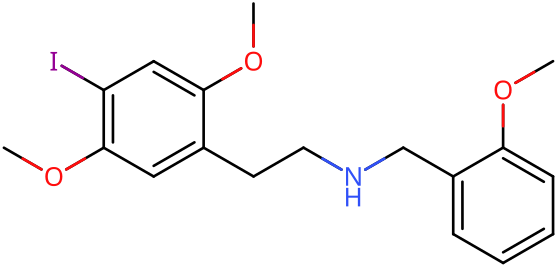
25I-NBOMe Stats & Data
COc1ccccc1CNCCc1cc(OC)c(I)cc1OCZFUOLNAKPBFDIJ-UHFFFAOYSA-NReceptor Profile
Receptor Actions
Receptor Binding
Measured Affinities
Guide to PHARMACOLOGYMeasured binding and functional data for NBOMe, curated by the IUPHAR/BPS Guide to PHARMACOLOGY. Each row cites the paper it came from. Lower concentrations mean tighter binding — a value in the sub-nanomolar range indicates a very potent interaction.
| Target | Action | Measure | Value | Concentration | Species | Source |
|---|---|---|---|---|---|---|
| 5-HT2A receptor Htr2a | Agonist | pKi | 8.66 | 2.19 nM | Rat | PMID 35939391 |
Reading this. pKi, pEC50 and pIC50 are negative log molar values, so a higher number means a tighter interaction; the concentration column converts them for you. Values from non-human species are laboratory measurements and do not translate directly to human effect. Receptor affinity is not a dose — it describes what a molecule binds, not how much of it is safe to take.
Receptor data from the IUPHAR/BPS Guide to PHARMACOLOGY (v2026.2), licensed CC BY-SA 4.0. Matched to this substance by InChIKey.
History & Culture
2000–2010
25I-NBOMe was first described in the scientific literature by Ralf Heim and colleagues at the Free University of Berlin around the year 2000, initially appearing in the form of conference abstracts. Heim provided a comprehensive account of the compound in his 2003 doctoral dissertation. The synthesis involved a reductive alkylation procedure using 2C-I as the starting material, which was reacted with 2-methoxybenzaldehyde to produce an imine intermediate, then reduced with sodium borohydride to yield the final product. Following Heim's initial work, a research team at Purdue University led by David Nichols further investigated 25I-NBOMe and related NBOMe compounds between 2006 and 2008. Their work examined the structure-activity relationships and pharmacological properties of various substances in this chemical series. The compound also attracted interest as a research tool for studying the serotonergic system, with the carbon-11 labelled version ([11C]Cimbi-5) being synthesized and validated in Copenhagen as a radiotracer for positron emission tomography. As the first full agonist PET radioligand for 5-HT2A receptors, this labelled compound showed promise as a functional marker for these receptors, particularly in their high-affinity states.
2010–present
25I-NBOMe had virtually no history of human recreational use prior to 2010, when internet vendors began selling the NBOMe series. It was apparently the first of its class to enter the market and quickly became the most popular member of the series. By 2012, NBOMe compounds had reportedly eclipsed more established psychedelics like LSD and psilocybin-containing mushrooms in popularity, at least temporarily. The substance's extreme potency—approximately sixteen times greater than its parent compound 2C-I—allowed even high doses to be dissolved and applied to blotter paper, a format traditionally associated with LSD. This physical similarity, combined with the compound's significantly lower cost (reportedly obtainable for under one dollar per dose when legal), created substantial incentive for misrepresentation. The drug has been distributed in three primary ways: marketed as a legal alternative to LSD (before scheduling made this obsolete), sold under its own name, and fraudulently represented as LSD. Street and media nicknames have included "N-Bomb," "Solaris," "Smiles," and "Wizard." The DEA reported seizures from 35 U.S. states between June 2011 and June 2013, with the first detection occurring in Milwaukee, Wisconsin. Russia became the first country to specifically schedule the NBOMe series in October 2011, followed by state-level scheduling in Virginia, Louisiana, and Florida over the subsequent years. The substance has been associated with numerous deaths and hospitalizations, leading to increasingly widespread international control measures throughout the 2010s.
Subjective Effects
Physical
- Sublingual numbness: The very first physical effect noticed immediately after sublingual absorption is a strong, unpleasant metallic chemical taste accompanied by a very obvious feeling of general numbness of the tongue and mouth which can stay for up to an hour after the blotter paper has been consumed. This is the key difference when determining whether blotter paper contains LSD or one of the NBOMe series.
- Spontaneous tactile sensations: The body high can be described as a generally mild, all-encompassing, soft but euphoric tingling sensation. This tingling sensation is also accompanied by spontaneous rushes of euphoria that become longer and more drawn out proportional to the dosage consumed.
- Decreased bodily weight: In terms of the body's perceived weight, this substance consistently leaves people feeling extremely light, often to the point of total weightlessness.
- Stimulation: 25I-NBOMe is usually considered to be very energetic and stimulating. For most people, this substance induces a unique type of physical stimulation which can be described as feeling extremely energetic but in a way which does not force the tripper to move unless they genuinely choose to do so. For others however, the stimulation can be quite uncontrollable, occasionally resulting in bodily shakes and teeth grinding comparable to that of MDMA and traditional stimulants such as amphetamine.
- Vasoconstriction: The narrowing of blood vessels resulting from contraction of the muscular wall, triggered through the way in which 25I-NBOMe's target receptor (5-HT2A) modulates both vasoconstriction and vasodilation among its many other functions. It can be described as feelings of tightness within one's arms and legs.
- Nausea: As the tripper begins to come up, nausea is not uncommon and can sometimes result in initial vomiting, but passes once this has either happened or the trip begins to fully set in. In comparison to other psychedelics such as psilocin, LSD, 2C-E and 2C-I, this could actually be considered very mild in its intensity.
Cognitive
The head space of 25I-NBOMe is described by many as remarkably light and underwhelming in comparison to the classical psychedelics. It is not uncommon for people to report feeling that their thought stream has maintained general normality in its specific style throughout low to moderate dosages. At high dosages however, mild to overwhelming cognitive alterations become present.
- Introspection: This component is consistently manifested only in the context of a non-social setting in which the user is alone.
- Thought acceleration
- Ego suppression, loss and death
- Time distortion
- Feelings of fascination, importance and awe
- Conceptual thinking
- Thought connectivity
- Current mind state enhancement
- Personal bias suppression
- Empathy, love and sociability enhancement: The entactogenic effects range from mild to powerful, but are inconsistently manifested. Entactogenic effects for people who try this substance usually become prominent in the presence of others. These feelings of increased sociability, love and empathy do not seem to be quite as strong or profound as those found within other entactogens such as MDMA, 2C-B and AMT.
Sensory
- Enhancements
- Distortions
- Hallucinations
- Visual drifting: (Melting, Flowing, Breathing and Morphing) - In comparison to other psychedelics, this effect can be described as highly detailed, slow and smooth in motion, static in their appearance and unrealistic/cartoon-like in style.
- Tracers
- After images
- Texture repetition: In comparison to other psychedelics such as LSD or psilocin, this particular visual alteration is significantly more basic and less intricate in style but still distinctively present.
- Increased visual acuity
- Enhancement of colours
- Enhanced pattern recognition
25I-NBOMe is capable of producing a full range of hallucinatory states within the level 1-3 range extremely consistently. However, level 4 hallucinatory breakthroughs are reported but very uncommon and inconsistent in comparison to other more commonly used psychedelics such as psilocin, 2C-E and DMT.
- External hallucinations
- Internal hallucinations: This particular effect commonly contains hallucinations with scenarios, settings, concepts and autonomous entity contact. They are more common within dark environments and can be described as internal in their manifestation, lucid in believability, interactive in style and almost exclusively of religious, spiritual, mystical or transcendental nature in their overall theme.
Forked from Subjective Effect Documentation by Josie Kins, April 2013. Via dose.wiki (CC0).
Toxicity
PsychonautWikiShort-term as well as long-term damage of NBOMes have been occasionally tied to serious physical and mental problems on seemingly random people, including memory and speech difficulties, heart problems, HPPD and in some cases Anxiety and PTSD, from particularly difficult experiences. 25I-NBOMe is a relatively new substance, and little is known about its pharmacological risks or its interaction with other substances. The LD50 has not yet been determined although it is potentially fatal at heavy dosages. PsychonautWiki advises that due to 25I-NBOMe's extreme potency it should not be insufflated as this method of administration appears to have led to several deaths in the past year. This substance came to media attention in early 2012 after a cluster of seven non-fatal overdoses with the drug were reported in or around Richmond, Virginia.
Effect Profile
Curated + 184 ReportsStrong visuals, headspace, and auditory effects with strong body load
Duration Timeline
BluelightCommunity Effects
TripSitTolerance & Pharmacokinetics
drugs.wikiTolerance Decay
Tolerance builds rapidly after a single dose and partially recovers over 3–7 days; near‑baseline typically returns after 1–2 weeks. Cross‑tolerance with other serotonergic psychedelics is expected. Values are heuristic (community/HR synthesis). Data quality: low/anecdotal.
Cross-Tolerances
Demographics
Gender Distribution
Age Distribution
Reports Over Time
Effect Analysis
Erowid + BluelightEffects aggregated from 172 experience reports (122 single-substance Erowid + 62 Bluelight)
Effect Sentiment Distribution
Confidence Distribution
Each bar is the share of reports mentioning the effect; its whisker, and the band on the rows below, is the 95% interval: where the share could plausibly be with other reports of the same kind.
Positive Effects 61
Adverse Effects 58
Show 37 more adverse effects
Show 22 neutral or unclassified mentions
Also reported in combinations. In the 104 25I-NBOMe reports where another drug was taken too, 19 (18.3%) mention hospital, emergency services or an overdose, 6 (5.8%) a seizure and 5 (4.8%) psychosis. In the 122 single-substance reports: 22.1%, 7.4% and 8.2%. These are not in the figures above: they cannot be put down to 25I-NBOMe alone, and a mention is not always something that happened to the writer.
Dose-Response Correlation
How effect frequency changes across dose levels. Whiskers, and the numbers' hover text, give each figure's 95% interval.
View data table
| Effect | Heavy (n=23) |
|---|---|
| Visual Distortions | 82.6% (95% interval 63 to 93 percent) |
| Color Enhancement | 78.3% (95% interval 58 to 90 percent) |
| Music Enhancement | 65.2% (95% interval 45 to 81 percent) |
| Anxiety | 60.9% (95% interval 41 to 78 percent) |
| Euphoria | 56.5% (95% interval 37 to 74 percent) |
| Confusion | 52.2% (95% interval 33 to 71 percent) |
| Auditory Effects | 43.5% (95% interval 26 to 63 percent) |
| Empathy | 43.5% (95% interval 26 to 63 percent) |
| Stimulation | 39.1% (95% interval 22 to 59 percent) |
| Nausea | 34.8% (95% interval 19 to 55 percent) |
| Closed-Eye Visuals | 30.4% (95% interval 16 to 51 percent) |
| Open-Eye Visuals | 30.4% (95% interval 16 to 51 percent) |
| Dissociation | 30.4% (95% interval 16 to 51 percent) |
| Memory Suppression | 26.1% (95% interval 12 to 46 percent) |
| Sedation | 26.1% (95% interval 12 to 46 percent) |
Subjective Effect Ontology
Experience ReportsStructured effect tags extracted from 276 Erowid & Bluelight experience reports using a controlled vocabulary of 220+ canonical effects across 15 domains.
Auditory
Cognitive
Emotional
Motor
Visual
Dose–Effect Mapping
Experience ReportsHow reported effects shift across dose tiers, based on 122 single-substance experience reports. The shaded band on each bar is its 95% interval. An arrow (↑ ↓) marks a change between the lowest and highest tier that count an effect only when the gap is bigger than chance would explain; ~ means no clear change. How changes are called
Limited tier coverage — most reports fall within the Heavy range. Effects at other dose levels may not be represented.
| Effect | Heavy (n=23) | Change with dose |
|---|---|---|
| visual distortions | ||
| color enhancement | ||
| music enhancement | ||
| anxiety | ||
| euphoria | ||
| confusion | ||
| auditory effects | ||
| empathy | ||
| stimulation | ||
| nausea | ||
| closed-eye visuals | ||
| open-eye visuals | ||
| dissociation | ||
| memory suppression | ||
| sedation | ||
| muscle tension | ||
| introspection | ||
| time distortion | ||
| pupil dilation | ||
| hospital |
Showing top 20 of 25 effects
Dosage Distribution
Dose distribution from experience reports, one dose per report (the first listed). Doses above Q3 + 3×IQR, far above what people typically take, are left out of the median and range and listed under each route: most are real heavy doses or overdoses, not mistakes.
1 report gave a dose above the typical range (20,000 µg), so it is not in the figures above. Listing a dose here does not mean it is safe.
1 dose more than 50 times the median may be a typing or unit error and is not in the figures either: check the report.
Show the reports
- 20,000 µg · another drug taken too
Possibly a typing or unit error:
- 800,000 µg · another drug taken too
Real-World Dose Distribution
ErowidFrom 131 of 261 recorded dose entries: those that state a weight (mg, g or µg), in routes with at least five of them. Values above Q3 + 3×IQR, far above what people typically take, are left out; they can include real heavy doses and overdoses, not only mistakes.
Sublingual (n=80)
Insufflated (n=28)
Oral (n=14)
Common Combinations
Most co-occurring substances, as a share of all 226 reports filed under 25I-NBOMe; whiskers are 95% intervals
Form / Preparation
Most common forms and preparations, as a share of the 192 reports that give one; whiskers are 95% intervals
Body-Weight Dosing
Dose per kg of body weight, one dose per report (the first listed), from reports giving a weight of 30–250 kg. Doses above Q3 + 3×IQR, far above what people typically take, are left out of the median and range and listed under each route.
Insufflated
1 report gave a dose above the typical range (0.398 mg/kg), so it is not in the figures above. It mentions hospital, emergency services or an overdose. Listing a dose here does not mean it is safe.
Show the report
- 0.398 mg/kg · mentions hospital, emergency services or an overdose
Oral
1 report gave a dose above the typical range (0.294 mg/kg), so it is not in the figures above. It mentions hospital, emergency services or an overdose. Listing a dose here does not mean it is safe.
Show the report
- 0.294 mg/kg · mentions hospital, emergency services or an overdose
Sublingual
1 report gave a dose above the typical range (0.315 mg/kg), so it is not in the figures above. Listing a dose here does not mean it is safe.
1 dose more than 50 times the median may be a typing or unit error and is not in the figures either: check the report.
Show the reports
- 0.315 mg/kg · another drug taken too
Possibly a typing or unit error:
- 14.467 mg/kg · another drug taken too
Unknown
Redose Patterns
Redosing behavior across 200 reports
Legal Status
| Country | Status | Notes |
|---|---|---|
| Australia | Controlled (state-level) | Possession, production, and sale is prohibited. Queensland explicitly scheduled 25I-NBOMe in April 2012, followed by New South Wales in October 2013. The federal government has no specific legislation concerning N-benzyl phenethylamines, with control occurring at state level. |
| Austria | Illegal (SMG) | Prohibited under the Suchtmittelgesetz (SMG) since June 26, 2019. Possession, production, and sale are criminal offenses. |
| Brazil | Illegal (Portaria SVS/MS nº 344) | The entire NBOMe series became controlled as of February 18, 2014, including 25I-NBOMe, 25C-NBOMe, 25B-NBOMe, and related compounds. Listed on Portaria SVS/MS nº 344. |
| Canada | Schedule III (CDSA) | Controlled under Schedule III of the Controlled Drugs and Substances Act as of October 31, 2016. Classified as a derivative of 2,5-dimethoxyphenethylamine, with the scheduling covering 2C-phenethylamines and their salts, derivatives, and isomers. |
| China | Controlled substance | Became a controlled substance in October 2015. Production, possession, and distribution are prohibited. |
| Denmark | Controlled | Regulated through the generic classification of phenethylamines in the Executive Order on Euphoriant Substances. |
| Finland | Schedule I | Initially controlled under the Medicines Act (395/87) as of March 15, 2013. Subsequently scheduled in the government decree on narcotic substances, preparations and plants as of 2022, making possession and use illegal. |
| Germany | Anlage I BtMG | Listed in Anlage I of the Betäubungsmittelgesetz (Narcotics Act) as of December 13, 2014. Manufacturing, possessing, importing, exporting, buying, selling, procuring, or dispensing without a license is prohibited. |
| Hungary | Schedule C | Falls within the generic definition of phenethylamines in Schedule C of Government Decree 66/2012. |
| Israel | Illegal | Banned in 2012-2013. The NBOMe series of psychoactives became controlled substances. |
| Italy | Schedule 1 (Tabella I) | Added to Tabella I in February 2015. Classified as a Schedule 1 controlled substance with criminal penalties for possession, production, and distribution. |
| Japan | Narcotic drug | Designated as a narcotic drug effective November 1, 2015. Subject to strict criminal penalties under Japanese narcotics legislation. |
| Latvia | Schedule I | Classified as a Schedule I controlled substance. Possession, production, and distribution are prohibited. |
| Netherlands | List I (Opiumwet) | Classified as a Lijst 1 substance under the Opiumwet (Opium Law). This is the most restrictive category for controlled substances in Dutch law. |
| New Zealand | Schedule 2 | Classified as a Schedule 2 controlled substance under New Zealand drug legislation. |
| Norway | Controlled | Regulated through the generic scheduling of phenethylamines as of February 14, 2013. |
| Poland | Substitution drug | Falls under the definition of a 'substitution drug' under the Act on Counteracting Drug Addiction and the Act on State Sanitary Inspection (2010). Marketing and production are penalized with administrative fines rather than criminal sanctions. |
| Romania | Illegal | Banned under broad psychoactive substance legislation enacted in 2011, which prohibits all psychoactive substances regardless of specific chemical classification. |
| Russia | Controlled substance | Russia was the first country to specifically regulate the NBOMe series. All NBOMe compounds, including 25I-NBOMe, became illegal in October 2011. |
| Serbia | Prohibited | Added to the list of prohibited substances in March 2015. |
| Slovenia | Controlled | Included in a Decree amending the classification of illicit drugs, published in Official Gazette of RS No. 62/2013. |
| Sweden | Schedule I | Added to the Narcotic Drugs Punishments Act under Swedish Schedule I (substances without medical use) effective August 1, 2013. Published by the Medical Products Agency in regulation LVFS 2013:15. |
| Switzerland | Controlled (Verzeichnis D) | Specifically named as a controlled substance under Verzeichnis D of Swiss narcotics legislation. |
| Taiwan | Class 4 | Placed in Class 4 of prohibited substances following the 2014 European Union decision. |
| United Arab Emirates | Illegal | Prohibited under Federal Law No. 14 of 1995, which criminalizes production, import, export, transport, buying, selling, possessing, and storing of narcotic and psychotropic substances. The UAE maintains a zero-tolerance policy for recreational drug use. |
| United Kingdom | Class A | Classified as a Class A drug under the N-benzylphenethylamine catch-all clause in the Misuse of Drugs Act 1971, effective June 10, 2014. Class A carries the most severe penalties, including up to 7 years imprisonment for possession. |
| United States | Schedule I | Permanently added to Schedule I effective October 27, 2016, after emergency scheduling on November 15, 2013. The DEA initially used emergency powers to temporarily schedule 25I-NBOMe, 25B-NBOMe, and 25C-NBOMe. Several states including Florida (December 2012), Louisiana (May 2013), Virginia, and Georgia (April 2013) had enacted state-level scheduling prior to federal action. |
Harm Reduction
drugs.wiki25I‑NBOMe is an ultra‑potent 5‑HT2A agonist active at microgram doses; the difference between a strong and dangerous dose can be small, particularly with nasal use or concentrated liquids. Numerous severe toxicities and fatalities have been reported, especially from misidentified blotters and insufflated powders. Reagent testing is essential when a blotter is sold as “LSD”: Ehrlich/Hofmann positive and a lack of rapid, vivid Marquis color change support lysergamide; NBOMes generally show no Ehrlich/Hofmann reaction and often give pronounced Marquis reactions on paper. Taste is not diagnostic, but a strong bitter/metallic taste with oral numbness is commonly reported for NBOMes; treat as a warning and test. Never eyeball powder; prepare measured solutions (volumetric dosing) and label concentrations clearly to avoid accidental overdoses. Because oral (swallowed) bioavailability is unreliable, sublingual/buccal absorption is the typical route; hold for 15–30 minutes before spitting/swallowing. Significant vasoconstriction (cold/numb extremities, cramps, hypertension) and agitation can occur; avoid stimulants, strenuous activity, overheating, and stay hydrated with small sips. In an emergency (seizure, hyperthermia, severe agitation, chest pain, uncontrolled hypertension), seek immediate medical help; clinicians typically use benzodiazepines and supportive care. NBOMes have frequently been laid on blotters resembling LSD; do not assume any blotter is LSD without testing. Strong cross‑tolerance exists with classical psychedelics (LSD, psilocybin, DOx, 2C‑x), and redosing within days will be less effective yet may increase side‑effects. Legal status: controlled in many jurisdictions (e.g., EU control recommended 2014; US Schedule I since 2016).
References
Data Sources
Cited References
Additional references
- Erowid NBOMe Series: Spotlight on NBOMes (overview of effects, vasoconstriction, duration)
- TripSit Wiki: NBOMes (dose/duration by ROA; general guidance)
- EUDA/EMCDDA Risk Assessment: 25I‑NBOMe (2014)
- Bluelight safety warning: NBOMe on blotters sold as LSD (HR advice; misrepresentation; taste/numbness caution)
- TripSit/Bluelight combo guidance (dangerous combinations incl. MAOIs, tramadol, DXM, stimulants, lithium)
- Erowid 25I‑NBOMe Vault