
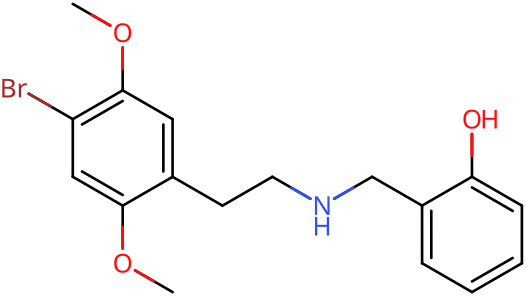
25B-NBOH Stats & Data
COc1cc(CCNCc2ccccc2O)c(OC)cc1BrRSUNJYKZRKIBNB-UHFFFAOYSA-NReceptor Profile
Receptor Actions
History & Culture
25B-NBOH was first synthesized and documented in 2011 by Martin Hansen at the University of Copenhagen. The compound is a structural derivative of the phenethylamine psychedelic 2C-B, belonging to the broader family of N-benzyl phenethylamines and sharing close structural relationships with the 25x-NBOMe series of compounds. Prior to its synthesis, 25B-NBOH had no documented history of human consumption. It emerged on the online designer drug market in 2011, the same year it was first characterized, appearing for sale without any established safety profile or prior research into its effects in humans. The compound remains one of the lesser-studied members of the NBOx class, with its availability driven primarily by the grey market rather than any scientific or therapeutic interest.
Toxicity
PsychonautWiki25B-NBOH is a relatively new substance, and little is known about its toxicity or interaction with other substances. It is assumed to pose similar acute health risks as 25B-NBOMe and other members of 25x-NBOMe series. The LD50 has not yet been determined although it is likely to be potentially fatal at heavy dosages. 25B-NBOH's extreme potency means it should not be insufflated (snorted) as this method of administration has been associated with many deaths and hospitalizations with closely related members of the 25x-NBOMe series.
Effect Profile
Curated + 4 ReportsStrong visuals, auditory effects, and headspace with strong body load
Tolerance & Pharmacokinetics
drugs.wikiTolerance Decay
Immediate acute tolerance develops after dosing; cross‑tolerance with other 5‑HT2A agonists is expected. Anecdotal reports suggest tolerance may persist ~1–2 weeks depending on dose and individual variability. Data quality is limited and primarily anecdotal.
Cross-Tolerances
Experience Report Analysis
ErowidDemographics
Gender Distribution
Too few reports for a chart: gender is known from 6 reports, and a split is drawn only from 20 reports or more. Counts are shown instead. Why 20?
- Male 6 of 6
Age Distribution
Reports Over Time
Effect Analysis
ErowidEffects aggregated from 4 experience reports (4 single-substance Erowid)
Effect Sentiment Distribution
Confidence Distribution
Each bar is the share of reports mentioning the effect; its whisker, and the band on the rows below, is the 95% interval: where the share could plausibly be with other reports of the same kind.
Too few reports for bars: these effects come from 4 single-substance Erowid reports, and a bar is drawn only from 20 reports or more. With fewer, a percentage cannot tell a common effect from a rare one. Counts are shown instead. Why 20?
Positive Effects 4
Adverse Effects 1
Form / Preparation
Most common forms and preparations, as a share of the 4 reports that give one
Too few reports for bars: these forms come from 4 reports, and a bar is drawn only from 20 reports or more. With fewer, a percentage cannot tell a common effect from a rare one. Counts are shown instead. Why 20?
- Blotter / Tab 3 of 4
Legal Status
| Country | Status | Notes |
|---|---|---|
| Brazil | Controlled (Portaria SVS/MS nº 344) | Added to the controlled substances list under Portaria SVS/MS nº 344 on December 10, 2018. Possession, distribution, and use are prohibited under Brazilian law. |
| Germany | Controlled (NpSG) | Regulated under the Neue-psychoaktive-Stoffe-Gesetz (New Psychoactive Substances Act) since November 26, 2016. Production and import with intent to distribute, administration to others, and commercial trading are criminally punishable. Personal possession is prohibited but not subject to criminal penalty. |
| Sweden | Schedule I (Narcotic) | Listed under Schedule I of the Narcotic Drugs Punishments Act, a classification for substances without recognized medical use. The scheduling was published by the Medical Products Agency in regulation HSLF-FS 2015:35. |
| Switzerland | Controlled (Verzeichnis E) | Regulated as a defined derivative of N-benzylphenethylamine under Verzeichnis E, point 131 of Swiss controlled substances legislation. An exemption exists permitting use for scientific or industrial purposes. |
| United Kingdom | Class A | Classified as a Class A controlled substance under the Misuse of Drugs Act 1971 through the N-benzylphenethylamine catch-all provision. Class A substances carry the most severe penalties under UK drug law. |
| United States | Unscheduled | Not explicitly scheduled under the Controlled Substances Act. However, possession or distribution intended for human consumption may be prosecuted under the Federal Analogue Act due to structural and pharmacological similarities to the Schedule I substance 25B-NBOMe. |
Harm Reduction
drugs.wiki25B‑NBOH is active in the microgram range; inaccurate measurement (e.g., eyeballing powder) greatly increases overdose risk and should be avoided. NBx compounds (NBOH/NBOMe) have produced severe adverse effects including vasoconstriction, agitation, seizures, hyperthermia, and rhabdomyolysis in clinical case series; medical evaluation is warranted for symptoms like chest pain, blue/cold extremities, prolonged confusion, or seizure. Buccal/sublingual absorption is the primary active route; swallowing reduces effects variably, and redosing during a slow onset has led to accidental overdoses with related NBx. 25B‑NBOH has been mis-sold as ‘LSD’ (including in powder form, which is atypical for LSD); use multi-reagent testing and drug checking where available. Ehrlich reagent turns purple for indole lysergamides (e.g., LSD) but shows no color with NBOH/NBOMe; Hofmann/Marquis patterns can add context—however, reagent tests are screening tools, not definitive IDs. Bitter taste and localized oral numbing are commonly reported with NBx, but taste is not a reliable identification method and should not replace testing. Strong stimulatory combinations (e.g., with amphetamines or cocaine) elevate risks of hypertension and dangerous vasoconstriction beyond either drug alone. Tramadol lowers seizure threshold and has been repeatedly associated with seizures when combined with serotonergic psychedelics; avoid. Lithium has many consistent reports of severe adverse reactions, including seizures, when combined with classical psychedelics; given the similar 5‑HT2A agonism of NBOH compounds, this combination should be considered high‑risk. SSRIs often blunt psychedelic effects via receptor downregulation; they are not reliable ‘safety buffers’ and may complicate responses—avoid intentional mixing. Cannabis can unpredictably potentiate psychedelics and anxiety; titrate cautiously or avoid. Tolerance to 5‑HT2A agonists can be pronounced for days; allow at least 1–2 weeks between strong psychedelic sessions to reduce the urge to escalate dose. Seek immediate care for signs of hyperthermia (hot, confused, profuse sweating), chest pain, severe headache, seizure activity, or new neurologic deficits.
References
Cited References
- A cluster of 25B-NBOH poisonings following exposure to powder sold as LSD
- Bluelight: 25B-NBOH Discussion Thread
- Erowid: 25B-NBOH Experience Reports
- Erowid: 25B-NBOH Vault
- Hansen et al. 2014 - Synthesis and Structure-Activity Relationships of N-Benzyl Phenethylamines
- Hansen 2010 - Design and Synthesis of Selective Serotonin Receptor Agonists (PhD Thesis)
- Identification of new NBOH drugs in seized blotter papers
- PiHKAL 25B-NBOH Entry
- Silva et al. 2011 - Theoretical studies on 5-HT2A receptor interaction
- Talaie et al. 2009 - Tramadol seizure risk
- Victoria Health Drug Alert - 25B-NBOH sold as powdered LSD
Additional references
- Erowid: NBOMe overview and issues (vasoconstriction, potency, duration)
- Erowid 25I‑NBOMe duration table (used as proxy reference for NBx sublingual/buccal)
- TripSit NBOMe page: dosage variability, routes, combo cautions (cannabis, stimulants)
- Hi‑Ground drug alert: 25B‑NBOH sold as ‘LSD’ powder; risks and testing notes
- Saferparty.ch warning: NBOMe sold as LSD; bitter taste, sublingual vs oral, avoid redosing
- NCBI Bookshelf scoping review: NBOMe intoxication—agitation, hypertension, seizures, hyperthermia
- Erowid: LSD and antidepressants—SSRIs/MAOIs reduce effects; lithium + LSD reports of seizures
- TripSit drug combinations chart rationale (NBOMe + stimulants unsafe; cannabis caution; tramadol unsafe with psychedelics)
- Erowid: 25B‑NBOH image/blotter context (distribution form)
- PubChem: 25B‑NBOH entry (identifier)
- EUDA/EMCDDA joint reports: NBOMe cases, short-acting, severe sympathomimetic/serotonergic toxicity
- Reddit user reports (dose variability, tolerance, redosing behavior)