
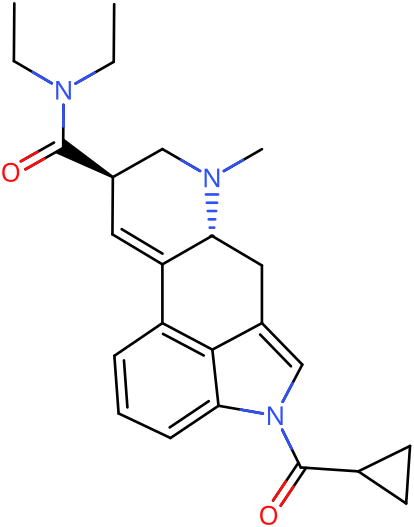
1cP-LSD Stats & Data
CCN(CC)C(=O)C1CN(C2CC3=CN(C4=CC=CC(=C34)C2=C1)C(=O)C5CC5)CRAFUPYYDHPFASC-DYESRHJHSA-NReceptor Profile
Receptor Actions
History & Culture
1cP-LSD was developed by Lizard Labs, a research chemical laboratory based in the Netherlands, as a legal alternative to LSD. The compound emerged on the grey market around 2019, reportedly created in anticipation of the impending prohibition of 1P-LSD in Germany. Like its predecessor, 1cP-LSD is widely regarded as a prodrug of LSD, converting to the parent compound following administration. The substance belongs to a broader wave of designer lysergamide analogs that have appeared on the research chemical market since the mid-2010s, including AL-LAD, ETH-LAD, and ALD-52. This pattern of novel analog development has been characteristic of the lysergamide research chemical scene, with each new prohibition prompting the emergence of structurally related alternatives. When Germany banned 1cP-LSD in July 2021, 1V-LSD promptly appeared on the market as its replacement, continuing this cycle of regulatory cat-and-mouse. Beyond its presence in the recreational research chemical market, 1cP-LSD has attracted some preliminary scientific attention. The compound has been investigated in veterinary contexts as a potential treatment for anxiety in dogs, representing an unusual application within psychedelic research.
Toxicity
PsychonautWikiThe toxicity and long-term health effects of recreational 1cP-LSD use have not been studied. This is because 1cP-LSD is a research chemical with almost no history of human use. However, as with LSD and psychedelics in general, it is likely that 1cP-LSD can act as a trigger for those with underlying mental disorders. Those with a personal or family history of mental illness are generally advised not to use this substance, particularly when outside of a supervised medical setting. It is strongly recommended that one uses harm reduction practices when using this substance.
Overdose
1cP-LSD has no known toxic dose. However, higher doses increase the risk of adverse psychological reactions. These reactions include anxiety, delusions and panic attacks.
Addiction & dependence
Although no formal studies have been conducted, it is assumed that like LSD itself, 1cP-LSD is non-addictive with a low abuse potential. There are no literature reports of successful attempts to train animals to self-administer LSD — an animal model predictive of abuse liability — indicating that it does not have the necessary pharmacology to either initiate or maintain dependence. Likewise, there is virtually no withdrawal syndrome when chronic use of LSD is stopped.
Effect Profile
Curated + 5 ReportsStrong visuals, headspace, and auditory effects with moderate body load
Duration Timeline
BluelightTolerance & Pharmacokinetics
drugs.wikiTolerance Decay
Empirical user reports suggest marked tolerance next day with partial recovery over 7–14 days; values are indicative and individualized. Redosing same day extends duration more than intensity.
Cross-Tolerances
Experience Report Analysis
ErowidDemographics
Gender Distribution
Too few reports for a chart: gender is known from 11 reports, and a split is drawn only from 20 reports or more. Counts are shown instead. Why 20?
- Male 8 of 11
- Female 1 of 11
- Not Specified 2 of 11
Age Distribution
Reports Over Time
Effect Analysis
ErowidEffects aggregated from 5 experience reports (5 single-substance Erowid)
Effect Sentiment Distribution
Confidence Distribution
Each bar is the share of reports mentioning the effect; its whisker, and the band on the rows below, is the 95% interval: where the share could plausibly be with other reports of the same kind.
Too few reports for bars: these effects come from 5 single-substance Erowid reports, and a bar is drawn only from 20 reports or more. With fewer, a percentage cannot tell a common effect from a rare one. Counts are shown instead. Why 20?
Positive Effects 6
Adverse Effects 1
Also reported in combinations. In the 6 1cP-LSD reports where another drug was taken too, 1 mentions hospital, emergency services or an overdose, 0 a seizure and 0 psychosis (too few reports for percentages). In the 5 single-substance reports: 0, 0 and 0. These are not in the figures above: they cannot be put down to 1cP-LSD alone, and a mention is not always something that happened to the writer.
Real-World Dose Distribution
ErowidFrom 26 of 26 recorded dose entries: those that state a weight (mg, g or µg), in routes with at least five of them. Values above Q3 + 3×IQR, far above what people typically take, are left out; they can include real heavy doses and overdoses, not only mistakes.
Sublingual (n=17)
Oral (n=8)
Common Combinations
Most co-occurring substances, as a share of all 11 reports filed under 1cP-LSD
Too few reports for bars: these combinations come from 11 reports, and a bar is drawn only from 20 reports or more. With fewer, a percentage cannot tell a common effect from a rare one. Counts are shown instead. Why 20?
- THC 4 of 11
Form / Preparation
Most common forms and preparations, as a share of the 10 reports that give one
Too few reports for bars: these forms come from 10 reports, and a bar is drawn only from 20 reports or more. With fewer, a percentage cannot tell a common effect from a rare one. Counts are shown instead. Why 20?
- Blotter / Tab 10 of 10
Redose Patterns
Redosing behavior across 10 reports
Too few reports for a chart: redosing is known from 10 reports, and a split is drawn only from 20 reports or more. Counts are shown instead. Why 20?
- Single dose 8 of 10
- Redosed 2 of 10
Legal Status
| Country | Status | Notes |
|---|---|---|
| Canada | Unscheduled | Not listed as a controlled substance under Canadian drug control legislation. Remains legal to possess and purchase. |
| Czech Republic | Uncontrolled | Not designated as a controlled substance and does not appear on the national list of prohibited drugs. |
| Germany | Controlled (NpSG) | Regulated under the Neue-psychoaktive-Stoffe-Gesetz (New Psychoactive Substances Act) as of July 2, 2021. Production and importation with intent to distribute, administration to others, and commercial trading are criminal offenses. Possession is prohibited but carries no penalty. Prior to this date, 1cP-LSD existed in a legal grey area as its cyclopropylcarbonyl group was not considered an alkyl radical under the original NpSG amendment regulation. |
| Japan | Controlled | Regulated under the Pharmaceutical Affairs Law. Both possession and sale are prohibited. |
| Sweden | Dangerous substance | Sweden's public health agency proposed classification as a dangerous substance on December 18, 2019. Formally classified as such on April 22, 2021. |
| Turkey | Illegal | Classified as a controlled drug. Possession, production, supply, and importation are all criminal offenses. |
| United Kingdom | Controlled (PSA) | Covered by the Psychoactive Substances Act 2016, effective May 26, 2016. Production, supply, and importation are criminal offenses. Personal possession is not penalized under this legislation, though the substance cannot be legally sold for human consumption. |
Harm Reduction
drugs.wiki• 1cP-LSD (1-cyclopropionyl-lysergic acid diethylamide) is an N‑1 acylated lysergamide that functions as a prodrug to LSD; in vitro human-serum work and animal behavior show conversion to LSD and LSD‑like action. Expect essentially classic LSD pharmacology. [Brandt 2020; community corroboration]
• Relative potency per microgram is reported as similar to or modestly below LSD; do not assume equi-potency across batches—start low with new sources. [Erowid/Bluelight user reports]
• Reagent testing: use an indole test (Ehrlich) AND a lysergamide-specific test (Hofmann). Ehrlich can show false-positives on gel tabs or with other indoles (e.g., melatonin); Hofmann should develop blue/purplish for lysergamides over up to ~60 min. Use Marquis/Mecke to help rule out NBOMe/DOx. [Reddit ReagentTesting threads referencing Erowid guidance]
• Volumetric dosing is strongly recommended for accurate titration with microgram-active drugs. Prepare a measured solution (e.g., in ethanol/water), label clearly, and calculate dose with a volumetric converter. [TripSit]
• Storage stability: light, heat, oxygen, and moisture accelerate lysergamide degradation. For longer storage, keep blotters/pellets in airtight, lightproof containers with desiccant; refrigerate/freezer storage can extend shelf-life. Warm to room temp before opening to avoid condensation. [Bluelight HR FAQ]
• Mental health: avoid if history of psychosis, bipolar disorder, or uncontrolled severe anxiety. Use sitter, safe setting, and have a de-escalation plan. [General HR consensus]
• Rescue plan: a benzodiazepine (e.g., 1–2 mg lorazepam or 5–10 mg diazepam) can quell panic, but avoid preloading and mixing with alcohol/other depressants. Seek medical help for chest pain, seizures, or extreme agitation. [HR org guidance]
• HPPD/lingering visuals are uncommon but documented after LSD-like experiences; risk may rise with frequent/high-dose use and concurrent cannabis. Space sessions, especially after difficult trips. [HR summaries]
• Driving and tasks requiring full attention: impairment can persist beyond the subjective end of effects; wait at least 24 hours before driving. [Hi‑Ground]
• Cross-tolerance: strong with LSD and other 5‑HT2A psychedelics; spacing 7–14 days between sessions reduces tolerance and psychological wear. [Bluelight HR FAQ]
• Legal status varies and changes frequently; in some jurisdictions 1cP‑LSD is controlled or may be treated as an analogue of LSD. Verify locally before purchase/possession/use. [HR advisory]
References
Data Sources
Cited References
- Brandt SD et al. - Return of the lysergamides Part VI: 1cP-LSD characterization (2020)
- Erowid: 1cP-LSD Experience Vault
- Halberstadt AL et al. - Pharmacological studies of LSD derivatives (2020)
- Henriquez-Hernandez L et al. - 1cP-LSD for canine anxiety pilot study (2024)
- Nichols DE - Hallucinogens pharmacology review (2004)
- PubChem Compound: 156536462
- TripSit Factsheet: 1CP-LSD
- Brandt SD et al. Return of the lysergamides Part VI: analytical & behavioural characterization of 1CP-LSD (2020)
- Erowid: 1cP-LSD Experience Vault – User Reports (accessed 2025-07-29)
- Bluelight: ‘Lysergamides Help’ thread – community discussion on 1cP-LSD potency (2019)
- Henríquez-Hernández L et al. Single-dose 1cP-LSD administration for canine anxiety: a pilot study (2024)
Additional references
- Brandt SD et al. Return of the lysergamides Part VI: analytical & behavioural characterization of 1CP-LSD (2020)
- Erowid 1cP-LSD Experience Vault – User Reports (accessed 2025-11-06)
- Erowid: LSD and Antidepressants (Lithium, TCAs, SSRIs/MAOIs) – summary & anecdotes
- TripSit – Harm Reduction hub (Combo chart, factsheets, volumetric converter index)
- TripSit Wiki – Drug combinations index (interaction categories and references)
- Hi‑Ground LSD factsheet (duration, combos, driving guidance, HR)
- Bluelight – Beginners Psychedelic FAQ (storage and tolerance HR)
- Reddit r/ReagentTesting – Gel tabs & reagent limitations (links to Erowid gel-tab column)
- Reddit r/LSD – Ehrlich false positives and Hofmann specificity notes
- Drug Users Bible – 1cP‑LSD overview (street/ref name; general dose bands)