
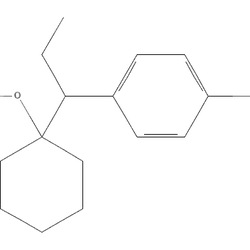
Venlafaxine Stats & Data
COc1ccc(cc1)C(CN(C)C)C1(O)CCCCC1PNVNVHUZROJLTJ-UHFFFAOYSA-NPharmacology
DrugBankDescription
Venlafaxine (Effexor) is an antidepressant within the serotonin-norepinephrine reuptake inhibitor (SNRI) class of medications. It exerts its effects primarily by blocking the transporters involved in the reuptake of the neurotransmitters serotonin and norepinephrine, therefore leaving more active neurotransmitter in the synapse. Venlafaxine is officially approved for use in the management of major depressive disorder (MDD), generalized anxiety disorder (GAD), social anxiety disorder, and panic disorder. As of 2014, Canadian clinical practice guidelines recommend venlafaxine as a first-line option for treatment of generalized anxiety, social anxiety, panic disorder, major depressive disorder (MDD), and consider it a second-line option for management of obsessive-compulsive disorder (OCD) . Venlafaxine is also used off-label for prophylaxis of migraine headaches , for reduction of vasomotor symptoms associated with menopause , and for management of neuropathic pain (although there is only minimal evidence of efficacy for this condition) .
Mechanism of Action
The exact mechanism of action of venlafaxine is unknown, but appears to be associated with the potentiation of neurotransmitter activity in the CNS. Venlafaxine and its active metabolite, O-desmethylvenlafaxine (ODV), inhibit the reuptake of both serotonin and norepinephrine with a potency greater for the 5-HT than for the NE reuptake process . Both venlafaxine and the ODV metabolite have weak inhibitory effects on the reuptake of dopamine but, unlike the tricyclics and similar to SSRIs, they are not active at histaminergic, muscarinic, or alpha(1)-adrenergic receptors.
Pharmacodynamics
The mechanism of venlafaxine's (and its metabolite, O-desmethylvenlafaxine (ODV)) antidepressant effect is believed to be due to their potentiation of neurotransmitter activity in the central nervous system through the inhibition of the reuptake of serotonin and norepinephrine from within the synapse. Venlafaxine has also been shown to weakly inhibit dopamine reuptake. Neither venlafaxine nor ODV bind to muscarinic, histaminergic, or alpha-1 adrenergic receptors; pharmacologic activity at these receptors is hypothesized to be associated with the various anticholinergic, sedative, and cardiovascular effects seen with other psychotropic drugs. Hyponatremia has also been shown to occur as a result of treatment with SNRIs, and is associated with the development of the syndrome of inappropriate antidiuretic hormone secretion (SIADH) FDA Label, A177244. Venlafaxine also demonstrates a clinically significant and dose-related effect on blood pressure, likely due to its potentiation of norepinephrine FDA Label, A177250.
Metabolism
Undergoes extensive first pass metabolism in the liver to its major, active metabolite, O-desmethylvenlafaxine ODV, and two minor, less active metabolites, N-desmethylvenlafaxine and N,O-didesmethylvenlafaxine. Formation of ODV is catalyzed by cytochrome P450 (CYP) 2D6, whereas N-demethylation is catalyzed by CYP3A4, 2C19 and 2C9. ODV possesses antidepressant activity that is comparable to that of venlfaxine.
Absorption
Venlafaxine is well absorbed, with at least 92% of a single dose absorbed on the basis of mass balance studies . Food does not affect the absorption of venlafaxine or its subsequent metabolism into ODV. Bioavailability is 45% following oral administration. Time to steady state = 3 days.
Indication
Venlafaxine is indicated in the management of major depressive disorder (MDD), generalized anxiety disorder (GAD), social anxiety disorder (social phobia), and panic disorder with or without agoraphobia. Venlafaxine is also used off-label for prophylaxis of migraine headaches , for reduction of vasomotor symptoms associated with menopause , and for management of neuropathic pain (although there is only minimal evidence of efficacy for this condition) . It is also considered a second-line option for management of obsessive-compulsive disorder (OCD) .
Protein Binding
The degree of binding of venlafaxine to human plasma is 27% ± 2% at concentrations ranging from 2.5 to 2215 ng/mL. The degree of ODV binding to human plasma is 30% ± 12% at concentrations ranging from 100 to 500 ng/mL. Protein-binding-induced drug interactions with venlafaxine are not expected.
Elimination
Renal elimination of venlafaxine and its metabolites is the primary route of excretion. Approximately 87% of a venlafaxine dose is recovered in the urine within 48 hours as either unchanged venlafaxine (5%), unconjugated ODV (29%), conjugated ODV (26%), or other minor inactive metabolites (27%).
Volume of Distribution
* 7.5 ± 3.7 L/kg venlafaxine * 5.7 ± 1.8 L/kg O-desmethylvenlafaxine(active metabolite)
Clearance
Steady state plasma clearance, venlafaxine = 1.3 ± 0.6 L/h/kg; Steady state plasma clearance, ODV = 0.4 ± 0.2 L/h/kg.
Measured Affinities
Guide to PHARMACOLOGYMeasured binding and functional data for venlafaxine, curated by the IUPHAR/BPS Guide to PHARMACOLOGY. Each row cites the paper it came from. Lower concentrations mean tighter binding — a value in the sub-nanomolar range indicates a very potent interaction.
| Target | Action | Measure | Value | Concentration | Species | Source |
|---|---|---|---|---|---|---|
| SERT SLC6A4 | Inhibition | pIC50 | 7.57 | 26.92 nM | Human | PMID 20378347 |
| NET SLC6A2 | Inhibition | pIC50 | 6.27 | 537.03 nM | Human | PMID 20378347 |
Reading this. pKi, pEC50 and pIC50 are negative log molar values, so a higher number means a tighter interaction; the concentration column converts them for you. Values from non-human species are laboratory measurements and do not translate directly to human effect. Receptor affinity is not a dose — it describes what a molecule binds, not how much of it is safe to take.
Receptor data from the IUPHAR/BPS Guide to PHARMACOLOGY (v2026.2), licensed CC BY-SA 4.0. Matched to this substance by InChIKey.
Signs and Symptoms of Overdose Symptoms of an overdose of venlafaxine can include tachycardia, unusual sleepiness, dilated pupils, seizures, vomiting, cardiac arrhythmias, hypotension, muscle aches or pains, or dizziness. Severe toxicity of venlafaxine, especially when combined with other antidepressants such as SSRI, SNRI, or MAOI, can lead to serotonin syndrome. Serotonin syndrome may present with a spectrum of clinical findings, including autonomic hyperactivity, mental status changes, and neuromuscular abnormalities. Serotonin syndrome characteristically presents with myoclonus, agitation, abdominal cramping, hyperpyrexia, hypertension, and potentially death.
Carcinogenicity
No indication of carcinogenicity to humans (not listed by IARC).
Liver injury risk
Low concern (rare serious cases reported)
Toxicity (DrugBank)
Overdose of venlafaxine is typically associated with mild symptoms. However, severe toxicity is reported with the most common symptoms being CNS depression, serotonin toxicity, seizure, or cardiac conduction abnormalities. Venlafaxine's toxicity appears to be higher than other SSRIs, with a fatal toxic dose closer to that of the tricyclic antidepressants than the SSRIs. Doses of 900 mg or more are likely to cause moderate toxicity. Deaths have been reported following large doses.
Tolerance & Pharmacokinetics
drugs.wikiTolerance Decay
Experience Report Analysis
ErowidDemographics
Gender Distribution
Age Distribution
Reports Over Time
Effect Analysis
ErowidEffects aggregated from 68 experience reports (68 single-substance Erowid)
Effect Sentiment Distribution
Confidence Distribution
Each bar is the share of reports mentioning the effect; its whisker, and the band on the rows below, is the 95% interval: where the share could plausibly be with other reports of the same kind.
Positive Effects 5
Adverse Effects 11
Show 5 neutral or unclassified mentions
Also reported in combinations. In the 87 Venlafaxine reports where another drug was taken too, 15 (17.2%) mention hospital, emergency services or an overdose, 11 (12.6%) a seizure and 2 (2.3%) psychosis. In the 68 single-substance reports: 14.7%, 2.9% and 7.4%. These are not in the figures above: they cannot be put down to Venlafaxine alone, and a mention is not always something that happened to the writer.
Dosage Distribution
Dose distribution from experience reports, one dose per report (the first listed). Doses above Q3 + 3×IQR, far above what people typically take, are left out of the median and range and listed under each route: most are real heavy doses or overdoses, not mistakes.
Real-World Dose Distribution
ErowidFrom 169 of 173 recorded dose entries: those that state a weight (mg, g or µg), in routes with at least five of them. Values above Q3 + 3×IQR, far above what people typically take, are left out; they can include real heavy doses and overdoses, not only mistakes.
Oral (n=169)
Common Combinations
Most co-occurring substances, as a share of all 155 reports filed under Venlafaxine; whiskers are 95% intervals
Form / Preparation
Most common forms and preparations, as a share of the 20 reports that give one; whiskers are 95% intervals
Body-Weight Dosing
Dose per kg of body weight, one dose per report (the first listed), from reports giving a weight of 30–250 kg. Doses above Q3 + 3×IQR, far above what people typically take, are left out of the median and range and listed under each route.
Redose Patterns
Redosing behavior across 143 reports