
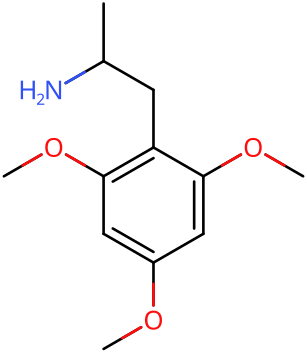
TMA-6 Stats & Data
CC(CC1=C(C=C(C=C1OC)OC)OC)NDDGNOUVDFKXADP-UHFFFAOYSA-NReceptor Profile
Receptor Actions
History & Culture
TMA-6 emerged from Alexander Shulgin's systematic exploration of trimethoxyamphetamines. After discovering that relocating a single methoxy group from the original TMA (3,4,5-trimethoxyamphetamine) to create TMA-2 resulted in a ten-fold increase in potency, Shulgin prioritized investigating all six possible arrangements of the three methoxy groups on the amphetamine scaffold. TMA-6, featuring the 2,4,6-trimethoxy pattern, was assigned its sequential name in 1970 alongside TMA-3, TMA-4, and TMA-5. The compound's precursor, phloroglucinol, occurs naturally in sources as diverse as coast redwood cones, tea plant leaves (Camellia species), citrus rinds, and Eucalyptus resins. Although the compound had been described in scientific literature as early as 1954, Shulgin discovered its psychedelic properties in 1964 and published the first account of its hallucinogenic effects in 1969, noting its potency relative to mescaline. He provided a more comprehensive description in his 1991 book PiHKAL (Phenethylamines I Have Known And Loved), where he characterized it as "one of the most rewarding and pleasurable of the methoxylated amphetamines." Prior to this publication, the compound had no documented history of human use outside Shulgin's research. Following PiHKAL's release, TMA-6 gained limited recognition within the psychedelics community and appeared as a novel designer drug in Europe in 2009, though it remains only sporadically available from clandestine sources.
Toxicity
PsychonautWikiThe toxicity and long-term health effects of recreational TMA-6 use do not seem to have been studied in any scientific context and the exact toxic dose is unknown. This is because TMA-6 has very little history of human usage. Anecdotal evidence from people within the psychonaut community who have tried TMA-6 suggests that there are no negative health effects attributed to simply trying the drug by itself at low to moderate doses and using it very sparingly (but nothing can be completely guaranteed). Independent research should always be done to ensure that a combination of two or more substances is safe before consumption.
Effect Profile
Curated + 4 ReportsLow headspace and visuals with moderate body load
Mild stimulation with strong anxiety/jitters, low euphoria and focus
Tolerance & Pharmacokinetics
drugs.wikiTolerance Decay
Experience Report Analysis
ErowidDemographics
Gender Distribution
Too few reports for a chart: gender is known from 7 reports, and a split is drawn only from 20 reports or more. Counts are shown instead. Why 20?
- Male 7 of 7
Age Distribution
Reports Over Time
Effect Analysis
ErowidEffects aggregated from 4 experience reports (4 single-substance Erowid)
Effect Sentiment Distribution
Confidence Distribution
Each bar is the share of reports mentioning the effect; its whisker, and the band on the rows below, is the 95% interval: where the share could plausibly be with other reports of the same kind.
Too few reports for bars: these effects come from 4 single-substance Erowid reports, and a bar is drawn only from 20 reports or more. With fewer, a percentage cannot tell a common effect from a rare one. Counts are shown instead. Why 20?
Positive Effects 2
Adverse Effects 0
Real-World Dose Distribution
ErowidFrom 5 of 9 recorded dose entries: those that state a weight (mg, g or µg), in routes with at least five of them. Values above Q3 + 3×IQR, far above what people typically take, are left out; they can include real heavy doses and overdoses, not only mistakes.
Oral (n=5)
Form / Preparation
Most common forms and preparations, as a share of the 4 reports that give one
Too few reports for bars: these forms come from 4 reports, and a bar is drawn only from 20 reports or more. With fewer, a percentage cannot tell a common effect from a rare one. Counts are shown instead. Why 20?
- Powder / Crystals 3 of 4
Legal Status
| Country | Status | Notes |
|---|---|---|
| Germany | NpSG (Controlled) | Controlled under the Neue-psychoaktive-Stoffe-Gesetz (New Psychoactive Substances Act) since November 26, 2016. Production and import with intent to distribute, administration to others, and trading are criminally punishable offenses. Possession is prohibited but does not carry criminal penalties. |
| Switzerland | Potentially illegal (analog provision) | Not explicitly scheduled by name. However, it may be considered an ether analog of PMA, which could render it controlled under Buchstabe C of the Swiss controlled substances regulations. |
| Turkey | Illegal | Classified as a controlled drug under national legislation. Possession, production, supply, and importation are all prohibited. |