
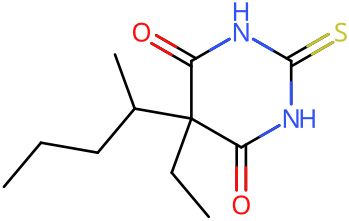
Thiopental Stats & Data
CCCC(C)C1(C(=O)NC(=S)NC1=O)CCIUJDSEJGGMCXSG-UHFFFAOYSA-NPharmacology
DrugBankDescription
A barbiturate that is administered intravenously for the induction of general anesthesia or for the production of complete anesthesia of short duration. It is also used for hypnosis and for the control of convulsive states. It has been used in neurosurgical patients to reduce increased intracranial pressure. It does not produce any excitation but has poor analgesic and muscle relaxant properties. Small doses have been shown to be anti-analgesic and lower the pain threshold. (From Martindale, The Extra Pharmacopoeia, 30th ed, p920)
Mechanism of Action
Thiopental binds at a distinct binding site associated with a Cl- ionopore at the GABAA receptor, increasing the duration of time for which the Cl- ionopore is open. The post-synaptic inhibitory effect of GABA in the thalamus is, therefore, prolonged.
Pharmacodynamics
Thiopental, a barbiturate, is used for the induction of anesthesia prior to the use of other general anesthetic agents and for induction of anesthesia for short surgical, diagnostic, or therapeutic procedures associated with minimal painful stimuli. Thiopental is an ultrashort-acting depressant of the central nervous system which induces hypnosis and anesthesia, but not analgesia. It produces hypnosis within 30 to 40 seconds of intravenous injection. Recovery after a small dose is rapid, with some somnolence and retrograde amnesia. Repeated intravenous doses lead to prolonged anesthesia because fatty tissues act as a reservoir; they accumulate Pentothal in concentrations 6 to 12 times greater than the plasma concentration, and then release the drug slowly to cause prolonged anesthesia
Metabolism
Thiopental is extensively metabolized, primarily in the liver, resulting in only 0.3% of an administered dose being excreted unchanged in the urine. Ring desulfuration leads to the generation of an active metabolite, pentobarbital, that exists in concentrations approximately 3-10% that of the parent concentration. Thiopental and pentobarbital are also subject to both oxidation and hydroxylation to carboxylic acids and alcohols, respectively, all of which are pharmacologically inert. While many of the specifics regarding thiopental biotransformation have not been elucidated, including the enzymes responsible, the oxidation of thiopental to its carboxylic acid may be the major driver of thiopental detoxification as this product appears to account for 10-25% of renally excreted drug.
Indication
For use as the sole anesthetic agent for brief (15 minute) procedures, for induction of anesthesia prior to administration of other anesthetic agents, to supplement regional anesthesia, to provide hypnosis during balanced anesthesia with other agents for analgesia or muscle relaxation, for the control of convulsive states during or following inhalation anesthesia or local anesthesia, in neurosurgical patients with increased intracranial pressure, and for narcoanalysis and narcosynthesis in psychiatric disorders.
Protein Binding
Approximately 80% of the drug in the blood is bound to plasma protein.
Receptor Profile
Receptor Actions
Receptor Binding
Measured Affinities
Guide to PHARMACOLOGYMeasured binding and functional data for thiopental, curated by the IUPHAR/BPS Guide to PHARMACOLOGY. Each row cites the paper it came from. Lower concentrations mean tighter binding — a value in the sub-nanomolar range indicates a very potent interaction.
| Target | Action | Measure | Value | Concentration | Species | Source |
|---|---|---|---|---|---|---|
| Kv3.4 Kcnc4 | Gating inhibitor | pIC50 | 4 | 100,000 nM | Rat | PMID 16217144 |
Reading this. pKi, pEC50 and pIC50 are negative log molar values, so a higher number means a tighter interaction; the concentration column converts them for you. Values from non-human species are laboratory measurements and do not translate directly to human effect. Receptor affinity is not a dose — it describes what a molecule binds, not how much of it is safe to take.
Receptor data from the IUPHAR/BPS Guide to PHARMACOLOGY (v2026.2), licensed CC BY-SA 4.0. Matched to this substance by InChIKey.
History & Culture
1930–1934
Sodium thiopental was discovered in the early 1930s by Ernest H. Volwiler and Donalee L. Tabern while working for Abbott Laboratories. The compound was first administered to human beings on March 8, 1934, by Dr. Ralph M. Waters, who investigated its properties and found it produced short-term anesthesia with surprisingly little analgesia. Three months after this initial human trial, Dr. John S. Lundy initiated a clinical trial of thiopental at the Mayo Clinic at Abbott's request. Abbott Laboratories continued manufacturing the drug until 2004, when it transferred production to Hospira as part of a spin-off of its hospital-products division. The substance has since been recognized as a therapeutic alternative on the World Health Organization's List of Essential Medicines.
1941–present
Thiopental became notoriously associated with a series of anesthetic deaths among victims of the attack on Pearl Harbor. These fatalities, occurring relatively soon after the drug's clinical introduction, were attributed to excessive doses administered to trauma patients in shock. This incident highlighted the importance of careful dosing considerations, particularly in patients with compromised cardiovascular function.
Thiopental has been employed therapeutically in psychiatry for narcoanalysis and narcosynthesis procedures. Psychiatrists have utilized the drug to desensitize patients suffering from phobias and to facilitate the recall of painful repressed memories. Dutch psychiatrist Jan Bastiaans notably employed thiopental-assisted therapy to help relieve trauma in surviving victims of the Holocaust. In the 1960s, Hungarian-Australian psychiatrist Imre Zádor began incorporating thiopental into psychoanalytic therapy settings in a manner somewhat analogous to psycholytic psychotherapy. Zádor administered the drug to reduce transferential resistance in patients with anorexia nervosa and to resolve unconscious blockages in other clinical cases.
Sodium thiopental achieved widespread recognition in popular culture under the name "sodium pentothal" as a purported "truth serum," though its actual efficacy in this role remains scientifically questioned. The compound continues to be used in some contexts as an interrogation aid intended to weaken a subject's resolve and increase compliance with questioning. The theoretical basis for this application rests on the observation that barbiturates decrease both higher cortical brain function and inhibition. Since lying is considered a more cognitively demanding process than telling the truth, suppression of higher cortical functions may theoretically facilitate the disclosure of accurate information.
2009–2011
Thiopental, along with pancuronium bromide and potassium chloride, was employed in 34 US states as part of a three-drug protocol for executing prisoners by lethal injection. In December 2009, Ohio became the first state to utilize a single dose of sodium thiopental for an execution when Kenneth Biros was put to death, following difficulties with the standard three-drug cocktail during a prior execution due to inability to locate suitable veins. Washington subsequently became the second state to adopt single-dose thiopental injections, with the September 2010 execution of Cal Coburn Brown being the first in that state to use this method. Following its use in the execution of Jeffrey Landrigan, the United Kingdom introduced a ban on the export of sodium thiopental in December 2010 after confirming that no European supplies to the United States were being used for purposes other than capital punishment. On December 21, 2011, the European Union extended trade restrictions to prevent the export of certain medicinal products for use in capital punishment, with the Union formally stating its disapproval of capital punishment in all circumstances and its commitment to working toward universal abolition. The US division of Hospira objected to the drug's use in executions and ceased manufacturing in 2011. In contrast to its controversial use in capital punishment, sodium thiopental is employed intravenously for voluntary euthanasia in jurisdictions where the practice is legal. In both Belgium and the Netherlands, the standard euthanasia protocol recommends sodium thiopental as the ideal agent to induce coma, followed by pancuronium bromide to paralyze muscles and cease respiration.
Thiopental binds at a distinct binding site associated with a Cl<sup>-</sup> ionopore at the GABA<sub>A</sub> receptor, increasing the duration of time for which the Cl<sup>-</sup> ionopore is open. The post-synaptic inhibitory effect of GABA in the thalamus is, therefore, prolonged.
LD50
LD50: 50.6 mg kg −1(95% CI, 50.0–54.9) (i.v, mice) (A2858)
Carcinogenicity
No indication of carcinogenicity to humans (not listed by IARC).
Health effects (PubChem excerpts)
They cause slurred speech, disorientation and "drunken" behavior. They are physically and psychologically addictive. May cause a potentially dangerous rash that may develop into Stevens Johnson syndrome, an extremely rare but potentially fatal skin disease.
Tolerance & Pharmacokinetics
drugs.wikiNo tolerance chart. Our decay curves for these drugs were estimates, and a curve can make tolerance look longer-lasting than it is, which is the dangerous direction.
How fast tolerance to these drugs fades after a break has not been measured well enough to draw, so don't count on a dose you used to take still being safe: after time off, start with a much smaller amount and don't use alone. Mixing sedatives with each other, with alcohol or with opioids sharply raises the risk of a fatal overdose. If you've been using regularly, don't stop suddenly: withdrawal from benzodiazepines, alcohol or GHB/GBL can cause seizures or delirium, so get medical help to cut down gradually. With barbiturates, you get used to the effects much more than to a dangerous dose, so the gap between a dose that works and one that kills shrinks the more you use. Stopping suddenly after regular use can cause convulsions and delirium.
Sources: FRANK: benzodiazepines · Alcohol and Drug Foundation: GHB · FDA 2020: benzodiazepine boxed warning · FDA 2019: gabapentinoids and breathing · NHS: alcohol use disorder · Phenobarbital label: drug abuse and dependence
Cross-Tolerances
Legal Status
| Country | Status | Notes |
|---|---|---|
| United States | Prescription medication (Withdrawn from market) | Previously FDA-approved as a prescription injectable anesthetic for intravenous administration. As a barbiturate, it is subject to controlled substance regulations. The injectable formulation was withdrawn from the US pharmaceutical market in January 2011. |
Harm Reduction
drugs.wiki• Profound respiratory depression and apnea are primary life‑threatening risks, especially when combined with other CNS depressants (alcohol, opioids, benzodiazepines); co‑use markedly lowers the dose needed to cause arrest. Use only where advanced airway management and continuous cardiorespiratory monitoring are available.
• Thiopental produces hypnosis without analgesia and can be anti‑analgesic at small doses, so it should never be relied upon for pain control; painful stimuli may provoke sympathetic responses unless adequate analgesia is provided by other agents.
• Effects after a single bolus end primarily via rapid redistribution from brain to muscle/fat; repeated boluses or infusions saturate peripheral compartments, leading to accumulation, prolonged sedation, and delayed respiratory depression.
• Extravasation risk: thiopental is a vesicant; infiltration can cause severe tissue necrosis. If infiltration is suspected, stop administration and follow institutional extravasation protocols (specialist management may include hyaluronidase or phentolamine). Avoid small/fragile veins.
• Histamine release (notable with thiopental and thiamylal) can precipitate hypotension and bronchospasm; exercise caution in reactive airway disease, hypovolemia, or hemodynamic instability.
• Absolute/major contraindications for barbiturates include acute intermittent/variegate porphyria, where barbiturates induce ALA‑synthase and can trigger life‑threatening attacks.
• Pregnancy/obstetrics: thiopental crosses the placenta within about 1 minute and can cause neonatal respiratory depression when used near delivery; if used, neonatal resuscitation capability is required.
• Lactation: after a single anesthetic dose, clinically significant exposure via breast milk is low; routine breastfeeding can usually resume when the mother is awake, alert, and neurologically recovered, per anesthetic lactation resources. Individualize based on procedure and co‑medications.
• Renal disease is a relative contraindication for thiopental; avoid or use extreme caution due to altered distribution/clearance. Hepatic impairment also increases risk because barbiturates undergo hepatic metabolism. Dose requirements are reduced in older adults.
• Because dosing is weight‑based (commonly ~3–5 mg/kg IV for induction) and cardiorespiratory depression is dose‑dependent, fixed‑milligram self‑administration is unsafe; any use must be by trained clinicians with airway equipment immediately available.
• Do not drive or operate machinery for the remainder of the day after exposure; psychomotor impairment can persist for hours, longer if multiple doses or other depressants are involved.
References
Cited References
Additional references
- DrugBank: Thiopental (DB00599)
- DrugBank: Thiopental Biointeractions
- StatPearls: Barbiturates (NCBI Bookshelf)
- StatPearls: Barbiturate Toxicity (NCBI Bookshelf)
- NCBI MeSH: Thiopental (synonyms)
- LactMed: Thiopental (NCBI Bookshelf)
- Erowid: Types of Barbiturates (classification reference)
- TripSit: Drug combinations (general CNS depressant interaction matrix)