
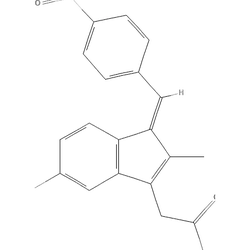
Sulindac Stats & Data
MLKXDPUZXIRXEP-MFOYZWKCSA-NPharmacology
DrugBankDescription
Sulindac is a nonsteroidal anti-inflammatory drug (NSAID) of the arylalkanoic acid class that is marketed by Merck under the brand name Clinoril. Like other NSAIDs, it may be used in the treatment of acute or chronic inflammatory conditions. Sulindac is a prodrug, derived from sulfinylindene, that is converted _in vivo_ to an active sulfide compound by liver enzymes. There is evidence from some studies that sulindac may be associated with fewer gastrointestinal side effects than other NSAIDs, except for the cyclooxygenase-2 (COX-2) inhibitor drug class. This may be due to the sulfide metabolite undergoing enterohepatic circulation thus maintaining constant blood levels of the compound without inducing gastrointestinal effects, where the drug is excreted in the bile and then reabsorbed from the intestines. While its full mechanism of action is not fully understood, sulindac is thought to primarily mediate its action by inhibiting prostaglandin synthesis by inhibiting COX-1 and COX-2.
Mechanism of Action
Sulindac's exact mechanism of action is unknown. Its antiinflammatory effects are believed to be due to inhibition of both COX-1 and COX-2 which leads to the inhibition of prostaglandin synthesis. Antipyretic effects may be due to action on the hypothalamus, resulting in an increased peripheral blood flow, vasodilation, and subsequent heat dissipation.
Pharmacodynamics
Sulindac is a non-steroidal anti-inflammatory indene derivative, also possessing analgesic and antipyretic activities.
Metabolism
Undergoes two major biotransformations: reversible reduction to the sulfide metabolite, and irreversible oxidation to the sulfone metabolite. Sulindac and its sulfide and sulfone metabolites undergo extensive enterohepatic circulation. Available evidence indicates that the biological activity resides with the sulfide metabolite. Side chain hydroxylation and hydration of the double bond also occur.
Absorption
Approximately 90% absorbed in humans following oral administration.
Indication
For acute or long-term use in the relief of signs and symptoms of osteoarthritis, rheumatoid arthritis, ankylosing spondylitis, acute painful shoulder (acute subacromial bursitis/supraspinatus tendinitis), and acute gouty arthritis.
Half-life
The mean half-life of sulindac is 7.8 hours while the mean half-life of the sulfide metabolite is 16.4 hours.
Protein Binding
At 1 mcg/ml concentrations, approximately 93% sulindac and 98% of its sulfide metabolite are bound to human serum albumin.
Elimination
Sulindac is excreted in rat milk; concentrations in milk were 10 to 20% of those levels in plasma. It is not known if sulindac is excreted in human milk. Approximately 50% of the administered dose of sulindac is excreted in the urine with the conjugated sulfone metabolite accounting for the major portion. Hepatic metabolism is an important elimination pathway.
Measured Affinities
Guide to PHARMACOLOGYMeasured binding and functional data for sulindac, curated by the IUPHAR/BPS Guide to PHARMACOLOGY. Each row cites the paper it came from. Lower concentrations mean tighter binding — a value in the sub-nanomolar range indicates a very potent interaction.
| Target | Action | Measure | Value | Concentration | Species | Source |
|---|---|---|---|---|---|---|
| COX-1 PTGS1 | Inhibition | pIC50 | 5.92 | 1,202 nM | Human | PMID 20541701 |
| COX-2 PTGS2 | Inhibition | pIC50 | 5.47 | 3,388 nM | Human | PMID 20541701 |
| Retinoid X receptor-α RXRA | Antagonist | pIC50 | 4.1 | 79,433 nM | Human | PMID 20541701 |
Reading this. pKi, pEC50 and pIC50 are negative log molar values, so a higher number means a tighter interaction; the concentration column converts them for you. Values from non-human species are laboratory measurements and do not translate directly to human effect. Receptor affinity is not a dose — it describes what a molecule binds, not how much of it is safe to take.
Receptor data from the IUPHAR/BPS Guide to PHARMACOLOGY (v2026.2), licensed CC BY-SA 4.0. Matched to this substance by InChIKey.
Signs and Symptoms of Overdose Sulindac toxicity is rare; few cases are reported in the literature. Though sulindac is an NSAID, the toxicity does not present similarly to salicylate (aspirin) toxicity with metabolic acidosis, respiratory alkalosis, and tinnitus. Management of Overdose
Liver injury risk
High concern (frequent serious cases reported)
Toxicity (DrugBank)
Acute oral toxicity (LD50) in rats is 264 mg/kg. Cases of overdose have been reported and rarely, deaths have occurred. The following signs and symptoms may be observed following overdose: stupor, coma, diminished urine output and hypotension.