
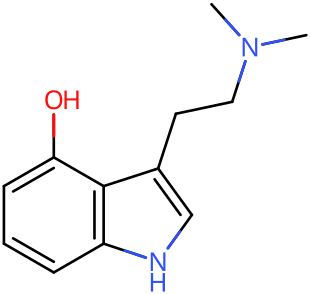
Psilocin Stats & Data
SPCIYGNTAMCTRO-UHFFFAOYSA-NPharmacology
DrugBankMetabolism
Psilocin has known human metabolites that include (2S,3S,4S,5R)-6-[3-[2-(dimethylamino)ethyl-1H-indol-4-yl]oxy]-3,4,5-trihydroxyoxane-2-carboxylic acid.
Receptor Profile
Receptor Actions
Measured Affinities
Guide to PHARMACOLOGYMeasured binding and functional data for psilocin, curated by the IUPHAR/BPS Guide to PHARMACOLOGY. Each row cites the paper it came from. Lower concentrations mean tighter binding — a value in the sub-nanomolar range indicates a very potent interaction.
| Target | Action | Measure | Value | Concentration | Species | Source |
|---|---|---|---|---|---|---|
| 5-HT2A receptor HTR2A | Agonist | pEC50 | 7.62 | 23.99 nM | Human | PMID 16061378 |
Reading this. pKi, pEC50 and pIC50 are negative log molar values, so a higher number means a tighter interaction; the concentration column converts them for you. Values from non-human species are laboratory measurements and do not translate directly to human effect. Receptor affinity is not a dose — it describes what a molecule binds, not how much of it is safe to take.
Receptor data from the IUPHAR/BPS Guide to PHARMACOLOGY (v2026.2), licensed CC BY-SA 4.0. Matched to this substance by InChIKey.
Subjective Effects
Physical
- Spontaneous tactile sensations: The "body high" of psilocin can be described as a pleasurable, warm, soft and all-encompassing tingling sensation. This maintains a consistent presence that steadily rises with the onset and hits its limit once the peak has been reached.
- Sedation: In terms of its effects on the physical energy levels of the tripper, psilocin is considered by most to be relaxing, stoning and mildly sedating. This sense of sedation is often accompanied by compulsive yawning.
- Runny nose
- Excessive yawning
- Watery eyes
- Nausea
- Changes in gravity
- Salivation
- Pupil dilation
Cognitive
- Current mind state enhancement
- Thought connectivity
- Novelty enhancement
- Time distortion
- Analysis enhancement: This effect is consistent in its manifestation and outrospection dominant.
- Déjà vu
- Personal bias suppression
- Feelings of predeterminism
- Immersion enhancement
- Conceptual thinking
- Direct communication with the subconscious
- Memory suppression
- Feelings of interdependent opposites
- Delusions
- Unity and interconnectedness
- Feelings of self-design
- Exposure to inner mechanics of consciousness
- Spirituality enhancement
- Enhancement and suppression cycles: This can be described as constant waves of extremely stimulated and profound thinking which are spontaneously surpassed in a cyclic fashion by waves of general thought suppression and mental intoxication. These two states seem to switch between each other in a consistent loop once every 20 - 60 minutes.
Sensory
- Enhancements
- Distortions
- Hallucinations
As for visual distortions and alterations, the effects experienced are detailed below:
- Drifting: (Melting, Flowing, Breathing and morphing) - In comparison to other psychedelics, this effect can be described as highly detailed, realistic, slow and smooth in motion and static in appearance.
- Tracers
- After images
- Symmetrical texture repetition
- Colour shifting
- Scenery slicing
Psilocin presents a full and complete array of possible visual enhancements which generally includes:
- Visual acuity enhancement
- Colour enhancement
- Pattern recognition enhancement
Psilocin and its various other forms produce a full range of high level hallucinatory states in a fashion that is more consistent and reproducible than that of many other commonly used psychedelics. These effects generally include:
- Transformations
- Internal hallucinations: (Autonomous entities, Settings, sceneries, and landscapes, Alterations in perspective and Scenarios and plots) - This effect is very consistent in dark environments at appropriately high dosages. They can be comprehensively described through their variations as lucid in believability, interactive in style, new experiences in content, autonomous in controllability, geometry-based in style and almost exclusively of a religious, spiritual, mystical, science fiction or transcendental nature in their overall theme.
Forked from Subjective Effect Documentation work by Josie Kins, April 2015. Via dose.wiki (CC0).
Psilocin is non-addictive, is not known to cause brain damage, and has an extremely low toxicity relative to dose. Similar to other psychedelic drugs, there are relatively few physical side effects associated with acute psilocin exposure. Various studies have shown that in reasonable doses in a careful context, it presents little to no negative cognitive, psychiatric or toxic physical consequences.
Carcinogenicity
No indication of carcinogenicity to humans (not listed by IARC).
Effect Profile
Curated + 6 ReportsModerate visuals with mild headspace and body load, low auditory effects
Strong sensory enhancement with moderate euphoria, low empathy and stimulation
Duration Timeline
BluelightTolerance & Pharmacokinetics
drugs.wikiTolerance Decay
Cross-Tolerances
Experience Report Analysis
ErowidDemographics
Gender Distribution
Too few reports for a chart: gender is known from 12 reports, and a split is drawn only from 20 reports or more. Counts are shown instead. Why 20?
- Male 12 of 12
Age Distribution
Reports Over Time
Effect Analysis
ErowidEffects aggregated from 6 experience reports (6 single-substance Erowid)
Effect Sentiment Distribution
Confidence Distribution
Each bar is the share of reports mentioning the effect; its whisker, and the band on the rows below, is the 95% interval: where the share could plausibly be with other reports of the same kind.
Too few reports for bars: these effects come from 6 single-substance Erowid reports, and a bar is drawn only from 20 reports or more. With fewer, a percentage cannot tell a common effect from a rare one. Counts are shown instead. Why 20?
Positive Effects 8
Adverse Effects 2
Show 1 neutral or unclassified mention
Also reported in combinations. In the 6 Psilocin reports where another drug was taken too, 1 mentions hospital, emergency services or an overdose, 0 a seizure and 1 psychosis (too few reports for percentages). In the 6 single-substance reports: 0, 0 and 1. These are not in the figures above: they cannot be put down to Psilocin alone, and a mention is not always something that happened to the writer.
Real-World Dose Distribution
ErowidFrom 13 of 20 recorded dose entries: those that state a weight (mg, g or µg), in routes with at least five of them. Values above Q3 + 3×IQR, far above what people typically take, are left out; they can include real heavy doses and overdoses, not only mistakes.
Oral (n=13)
Form / Preparation
Most common forms and preparations, as a share of the 8 reports that give one
Too few reports for bars: these forms come from 8 reports, and a bar is drawn only from 20 reports or more. With fewer, a percentage cannot tell a common effect from a rare one. Counts are shown instead. Why 20?
- Liquid 3 of 8
- Powder / Crystals 3 of 8
- Capsule 2 of 8
Legal Status
| Country | Status | Notes |
|---|---|---|
| Australia | Psilocin is considered a Schedule 9 prohibited substance in Australia under the Poisons Standard (October 2015). | A Schedule 9 substance is a substance which may be abused or misused, the manufacture, possession, sale or use of which should be prohibited by law except when required for medical or scientific research, or for analytical, teaching or training purposes with approval of Commonwealth and/or State or Territory Health Authorities. |
| Russia | Psilocin and psilocybin are banned in Russia, due to their status as narcotic drugs, with a criminal penalty for possession of more than 50 mg. | |
| United States | Psilocin is a Schedule I controlled substance in the United States since 1971. |
References
Cited References
- Bluelight: The Big and Dandy 4-HO-DMT Thread
- Drug-drug interactions between psychiatric medications and MDMA or psilocybin
- Drug-drug interactions involving classic psychedelics: A systematic review
- Erowid: Psilocin Experience Reports
- PsychonautWiki: Psilocin
- TiHKAL #18: 4-HO-DMT by Alexander Shulgin