
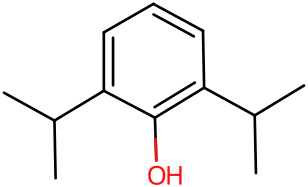
Propofol Stats & Data
CC(C)c1cccc(C(C)C)c1OOLBCVFGFOZPWHH-UHFFFAOYSA-NPharmacology
DrugBankDescription
Propofol is an intravenous anaesthetic agent used for induction and maintenance of general anaesthesia. IV administration of propfol is used to induce unconsciousness after which anaesthesia may be maintained using a combination of medications. Recovery from propofol-induced anaesthesia is generally rapid and associated with less frequent side effects (e.g. drowsiness, nausea, vomiting) than with thiopental, methohexital, and etomidate. Propofol may be used prior to diagnostic procedures requiring anaesthesia, in the management of refractory status epilepticus, and for induction and/or maintenance of anaesthesia prior to and during surgeries.
Mechanism of Action
The action of propofol involves a positive modulation of the inhibitory function of the neurotransmitter gama-aminobutyric acid (GABA) through GABA-A receptors.
Pharmacodynamics
Propofol is a sedative-hypnotic agent for use in the induction and maintenance of anesthesia or sedation. Intravenous injection of a therapeutic dose of propofol produces hypnosis rapidly with minimal excitation, usually within 40 seconds from the start of an injection (the time for one arm-brain circulation).
Metabolism
Hepatically metabolized mainly by glucuronidation at the C1-hydroxyl. Hydroxylation of the benzene ring to 4-hydroxypropofol may also occur via CYP2B6 and 2C9 with subsequent conjugation to sulfuric and/or glucuronic acid. Hydroxypropofol has approximately 1/3 of hypnotic activity of propofol.
Absorption
Rapid - time to onset of unconsciousness is 15-30 seconds, due to rapid distribution from plasma to the CNS. Distribution is so rapid that peak plasma concentrations cannot be readily measured. Duration of action is 5-10 minutes.
Indication
Used for induction and/or maintenance of anaesthesia and for management of refractory status epilepticus.
Half-life
Initial distribution phase t1/2α=1.8-9.5 minutes. Second redistirubtion phase t1/2β=21-70 minutes. Terminal elimination phase t1/2γ=1.5-31 hours.
Protein Binding
95 to 99%, primarily to serum albumin and hemoglobin
Elimination
It is chiefly eliminated by hepatic conjugation to inactive metabolites which are excreted by the kidney.
Measured Affinities
Guide to PHARMACOLOGYMeasured binding and functional data for propofol, curated by the IUPHAR/BPS Guide to PHARMACOLOGY. Each row cites the paper it came from. Lower concentrations mean tighter binding — a value in the sub-nanomolar range indicates a very potent interaction.
| Target | Action | Measure | Value | Concentration | Species | Source |
|---|---|---|---|---|---|---|
| HCN1 Hcn1 | Channel blocker | pIC50 | 5.2 | 6,310 nM | Mouse | — |
| TRPV4 TRPV4 | Inhibition | pIC50 | 4.41 | 38,905 nM | Human | PMID 31636563 |
| Piezo1 PIEZO1 | Inhibition | - | — | — | Human | PMID 40485107 |
| Piezo2 PIEZO2 | Inhibition | - | — | — | Human | PMID 40485107 |
Reading this. pKi, pEC50 and pIC50 are negative log molar values, so a higher number means a tighter interaction; the concentration column converts them for you. Values from non-human species are laboratory measurements and do not translate directly to human effect. Receptor affinity is not a dose — it describes what a molecule binds, not how much of it is safe to take.
Receptor data from the IUPHAR/BPS Guide to PHARMACOLOGY (v2026.2), licensed CC BY-SA 4.0. Matched to this substance by InChIKey.
Propofol Infusion Syndrome (PRIS): This is a rare but serious side effect of prolonged infusion of propofol (usually > 4mg/kg/hour for more than 24 hours). The syndrome presents as metabolic acidosis, hyperkalemia, hyperlipidemia, and rhabdomyolysis and may proceed to renal and cardiac failure and, ultimately, death. It is thought to occur due to alterations in mitochondrial metabolism and electron transport chain function, but the exact mechanism of PRIS is still unknown. The onset of PRIS usually occurs within four days of the initial propofol treatment. PRIS is a diagnosis of exclusion. Management of PRIS is the discontinuation of propofol infusion and supportive treatment.
Carcinogenicity
No indication of carcinogenicity to humans (not listed by IARC).
Liver injury risk
Low concern (rare serious cases reported)
Toxicity (DrugBank)
Overdosage may increase pharmacologic and adverse effects or cause death. <p>IV LD50=53 mg/kg (mice), 42 mg/kg (rats). Oral LD50 (as a solution in soybean oil)=1230 mg/kg (mice), 600 mg/kg (rats)</p>
Health effects (PubChem excerpts)
Mild myoclonic movements are common, as with other intravenous hypnotic agents. Another recently described rare, but serious, side effect is propofol infusion syndrome. This potentially lethal metabolic derangement has been reported in critically-ill patients after a prolonged infusion of high-dose propofol in combination with catecholamines and/or corticosteroids. Overdose of these agents is likely to cause cardiorespiratory depression. (L1002, L1160) They cause slurred speech, disorientation and "drunken" behavior. They are physically and psychologically addictive. May cause a potentially dangerous rash that may develop into Stevens Johnson syndrome, an extremely rare but potentially fatal skin disease.
Tolerance & Pharmacokinetics
drugs.wikiNo tolerance chart. Our decay curves for these drugs were estimates, and a curve can make tolerance look longer-lasting than it is, which is the dangerous direction.
How fast tolerance to these drugs fades after a break has not been measured well enough to draw, so don't count on a dose you used to take still being safe: after time off, start with a much smaller amount and don't use alone. Mixing sedatives with each other, with alcohol or with opioids sharply raises the risk of a fatal overdose. If you've been using regularly, don't stop suddenly: withdrawal from benzodiazepines, alcohol or GHB/GBL can cause seizures or delirium, so get medical help to cut down gradually.
Sources: FRANK: benzodiazepines · Alcohol and Drug Foundation: GHB · FDA 2020: benzodiazepine boxed warning · FDA 2019: gabapentinoids and breathing · NHS: alcohol use disorder
Experience Report Analysis
ErowidDemographics
Gender Distribution
Too few reports for a chart: gender is known from 16 reports, and a split is drawn only from 20 reports or more. Counts are shown instead. Why 20?
- Male 12 of 16
- Not Specified 3 of 16
- Female 1 of 16
Age Distribution
Reports Over Time
Effect Analysis
ErowidEffects aggregated from 11 experience reports (11 single-substance Erowid)
Effect Sentiment Distribution
Confidence Distribution
Each bar is the share of reports mentioning the effect; its whisker, and the band on the rows below, is the 95% interval: where the share could plausibly be with other reports of the same kind.
Too few reports for bars: these effects come from 11 single-substance Erowid reports, and a bar is drawn only from 20 reports or more. With fewer, a percentage cannot tell a common effect from a rare one. Counts are shown instead. Why 20?
Positive Effects 2
Adverse Effects 1
Show 1 neutral or unclassified mention
Also reported in combinations. In the 5 Propofol reports where another drug was taken too, 3 mention hospital, emergency services or an overdose, 0 a seizure and 0 psychosis (too few reports for percentages). In the 11 single-substance reports: 2, 0 and 0. These are not in the figures above: they cannot be put down to Propofol alone, and a mention is not always something that happened to the writer.
Real-World Dose Distribution
ErowidFrom 5 of 5 recorded dose entries: those that state a weight (mg, g or µg), in routes with at least five of them. Values above Q3 + 3×IQR, far above what people typically take, are left out; they can include real heavy doses and overdoses, not only mistakes.
Intravenous (n=5)
Form / Preparation
Most common forms and preparations, as a share of the 11 reports that give one
Too few reports for bars: these forms come from 11 reports, and a bar is drawn only from 20 reports or more. With fewer, a percentage cannot tell a common effect from a rare one. Counts are shown instead. Why 20?
- Liquid 11 of 11
Redose Patterns
Redosing behavior across 11 reports
Too few reports for a chart: redosing is known from 11 reports, and a split is drawn only from 20 reports or more. Counts are shown instead. Why 20?
- Single dose 11 of 11
- Redosed 0 of 11