
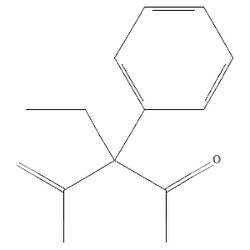
Primidone Stats & Data
DQMZLTXERSFNPB-UHFFFAOYSA-NPharmacology
DrugBankDescription
Primidone is an anticonvulsant used to treat essential tremor as well as grand mal, psychomotor, and focal epileptic seizures. Primidone was developed by J Yule Bogue and H C Carrington in 1949. Primidone was granted FDA Approval on 8 March 1954.
Mechanism of Action
Primidone and its metabolites, phenobarbital and phenylethylmalonamide (PEMA), are active anticonvulsants. Primidone does not directly interact with GABA-A receptors or chloride channels but phenobarbital does. Primidone alters transmembrane sodium and calcium channel transport, reducing the frequency of nerve firing, which may be responsible for the primidone’s effect on convulsions and essential tremor.
Pharmacodynamics
Primidone alters sodium and calcium channel transport, reducing the frequency of nerve firing, which may be responsible for its effect on convulsions and essential tremor. Primidone has a wide therapeutic window as doses of 50-1000mg/day were effective. Patients should be counselled regarding the risk of status epilepticus with abrupt cessation of primidone.
Metabolism
Primidone is metabolized to phenobarbitol and phenylethylmalonamide (PEMA). This metabolism is largely mediated by CYP2C9, CYP2C19, and CYP2E1.
Absorption
Oral primidone is up to 80% bioavailable with a Tmax if 2-4h. A 500mg oral dose of primidone Reaches a Cmax of 2.7±0.4µg/mL with a Tmax of 0.5-7h. Data regarding the AUC of primidone is not readily available.
Indication
Primidone is commonly indicated for the management of grand mal, psychomotor, and focal epileptic seizures. In addition, it has also been studied and utilized as an effective management of essential tremor.
Half-life
The half life of primidone is 7-22h in adults, 5-11h in children, and 8-80h in newborns.
Protein Binding
Primidone is 10.78-13.70% protein bound in serum.
Elimination
Primidone is 72.9-80.6% recovered in urine.
Volume of Distribution
The volume of distribution of primidone is 0.5-0.8L/kg.
Measured Affinities
Guide to PHARMACOLOGYMeasured binding and functional data for primidone, curated by the IUPHAR/BPS Guide to PHARMACOLOGY. Each row cites the paper it came from. Lower concentrations mean tighter binding — a value in the sub-nanomolar range indicates a very potent interaction.
| Target | Action | Measure | Value | Concentration | Species | Source |
|---|---|---|---|---|---|---|
| TRPM3 TRPM3 | Channel blocker | pIC50 | 6.2 | 630.96 nM | Human | PMID 28106668 |
Reading this. pKi, pEC50 and pIC50 are negative log molar values, so a higher number means a tighter interaction; the concentration column converts them for you. Values from non-human species are laboratory measurements and do not translate directly to human effect. Receptor affinity is not a dose — it describes what a molecule binds, not how much of it is safe to take.
Receptor data from the IUPHAR/BPS Guide to PHARMACOLOGY (v2026.2), licensed CC BY-SA 4.0. Matched to this substance by InChIKey.
Overdosage of primidone results in symptoms similar to those of acute barbiturate intoxication. In addition, primidone crystalluria may occur and may facilitate the diagnosis. Primidone toxicity has been studied in numerous animal species and was found to be exceptionally low. Toxic levels are >15 μg/mL. Moreover, several studies demonstrated that primidone could have significant toxicity, including:
Carcinogenicity
Group 2B: Possibly carcinogenic to humans
Liver injury risk
No documented concern
Toxicity (DrugBank)
The oral LD50 in rats is 1500mg/kg and in mice is 280mg/kg. The intraperitoneal LD50 in rats was 240mg/kg and in mice was 332mg/kg. Patients experiencing a primidone overdose may present with CNS depression, coma, respiratory depression, suppressed reflexes, suppressed response to pain, hypotension, and decreased urine output. Overdose should be treated with symptomatic and supportive treatment, including the removal of unabsorbed drug.