
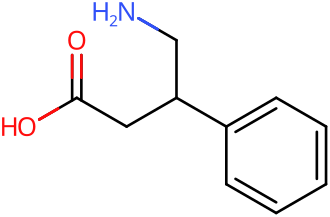
Phenibut Stats & Data
NCC(CC(=O)[O-])c1ccccc1.[H+]DAFOCGYVTAOKAJ-UHFFFAOYSA-NReceptor Profile
Receptor Actions
History & Culture
1960s–1974
Phenibut was synthesized during the 1960s at the Department of Organic Chemistry at the Al Gertsen Leningrad Pedagogical Institute under the supervision of Professor V. V. Perekalin. Following its development, the compound was researched for potential applications in treating various conditions including anxiety, depression, post-traumatic stress disorder, insomnia, and general weakness or asthenia. Early research indicated that while phenibut shared certain properties with traditional sedatives, it produced less impairment and fewer "narcotic-like" effects in animal studies. The compound was initially introduced under the brand name Citrocard during the late 1960s to early 1970s. On December 18, 1974, phenibut was officially added to the State Drug Register under Order No. 1126 by the USSR's Ministry of Public Health, establishing it as an approved neuropsychotropic medication.
1975–present
Phenibut gained notable recognition for its inclusion in Soviet space program protocols. According to Neumyvakin (1978), the substance was available to Russian cosmonauts during the Soyuz-19 mission in 1975. The compound has since been cited as a mandated component of cosmonaut medical kits, though the precise extent of its utilization throughout the broader Soviet and Russian space programs remains unclear.
2000s–present
While phenibut has maintained continuous pharmaceutical availability in Russia since its initial release, the substance has seen minimal expansion into medical settings beyond Russian borders and remains unapproved for clinical use in most other countries. However, beginning in the 2000s and accelerating through the 2010s, phenibut became widely accessible internationally through the nutritional supplement industry, marketed and sold without prescription in many regions where it lacks pharmaceutical approval.
Subjective Effects
In comparison to other commonly used GABAgenic depressants such as alcohol or benzodiazepines, this compound is significantly longer lasting, more euphoric and more recreational.
Physical
- Stimulation and Sedation: At lower doses, phenibut has a mild physical and mental stimulation effect, encouraging movement, wakefulness, and productivity. At higher doses, however, it becomes physically sedating, encouraging sleep and lethargy. Sleeping after dosing a small amount results in a deep, restful sleep which can leave the user feeling refreshed and alert upon waking.
- Respiratory depression
- Nausea: Phenibut can induce mild to extreme nausea depending greatly on dose and tolerance. It usually manifests roughly 5 hours after the initial dose and generally involves waves of nausea accompanied by excessive sweating and vomiting.
- Increased perspiration
- Motor control loss
- Stomach cramps
- Dizziness
- Dehydration: Dehydration is reported to occur from regular multi-day usage or overdoses.
- Headaches: Moderate to high doses can induce a mild headache many hours after dosing.
- Physical euphoria
- Muscle cramps: Muscle cramps and joint pain are sometimes accompanied at high doses.
- Difficulty urinating: This effect generally only occurs after frequent usage.
- Increased blood pressure
- Temperature regulation loss
- Appetite enhancement
Cognitive
- Empathy, love and sociability enhancement: Unlike alcohol which merely increases sociability through disinhibition, phenibut presents strong entactogenic effects which, although much weaker than that of traditional entactogens such as MDMA, are still prominent and well-defined even at light doses.
- Disinhibition
- Information processing suppression: High doses will usually induce a state of mild stupor and confusion.
- Thought deceleration
- Cognitive euphoria
- Motivation enhancement
- Anxiety suppression
- Depression: A low mood can be experienced as an after-effect of high or frequent dosing.
- Amnesia
Forked from Subjective Effect Documentation by Josie Kins, July 2016. Via dose.wiki (CC0).
Toxicity
PsychonautWikiPhenibut has a low toxicity relative to dose. However, it is potentially lethal when mixed with depressants like alcohol, benzodiazepines or opioids. Phenibut hydrochloride is highly caustic and in sensitive users can cause intestinal discomfort and diarrhea with some lower digestive tract bleeding. Due to the extremely long come up period relative to other substances, some users may experience an urge to redose out of the belief that it is weak or not working. This should be avoided to prevent overdose.
Addiction & dependence
Phenibut is moderately physically and psychologically addictive, although this usually only occurs with heavy abuse of the substance. Tolerance will develop to the sedative-hypnotic effects within a couple of days of continuous use.
Duration Timeline
BluelightCommunity Effects
TripSitTolerance & Pharmacokinetics
drugs.wikiNo tolerance chart. Our decay curves for these drugs were estimates, and a curve can make tolerance look longer-lasting than it is, which is the dangerous direction.
How fast tolerance to these drugs fades after a break has not been measured well enough to draw, so don't count on a dose you used to take still being safe: after time off, start with a much smaller amount and don't use alone. Mixing sedatives with each other, with alcohol or with opioids sharply raises the risk of a fatal overdose. If you've been using regularly, don't stop suddenly: withdrawal from benzodiazepines, alcohol or GHB/GBL can cause seizures or delirium, so get medical help to cut down gradually. Phenibut withdrawal after regular use has put people in hospital, where it is treated with the drugs used for benzodiazepine and alcohol withdrawal.
Sources: FRANK: benzodiazepines · Alcohol and Drug Foundation: GHB · FDA 2020: benzodiazepine boxed warning · FDA 2019: gabapentinoids and breathing · NHS: alcohol use disorder · Penzak & Bulloch 2024
Cross-Tolerances
Demographics
Gender Distribution
Age Distribution
Reports Over Time
Effect Analysis
Erowid + BluelightEffects aggregated from 86 experience reports (61 single-substance Erowid + 25 Bluelight)
Effect Sentiment Distribution
Confidence Distribution
Each bar is the share of reports mentioning the effect; its whisker, and the band on the rows below, is the 95% interval: where the share could plausibly be with other reports of the same kind.
Positive Effects 32
Adverse Effects 49
Show 27 more adverse effects
Show 15 neutral or unclassified mentions
Also reported in combinations. In the 59 Phenibut reports where another drug was taken too, 5 (8.5%) mention hospital, emergency services or an overdose, 2 (3.4%) a seizure and 3 (5.1%) psychosis. In the 61 single-substance reports: 18.0%, 1.6% and 1.6%. These are not in the figures above: they cannot be put down to Phenibut alone, and a mention is not always something that happened to the writer.
Dosage Distribution
Dose distribution from experience reports, one dose per report (the first listed). Doses above Q3 + 3×IQR, far above what people typically take, are left out of the median and range and listed under each route: most are real heavy doses or overdoses, not mistakes.
1 report gave a dose above the typical range (10,000 mg), so it is not in the figures above. Listing a dose here does not mean it is safe.
Show the report
- 10,000 mg · another drug taken too
Real-World Dose Distribution
ErowidFrom 166 of 188 recorded dose entries: those that state a weight (mg, g or µg), in routes with at least five of them. Values above Q3 + 3×IQR, far above what people typically take, are left out; they can include real heavy doses and overdoses, not only mistakes.
Oral (n=155)
Insufflated (n=6)
Common Combinations
Most co-occurring substances, as a share of all 120 reports filed under Phenibut; whiskers are 95% intervals
Form / Preparation
Most common forms and preparations, as a share of the 47 reports that give one; whiskers are 95% intervals
Body-Weight Dosing
Dose per kg of body weight, one dose per report (the first listed), from reports giving a weight of 30–250 kg. Doses above Q3 + 3×IQR, far above what people typically take, are left out of the median and range and listed under each route.
1 report gave a dose above the typical range (125 mg/kg), so it is not in the figures above. Listing a dose here does not mean it is safe.
Show the report
- 125 mg/kg · another drug taken too
Redose Patterns
Redosing behavior across 74 reports
Legal Status
| Country | Status | Notes |
|---|---|---|
| Australia | Schedule 9 | Classified as a prohibited substance as of February 1st, 2018. Possession, importation, supply, and manufacture are illegal. |
| Canada | Uncontrolled | Not a controlled substance under Canadian law. Legal to possess without license or prescription. |
| Germany | Potentially NpSG | May be controlled under the Neue-psychoaktive-Stoffe-Gesetz (New Psychoactive Substances Act) as of July 18, 2019. Whether this legislation applies to phenibut remains legally unclear. |
| Italy | Schedule 1 | Classified as a Schedule 1 controlled substance. Possession, production, and distribution are prohibited. |
| Latvia | Prescription medication | Available as an unscheduled prescription drug marketed under the brand name 'Noofen.' Also sold as 'Cognifen' in combination with ipidacrine for cognitive impairment associated with vascular disorders. |
| Russia | Approved pharmaceutical | Added to the State Drug Register in 1974 under Order No. 1126 by the USSR Ministry of Public Health. Remains available as a neuropsychotropic medication for conditions including anxiety, depression, PTSD, insomnia, and vestibular disorders. |
| Switzerland | Not controlled | Not listed under Buchstabe A, B, C, or D of controlled substances legislation. Generally considered legal to possess. |
| United Kingdom | Not specifically controlled | Not a controlled substance under the Misuse of Drugs Act 1971. However, production, supply, or importation may potentially be prohibited under the Psychoactive Substances Act 2016, which applies blanket restrictions on psychoactive substances with exemptions for alcohol, nicotine, and medicinal products. |
| United States | Federally uncontrolled | Not a federally scheduled substance. Legal to possess without license or prescription. Sales, distribution, and labeling are regulated by FDA rules when sold for human consumption. Note that Alabama classified phenibut as a Schedule II controlled substance at the state level as of November 21st, 2021. |
References
Data Sources
Cited References
- Dambrova et al. 2008 - Comparative pharmacological activity of optical isomers of phenibut
- DrugBank: Phenibut
- Lapin 2001 - Phenibut: A Tranquilizer and Nootropic Drug
- Substance Search: Phenibut
- TripSit: Drug Combinations
- WHO Expert Committee on Drug Dependence - Phenibut Critical Review
- TripSit Factsheet: Phenibut