
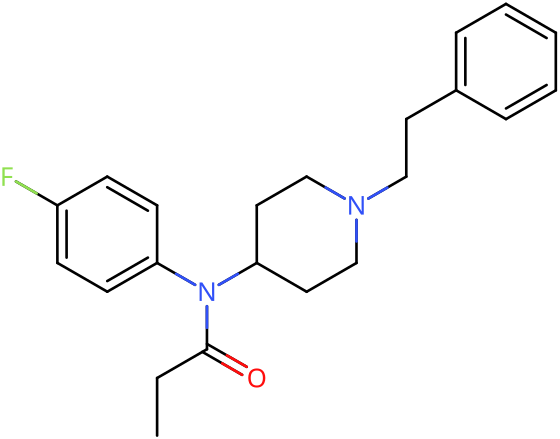
Parafluorofentanyl Stats & Data
CCC(=O)N(C1CCN(CCc2ccccc2)CC1)c1ccc(F)cc1KXUBAVLIJFTASZ-UHFFFAOYSA-NPharmacology
DrugBankDescription
p-Fluorofentanyl is an opioid analgesic being an analogue of fentanyl developed by Janssen Pharmaceutica in the 1960s. p-Fluorofentanyl was sold briefly on the US black market in the early 1980s, before the introduction of the Federal Analog Act which for the first time attempted to control entire families of drugs based on their structural similarity rather than scheduling each drug individually as they appeared. p-Fluorofentanyl is made with the same synthetic route as fentanyl, but by substituting para-fluoroaniline for aniline in the synthesis.
History & Culture
Parafluorofentanyl was originally developed by Janssen Pharmaceutica during the 1960s as part of their extensive research into fentanyl analogs. The compound appeared briefly on the illicit United States market in the early 1980s, notably predating the introduction of the Federal Analog Act, which represented the first legislative attempt to control entire families of drugs based on structural similarity rather than scheduling each compound individually as it emerged. Fentanyl analogs as a class have been responsible for thousands of fatalities across Europe and former Soviet republics since a resurgence in use that originated in Estonia during the early 2000s, with novel derivatives continuing to appear on illicit markets. In 2020, the United States Drug Enforcement Administration issued warnings regarding the increasing prevalence of parafluorofentanyl specifically in Arizona. Despite these developments, the substance remains relatively rare and poorly characterized in the scientific literature.
Tolerance & Pharmacokinetics
drugs.wikiNo tolerance chart. Our decay curves for opioids were estimates, and a curve can make tolerance look longer-lasting than it is, which is the dangerous direction.
Opioid tolerance drops fast when you stop, and even a few days off can be enough, so a dose that used to be normal can now stop your breathing. Overdose deaths rise sharply after prison, detox or leaving treatment, and tolerance also falls during a hospital stay. After any break, start with a much smaller amount, try a test dose first, don't use alone, and keep naloxone within reach. Alcohol, benzodiazepines, gabapentinoids and other sedatives make an opioid overdose much more likely.
Sources: FRANK: heroin · National Harm Reduction Coalition · WHO: opioid overdose · Merrall et al. 2010 · Binswanger et al. 2007 · Strang et al. 2003 · FDA 2019: gabapentinoids and breathing