
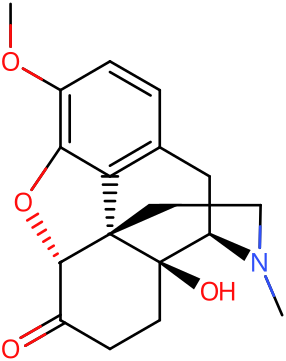
Oxycodone Stats & Data
CN1CCC23C4C(=O)CCC2(C1CC5=C3C(=C(C=C5)OC)O4)OBRUQQQPBMZOVGD-XFKAJCMBSA-NPharmacology
DrugBankDescription
Oxycodone is a semisynthetic opioid analgesic derived from thebaine in Germany in 1917. It is currently indicated as an immediate release product for moderate to severe pain and as an extended release product for chronic moderate to severe pain requiring continuous opioid analgesics for an extended period. The first oxycodone containing product, Percodan, was approved by the FDA on April 12, 1950.
Mechanism of Action
The full mechanism of oxycodone is not known. Under conditions of inflammation or hyperalgesia, opioid receptors in the heart, lungs, liver, gastrointestinal tract, and reproductive system are upregulated and transported to nerve terminals. Oxycodone and its active metabolites, noroxycodone, oxymorphone, and noroxymorphone are opioid agonists. These compounds passively diffuse across the blood brain barrier or may be actively transported across by an unknown mechanism. Oxycodone and its active metabolites can selectively bind to the mu opioid receptor, but also the kappa and delta opioid receptors in the central nervous system and periphery, and induce a G protein coupled receptor signalling pathway. Activation of mu opioid receptors inhibits N-type voltage operated calcium channels, inhibiting responses to pain.
Pharmacodynamics
Oxycodone acts directly on a number of tissues not related to its analgesic effect. These tissues include the respiratory centre in the brain stem, the cough centre in the medulla, muscles of the pupils, gastrointestinal tract, cardiovascular system, endocrine system, and immune system. Oxycodone's effect on the respiratory centre is dose dependant respiratory depression. The action on the cough centre is suppression of the cough reflex. Pupils become miopic or decrease in size, peristalsis of the gastrointestinal tract slows, and muscle tone in the colon may increase causing constipation. In the cardiovascular system histamine may be released leading to pruritis, red eyes, flushing, sweating, and decreased blood pressure. Endocrine effects may include increased prolactin, decreased cortisol, and decreased testosterone. It is not yet known if the effects of opioids on the immune system are clinically significant.
Metabolism
Oxycodone's hepatic metabolism is extensive and completed by 4 main reactions. CYP3A4 and 3A5 perform N-demethylation, CYP2D6 performs O-demethylation, unknown enzymes perform 6-keto-reduction, and unknown enzymes perform conjugation. Oxycodone is metabolized by CYP3A4 and CYP3A5 to noroxycodone and then by CYP2D6 to noroxymorphone. Noroxycodone and noroxymorphone are the primary circulating metabolites. Noroxycodone can also be 6-keto-reduced to alpha or beta noroxycodol. Oxycodone can be metabolized by CYP2D6 to oxymorphone and then by CYP3A4 to noroxymorphone. Oxymorphone can also be 6-keto-reduced to alpha or beta oxymorphol. Oxycodone can also be 6-keto-reduced to alpha and beta oxycodol. The active metabolites noroxycodone, oxymorphone, and noroxymorphone can all be conjugated before elimination.
Absorption
Oxycodone has an oral bioavailability of 60% to 87% that is unaffected by food. The area under the curve is 135ng/mL\*hr, maximum plasma concentration is 11.5ng/mL, and time to maximum concentration is 5.11hr in patients given a 10mg oral immediate release dose of oxycodone.
Indication
Oxycodone is indicated for the treatment of moderate to severe pain. There is also an extended release formulation indicated for chronic moderate to severe pain requiring continuous opioid analgesics for an extended period.
Half-life
The apparent elimination half life of oxycodone is 3.2 hours for immediate release formulations and 4.5 hours for extended release formulations. Noroxycodone has a half life of 5.8 hours, oxymorphone has a half life of 8.8 hours, noroxymorphone has a half life of 9 hours.
Protein Binding
45%. Oxycodone is primarily bound to serum albumin and to a lesser degree alpha1-acid glycoprotein.
Elimination
Oxycodone and its metabolites are eliminated in the urine. Unbound noroxycodone makes up 23% of the dose recovered in urine and oxymorphone makes up <1%. Conjugated oxymorphone makes up 10% of the recovered dose. Free and conjugated oxycodone makes up 8.9% of the recovered dose, noroxymorphone makes up 14%, and reduced metabolites make up 18%.
Receptor Profile
Receptor Actions
Receptor Binding
History & Culture
1916–1917
Oxycodone was first synthesized from the opium poppy alkaloid thebaine by Martin Freund and Edmund Speyer at the University of Frankfurt in Germany, with their synthesis published in 1916. Clinical application of the drug followed the next year, when it was initially employed for postoperative pain management among Central Powers soldiers during World War I, administered both intravenously and intramuscularly. Edmund Speyer, born to a Jewish family in Frankfurt am Main in 1878, would later become a victim of the Holocaust. He perished on May 5, 1942, during the second day of deportations from the Łódź Ghetto—a fate documented in the ghetto's chronicle. When Freund died in 1920, Speyer had authored his obituary for the German Chemical Society.
1928–1945
In early 1928, Merck introduced a combination product containing scopolamine, oxycodone, and ephedrine under the German initials SEE, later renamed Scophedal in 1942. This formulation was expressly designed to produce what its patent application and package insert described as "very deep analgesia and profound and intense euphoria," along with tranquilization and anterograde amnesia useful for surgical and battlefield injury cases. The ephedrine component was added to counteract circulatory and respiratory depression. The preparation became known as the "Miracle Drug of the 1930s" across Continental Europe and was selected by the Wehrmacht as a battlefield analgesic. Oxycodone was reportedly chosen over other opiates because it produced less sedation at equivalent analgesic doses compared to morphine, hydromorphone, and hydrocodone. Personal notes from Adolf Hitler's physician, Theodor Morell, reveal that Hitler received repeated injections of "Eukodal" (Merck's oxycodone product) and Scophedal, along with other opioids including pethidine, codeine, and morphine. Records indicate that oxycodone supplies became unobtainable after late January 1945 as the war concluded. Scophedal remained in production until 1987, though the formulation can still be extemporaneously compounded.
1939–1950
Oxycodone entered the American pharmaceutical market in May 1939. The first oxycodone-containing product to receive FDA approval was Percodan, granted on April 12, 1950. These initial formulations established oxycodone as a recognized option within American pain management practice.
1995–2011
During the early 1990s, Purdue Pharma, a privately held company headquartered in Stamford, Connecticut, developed a controlled-release oxycodone formulation marketed as OxyContin (the suffix referencing its continuous, extended-duration pain relief). The FDA granted approval in 1995 without requiring long-term efficacy studies or formal assessment of the drug's addiction potential. Upon release, OxyContin was promoted as a breakthrough for patients experiencing moderate to severe pain, and it rapidly became a commercial success, reportedly generating approximately $35 billion in revenue for Purdue Pharma. However, the controlled-release mechanism proved vulnerable to circumvention—crushing the tablets released the full oxycodone dose immediately rather than gradually. David Kessler, who served as FDA commissioner during the approval, later characterized the decision as "certainly one of the worst medical mistakes." By 2011, oxycodone had become the leading cause of drug-related deaths in the United States, though heroin and fentanyl overtook it in this regard from 2012 onward.
2017–2019
The role of Purdue Pharma and its owners in the emerging opioid crisis became subject to intense public examination. In October 2017, The New Yorker published an investigation examining Mortimer Sackler and Purdue Pharma's connection to marketing practices that may have contributed to widespread oxycodone dependence. The article traced how business approaches pioneered by Raymond and Arthur Sackler in direct pharmaceutical marketing were subsequently applied to OxyContin promotion. In 2019, The New York Times published reporting based on verified documents from a Massachusetts lawsuit filed by Attorney General Maura Healey. These materials revealed that Richard Sackler, son of Raymond Sackler, had instructed company officials in 2008 to "measure our performance by Rx's by strength, giving higher measures to higher strengths." The lawsuit alleged that both Purdue Pharma and members of the Sackler family were aware that prescribing high doses of OxyContin over extended periods would increase the risk of serious adverse effects, including the development of addiction.
2010–2013
In August 2010, Purdue Pharma introduced a reformulated OxyContin line incorporating a polymer called Intac, engineered to resist crushing or dissolution in water and thereby reduce non-medical use. The FDA approved relabeling this reformulated version as abuse-resistant in April 2013. The agency had revoked approval for the original sustained-release formulation due to documented widespread misuse. Despite its complex and often controversial history, oxycodone maintains its place as a therapeutic alternative on the World Health Organization's List of Essential Medicines and is available in generic form. As of 2023, it ranked as the 49th most commonly prescribed medication in the United States, with more than 13 million prescriptions dispensed annually.
Subjective Effects
Physical
The physical effects of oxycodeine can be broken down into several components which progressively intensify proportional to dosage. The general head space of codeine is described by many as one of intense euphoria, relaxation, anxiety suppression and pain relief.
- Pain relief: This component is subjectively different from other anaesthetics as it does not necessarily remove the pain entirely whilst still remaining equal in terms of its effectiveness. Instead of directly suppressing pain these substances simply dull the perceived sensation and cover it up with feelings of physical and emotional pleasure. The analgesic effects of the drug are due to decreased perception of pain, a decreased reaction to pain, and increased pain tolerance.
- Euphoria: In comparison to other opioids, this particular substance can be considered similar in its physical euphoria when compared with that of morphine or diacetylmorphine (heroin) and more intense when compared to kratom and Hydrocodone. The sensation itself can be described as extreme feelings of hyper intense physical comfort, snugglyness, warmth, love and blissful euphoria.
- Respiratory depression: At low to moderate doses, this effect results in the sensation that the breath is slowed down mildly to moderately, but does not cause noticeable impairment. At high doses and overdoses, opioid-induced respiratory depression can result in a shortness of breath, abnormal breathing patterns, semi-consciousness, or unconsciousness. Severe overdoses can result in a coma or death without immediate medical attention.
- Sedation: Oxycodone is considerably less sedating than codeine but more sedating than kratom.
- Itchiness
- Constipation
- Cough suppression
- Difficulty urinating
- Nausea
- Stomach cramps
- Pupil constriction
Cognitive
The cognitive effects of codeine can be broken down into several components which progressively intensify proportional to dosage.
- Euphoria: This seems to be caused by both u agonism and downstream dopamine reinforcement. In comparison to other opioids, this particular substance can be considered similar in its cognitive euphoria when compared with that of morphine or diacetylmorphine (heroin) and more intense when compared to kratom and hydrocodone. The sensation itself can be described as powerful and overwhelming feeling of emotional bliss, contentment, love and happiness.
- Anxiety suppression
Sensory
- Internal hallucinations: One may experience a state of semi-consciousness and hypnagogia during heavy dosage nodding which results in dream-like states and up to level 3 imagery and mild geometry.
Forked from Subjective Effect Documentation by Josie Kins, September 2015. Via dose.wiki (CC0).
Oxycodone has a low toxicity relative to dose. As with all opioids, long-term effects can vary but can include diminished libido, apathy, and memory loss. It is also potentially lethal when mixed with depressants like alcohol or benzodiazepines. It is strongly recommended that one use harm reduction practices when using this drug.
Carcinogenicity
No indication of carcinogenicity to humans (not listed by IARC).
Toxicity (DrugBank)
Patients experiencing an overdose may present with respiratory depression, sleepiness, stupor, coma, skeletal muscle flaccidity, cold sweat, constricted pupils, bradycardia, hypotension, partial or complete airway obstruction, atypical snoring, and death. Overdose should be treated by maintaining airway, ventilation, and oxygenation. Oxygen and vasopressor treatment may be necessary to treat circulatory shock and pulmonary edema and defibrillation may be required for cardiac arrest of arrhythmia. Naloxone, nalmefene, or naltrexone may be used to counteract the effects of opioids but patients should be monitored in case further doses are required. The intraperitoneal LD50 in mice is 320mg/kg, the oral LD50 is 426mg/kg. The oral lowest dose causing toxic effects in humans is 0.14mg/kg and subcutaneously in rats it is 1.53mg/kg. Oxycodone is pregnancy category B according to the FDA. There is a paucity of data regarding oxycodone use in pregnancy, though animal studies show no teratogenic effects. Rats given oxycodone during lactation showed smaller offspring, though after lactation, they recovered to normal size. Oxycodone is excreted in breast milk and so patients should not breastfeed while taking oxycodone due to risk of sedation and respiratory depression in infants. No studies on the carcinogenicity of oxycodone have been performed.
Effect Profile
Curated + 289 ReportsStrong euphoria with strong itching/nausea, moderate sedation and pain relief
Empirical Duration
Erowid ReportsMedian times after the dose that Erowid reports state. A curve is drawn only when reports state all four points (onset, peak begins, comedown begins, back to baseline) and the medians fall in that order. No point is estimated from another.
No curve: fewer than 5 reports state the return to baseline, and no point is estimated from another.
Tolerance & Pharmacokinetics
drugs.wikiNo tolerance chart. Our decay curves for opioids were estimates, and a curve can make tolerance look longer-lasting than it is, which is the dangerous direction.
Opioid tolerance drops fast when you stop, and even a few days off can be enough, so a dose that used to be normal can now stop your breathing. Overdose deaths rise sharply after prison, detox or leaving treatment, and tolerance also falls during a hospital stay. After any break, start with a much smaller amount, try a test dose first, don't use alone, and keep naloxone within reach. Alcohol, benzodiazepines, gabapentinoids and other sedatives make an opioid overdose much more likely.
Sources: FRANK: heroin · National Harm Reduction Coalition · WHO: opioid overdose · Merrall et al. 2010 · Binswanger et al. 2007 · Strang et al. 2003 · FDA 2019: gabapentinoids and breathing
Cross-Tolerances
Demographics
Gender Distribution
Age Distribution
Reports Over Time
Effect Analysis
Erowid + BluelightEffects aggregated from 244 experience reports (194 single-substance Erowid + 95 Bluelight)
Effect Sentiment Distribution
Confidence Distribution
Each bar is the share of reports mentioning the effect; its whisker, and the band on the rows below, is the 95% interval: where the share could plausibly be with other reports of the same kind.
Positive Effects 47
Adverse Effects 53
Show 31 more adverse effects
Show 20 neutral or unclassified mentions
Also reported in combinations. In the 156 Oxycodone reports where another drug was taken too, 24 (15.4%) mention hospital, emergency services or an overdose, 7 (4.5%) a seizure and 2 (1.3%) psychosis. In the 194 single-substance reports: 13.4%, 0.0% and 0.0%. These are not in the figures above: they cannot be put down to Oxycodone alone, and a mention is not always something that happened to the writer.
Dose-Response Correlation
How effect frequency changes across dose levels. Whiskers, and the numbers' hover text, give each figure's 95% interval.
Not drawn, too few reports (a dose tier needs 20): Insufflated Strong (n=11), Oral Heavy (n=17). Why 20?
Insufflated
View data table
| Effect | Heavy (n=25) |
|---|---|
| Euphoria | 60.0% (95% interval 41 to 77 percent) |
| Nausea | 48.0% (95% interval 30 to 66 percent) |
| Empathy | 48.0% (95% interval 30 to 66 percent) |
| Sedation | 28.0% (95% interval 14 to 48 percent) |
| Sweating | 28.0% (95% interval 14 to 48 percent) |
| Stimulation | 24.0% (95% interval 12 to 43 percent) |
| Anxiety | 24.0% (95% interval 12 to 43 percent) |
| Confusion | 20.0% (95% interval 9 to 39 percent) |
| Body High | 20.0% (95% interval 9 to 39 percent) |
| Headache | 16.0% (95% interval 6 to 35 percent) |
| Hospital | 16.0% (95% interval 6 to 35 percent) |
| Tactile Enhancement | 16.0% (95% interval 6 to 35 percent) |
| Auditory Effects | 12.0% (95% interval 4 to 30 percent) |
| Music Enhancement | 12.0% (95% interval 4 to 30 percent) |
| Focus Enhancement | 12.0% (95% interval 4 to 30 percent) |
Oral
View data table
| Effect | Common (n=30) |
|---|---|
| Euphoria | 50.0% (95% interval 33 to 67 percent) |
| Empathy | 46.7% (95% interval 30 to 64 percent) |
| Music Enhancement | 40.0% (95% interval 25 to 58 percent) |
| Nausea | 36.7% (95% interval 22 to 54 percent) |
| Sedation | 30.0% (95% interval 17 to 48 percent) |
| Anxiety | 26.7% (95% interval 14 to 44 percent) |
| Color Enhancement | 16.7% (95% interval 7 to 34 percent) |
| Dissociation | 13.3% (95% interval 5 to 30 percent) |
| Pain Relief | 13.3% (95% interval 5 to 30 percent) |
| Auditory Effects | 13.3% (95% interval 5 to 30 percent) |
| Pupil Dilation | 13.3% (95% interval 5 to 30 percent) |
| Stimulation | 13.3% (95% interval 5 to 30 percent) |
| Tactile Enhancement | 10.0% (95% interval 4 to 26 percent) |
| Focus Enhancement | 10.0% (95% interval 4 to 26 percent) |
| Closed-Eye Visuals | 10.0% (95% interval 4 to 26 percent) |
Subjective Effect Ontology
Experience ReportsStructured effect tags extracted from 400 Erowid & Bluelight experience reports using a controlled vocabulary of 220+ canonical effects across 15 domains.
Emotional
Gastrointestinal
Motor
Dose–Effect Mapping
Experience ReportsHow reported effects shift across dose tiers, based on 194 single-substance experience reports. The shaded band on each bar is its 95% interval. An arrow (↑ ↓) marks a change between the lowest and highest tier that count an effect only when the gap is bigger than chance would explain; ~ means no clear change. How changes are called
Not drawn, too few reports (a dose tier needs 20): Insufflated Strong (n=11), Oral Heavy (n=17). Why 20?
Limited tier coverage — most reports fall within the Heavy / Common range. Effects at other dose levels may not be represented.
| Effect | Heavy (n=25) | Change with dose |
|---|---|---|
| euphoria | ||
| nausea | ||
| empathy | ||
| sedation | ||
| sweating | ||
| stimulation | ||
| anxiety | ||
| confusion | ||
| body high | ||
| headache | ||
| hospital | ||
| tactile enhancement | ||
| auditory effects | ||
| music enhancement | ||
| focus enhancement | ||
| memory suppression | ||
| color enhancement | ||
| pupil dilation |
| Effect | Common (n=30) | Change with dose |
|---|---|---|
| euphoria | ||
| empathy | ||
| music enhancement | ||
| nausea | ||
| sedation | ||
| anxiety | ||
| color enhancement | ||
| dissociation | ||
| pain relief | ||
| auditory effects | ||
| pupil dilation | ||
| stimulation | ||
| tactile enhancement | ||
| focus enhancement | ||
| closed-eye visuals | ||
| body high | ||
| headache | ||
| muscle tension | ||
| confusion | ||
| hospital |
Dosage Distribution
Dose distribution from experience reports, one dose per report (the first listed). Doses above Q3 + 3×IQR, far above what people typically take, are left out of the median and range and listed under each route: most are real heavy doses or overdoses, not mistakes.
Insufflated
3 reports gave a dose above the typical range (140–160 mg), so they are not in the figures above. Listing a dose here does not mean it is safe.
Oral
2 reports gave a dose above the typical range (160–200 mg), so they are not in the figures above. 1 of them mentions hospital, emergency services or an overdose. Listing a dose here does not mean it is safe.
Real-World Dose Distribution
ErowidFrom 450 of 508 recorded dose entries: those that state a weight (mg, g or µg), in routes with at least five of them. Values above Q3 + 3×IQR, far above what people typically take, are left out; they can include real heavy doses and overdoses, not only mistakes.
Oral (n=235)
Insufflated (n=185)
Intravenous (n=12)
Common Combinations
Most co-occurring substances, as a share of all 350 reports filed under Oxycodone; whiskers are 95% intervals
Form / Preparation
Most common forms and preparations, as a share of the 264 reports that give one; whiskers are 95% intervals
Body-Weight Dosing
Dose per kg of body weight, one dose per report (the first listed), from reports giving a weight of 30–250 kg. Doses above Q3 + 3×IQR, far above what people typically take, are left out of the median and range and listed under each route.
Insufflated
4 reports gave a dose above the typical range (1.918–2.822 mg/kg), so they are not in the figures above. Listing a dose here does not mean it is safe.
Show the reports
- 2.822 mg/kg
- 2.288 mg/kg
- 1.961 mg/kg
- 1.918 mg/kg · another drug taken too
Oral
2 reports gave a dose above the typical range (1.961–2.643 mg/kg), so they are not in the figures above. 1 of them mentions hospital, emergency services or an overdose. Listing a dose here does not mean it is safe.
Show the reports
- 2.643 mg/kg
- 1.961 mg/kg · another drug taken too · mentions hospital, emergency services or an overdose
Unknown
Redose Patterns
Redosing behavior across 301 reports
Opioid Equivalence (MME)
NIH HEAL 2024 & CDC 2022Oxycodone 6.7 mg oral ≈ 10 mg Morphine oral
Legal Status
| Country | Status | Notes |
|---|---|---|
| Australia | Schedule 8 (Poisons Standard) / Schedule I (Narcotic Drugs Act) | Listed in Schedule I of the Commonwealth's Narcotic Drugs Act 1967 pursuant to international treaty obligations. Additionally classified as Schedule 8 under the Poisons Standard, designating it as a controlled drug available for medical use but requiring restriction of manufacture, supply, distribution, possession, and use to reduce potential for abuse and dependence. |
| Austria | Prescription only (AMG/SMG) | Legal for medical use under the Arzneimittelgesetz (Medicines Act). Possession or sale without a valid prescription is prohibited under the Suchtmittelgesetz (Addiction Substances Act). |
| Canada | Schedule I (CDSA) | Controlled substance under Schedule I of the Controlled Drugs and Substances Act. Note that Canadian scheduling differs significantly from the United States system. Possession and distribution without authorization carry criminal penalties. |
| Germany | Anlage III BtMG | Listed in Appendix III of the Betäubungsmittelgesetz (Narcotics Act), meaning it is a controlled narcotic available for medical prescription. Only licensed physicians, dentists, and veterinarians may prescribe oxycodone, and the federal government regulates prescriptions through reporting requirements. |
| Hong Kong | Schedule 1, Part I (Dangerous Drugs Ordinance) | Regulated under Part I of Schedule 1 of Chapter 134, the Dangerous Drugs Ordinance. Unauthorized possession, manufacture, and trafficking are criminal offenses. |
| Netherlands | List I (Opiumwet) | Classified as a List I substance under the Opium Act, designating it as a 'hard drug' associated with significant health risks. Despite this classification, physicians retain the ability to prescribe oxycodone for legitimate medical purposes under the Medicines Act. |
| Russia | Schedule II | Classified as a Schedule II controlled substance under Russian narcotics legislation. Medical use is permitted under strict regulation. |
| Singapore | Class A (Misuse of Drugs Act) | Listed as a Class A drug, attracting the most severe penalties under Singapore law. Unauthorized manufacture carries a minimum sentence of 10 years imprisonment plus 5 strokes of the cane, with maximum penalties of life imprisonment or 30 years plus 15 strokes. Trafficking offenses carry minimum penalties of 5 years imprisonment plus 5 strokes, and maximum penalties of 20 years plus 15 strokes. |
| Switzerland | Verzeichnis A | Specifically named as a controlled substance under Verzeichnis A of Swiss narcotics legislation. Medicinal use is permitted with appropriate prescription. |
| Turkey | Red prescription only | Designated as a 'red prescription' substance, indicating the highest level of prescription control in Turkey. Possession or sale without a valid red prescription is illegal. |
| United Kingdom | Class A / Schedule 2 | Controlled under the Misuse of Drugs Act as a Class A substance, considered among those most likely to cause harm. Possession without prescription is punishable by up to seven years imprisonment, an unlimited fine, or both. Dealing carries penalties up to life imprisonment. Also listed as Schedule 2 under the Misuse of Drugs Regulations 2001, permitting medical prescription. |
| United States | Schedule II | Controlled under the Controlled Substances Act since 1970. Illegal to sell without a DEA license and illegal to purchase or possess without a valid prescription. The FDA revoked approval of the original sustained-release OxyContin formulation in 2010 due to widespread misuse, with reformulated abuse-deterrent versions subsequently approved. |
Harm Reduction
drugs.wiki• Combining oxycodone with other CNS depressants (alcohol, benzodiazepines, Z-drugs, gabapentinoids, GHB) greatly magnifies risks of overdose, respiratory depression, and death; this is a leading driver of fatalities. TripSit and clinical reviews flag opioid+benzo/gaba combos as dangerous; gabapentinoid co-prescription doubles opioid-related mortality in observational data. • CYP3A4 strongly affects oxycodone exposure. Adding an inhibitor (e.g., azole antifungals, macrolides, protease inhibitors, grapefruit) after you’re stable on a dose can acutely raise oxycodone levels and cause overdose; starting/stopping inducers (rifampin/carbamazepine/phenytoin/St. John’s wort) can lower levels or, when stopped, rebound them upward. This warning appears in the oxycodone label summaries (MedGen/NCBI) and DrugBank metabolism section. • CYP2D6 inhibitors (fluoxetine, paroxetine, bupropion, some SSRIs/SNRIs) reduce formation of oxymorphone and can change effect profile (sometimes less analgesia but more parent-drug sedation). Use extra caution if adding/stopping these. Label summaries note enhanced effects when 3A4 and 2D6 inhibitors are combined. • Counterfeit “oxycodone/Percocet” tablets are common; drug-checking projects repeatedly find fentanyl, fluorofentanyl, nitazenes (e.g., metonitazene, protonitazepyne), and benzodiazepines (e.g., bromazolam) instead of oxycodone. Use fentanyl test strips, but know they do not detect nitazenes; many onsite FTIR devices also miss <5% content. Laboratory checking where available is safer. • Keep naloxone (or nalmefene) accessible and teach people around you to use it. Naloxone reverses opioid respiratory depression; multiple doses may be required with potent adulterants. Community distribution programs show thousands of overdose reversals. • If you only have acetaminophen-containing products (e.g., Percocet), track total daily APAP from all sources and stay ≤4,000 mg/day to avoid liver injury. Consider a properly performed cold-water extraction (CWE) to reduce APAP before non-medical use; never rely on CWE to make unsafe doses “safe.” • Prefer oral dosing. Avoid injecting or smoking crushed tablets: insoluble binders and tamper-resistant matrices raise risks of emboli and serious tissue/organ harm; TripSit explicitly flags IV use of oxycodone tablets as extremely dangerous. • Do not chew/crush ER products (e.g., OxyContin) for non-medical use: this can release the full dose at once (“dose dumping”) and sharply increase overdose risk. Redose cautiously and leave several hours between doses because sedation/respiratory depression can outlast euphoria. Label summaries and clinical texts warn about this. • When using alone is unavoidable, use tiny test doses, avoid mixing depressants, and arrange a check-in or use an overdose-detection line; know basic rescue breathing. If someone is unresponsive, call emergency services, give naloxone, and provide rescue breathing until help arrives. • Chronic use: constipation is near-universal; hydrate, use fiber/osmotic laxatives as needed. Opioid-induced hyperalgesia can occur; increasing doses may paradoxically worsen pain—seek medical review. • Driving/operating machinery is unsafe while affected. People with sleep apnea, COPD, or on sedatives are at higher risk of nocturnal hypoventilation—start at low doses and avoid co-depressants.
References
Data Sources
Cited References
Additional references
- DrugBank: Oxycodone (mechanism, PK, interactions)
- TripSit Wiki: Oxycodone (doses, ROA cautions, grapefruit warning)
- TripSit: Drug combinations (opioids + depressants = dangerous)
- NCBI MedGen (Oxycodone response: 3A4/2D6 inhibitor/inducer warnings)
- NCBI StatPearls: Hydrocodone/Acetaminophen (class cautions; co‑depressants; monitoring)
- NCBI StatPearls: Acetaminophen Toxicity (adult max 4 g/day)
- DrugChecking.community: Nitazenes in oxycodone/Percocet; FTIR/strip limitations
- DrugChecking.community: Service and technology limitations (FTIR 5% LoD; FTS scope)
- Saferparty.ch alert: “Oxycodon” tablet contained metonitazene + bromazolam
- Erowid/DrugsData project overview (lab drug checking)
- EUDA/EMCDDA joint report excerpt (carfentanil sold as counterfeit oxycodone)