
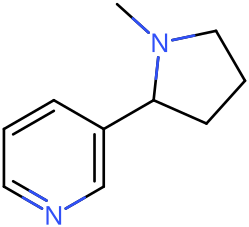
Nicotine Stats & Data
SNICXCGAKADSCV-JTQLQIEISA-NPharmacology
DrugBankMechanism of Action
Nicotine is a stimulant drug that acts as an agonist at nicotinic acetylcholine receptors. These are ionotropic receptors composed up of five homomeric or heteromeric subunits. In the brain, nicotine binds to nicotinic acetylcholine receptors on dopaminergic neurons in the cortico-limbic pathways. This causes the channel to open and allow conductance of multiple cations including sodium, calcium, and potassium. This leads to depolarization, which activates voltage-gated calcium channels and allo
Metabolism
Primarily hepatic, cotinine is the primary metabolite.
Metabolites
Measured Affinities
Guide to PHARMACOLOGYMeasured binding and functional data for nicotine, curated by the IUPHAR/BPS Guide to PHARMACOLOGY. Each row cites the paper it came from. Lower concentrations mean tighter binding — a value in the sub-nanomolar range indicates a very potent interaction.
| Target | Action | Measure | Value | Concentration | Species | Source |
|---|---|---|---|---|---|---|
| nicotinic acetylcholine receptor α4 subunit CHRNA4 | Agonist | pKi | 8.66 | 2.19 nM | Human | PMID 32026697 |
| Kv4.3 Kcnd3 | Channel blocker | pIC50 | 7.4 | 39.81 nM | Rat | PMID 10973847 |
| nicotinic acetylcholine receptor α3 subunit CHRNA3 | Agonist | pKi | 5.76 | 1,738 nM | Human | PMID 32026697 |
| TRPA1 TRPA1 | Activation | pEC50 | 4.8 | 15,849 nM | Human | PMID 19749751 |
Reading this. pKi, pEC50 and pIC50 are negative log molar values, so a higher number means a tighter interaction; the concentration column converts them for you. Values from non-human species are laboratory measurements and do not translate directly to human effect. Receptor affinity is not a dose — it describes what a molecule binds, not how much of it is safe to take.
Receptor data from the IUPHAR/BPS Guide to PHARMACOLOGY (v2026.2), licensed CC BY-SA 4.0. Matched to this substance by InChIKey.
History & Culture
1530s–1560
Tobacco first arrived in Europe during the early 1530s, brought back by Spanish explorers from the Americas. The plant quickly gained a reputation as a medicinal wonder, with smoking believed to offer protection against various illnesses, including the plague. This perception of tobacco as a "holy herb" with curative properties contributed to its rapid adoption across the continent. The substance takes its name from the tobacco plant Nicotiana tabacum, which was itself named after Jean Nicot de Villemain, a French ambassador stationed in Portugal. In 1560, Nicot sent tobacco plants and seeds to Paris, presenting them to the French King and actively promoting their medicinal applications. His enthusiastic advocacy helped establish tobacco's reputation among European aristocracy and medical practitioners.
1828–1904
The active compound responsible for tobacco's effects was first isolated in 1828 by German chemists Wilhelm Heinrich Posselt and Karl Ludwig Reimann, who identified the substance as a poison.[cite:posselt-reimann-1828] The chemical empirical formula was subsequently described by Melsens in 1843, while the complete molecular structure was elucidated by Adolf Pinner and Richard Wolffenstein in 1893. The first total synthesis of nicotine was achieved by Amé Pictet and A. Rotschy in 1904, confirming the structural work of the previous decade.
1612–1619
Following its introduction to Europe, tobacco's stimulating effects and the addictive properties of nicotine drove enormous demand that transformed colonial economics. By the early 17th century, tobacco cultivation had become central to the Virginia colonies in North America. John Rolfe's introduction of commercially viable tobacco farming in 1612 rescued the Jamestown settlement from economic collapse and famine.[cite:rolfe-jamestown-1612] Within seven years, the colony was exporting over 20,000 pounds of tobacco annually, establishing the foundation for transatlantic trade networks.[cite:tobacco-exports-1619] From the 17th century onward, tobacco smoking became deeply embedded in European social, economic, and cultural life, shaping daily rituals, trade relationships, and even international conflicts.
1690s–1980s
Beyond its use as a recreational substance, nicotine found extensive application as an agricultural pesticide. By the late 17th century, tobacco preparations were already being employed as insecticides.[cite:nicotine-insecticide-1690] This application expanded dramatically following World War II, when global nicotine insecticide usage exceeded 2,500 tons annually. However, by the 1980s, consumption had declined to below 200 tons as cheaper synthetic alternatives with lower mammalian toxicity became available. The molecular structure of nicotine nevertheless provided the template for developing the neonicotinoid class of synthetic pesticides, which remain widely used in modern agriculture.
1980s–2010s
Public health campaigns in the United Kingdom created the character Nick O'Teen, a villain developed for the Health Education Council to personify the harms of tobacco smoking and nicotine addiction.[cite:nick-oteen-hec] The character, depicted as a humanoid figure with cigarette-like features incorporated into his appearance, appeared in three animated public service announcements where he attempted to lure children into smoking before being thwarted by the superhero Superman.[cite:nick-oteen-hec] The tobacco industry responded to growing health concerns by comparing nicotine to caffeine in 1980s advertising campaigns, attempting to normalize its use and reduce public perception of risk. This marketing strategy was later adopted by the electronic cigarette industry in the 2010s as a means of reducing stigmatization associated with nicotine consumption.
Subjective Effects
Physical
- Stimulation and Sedation: The stimulatory effects of nicotine are much less pronounced than other stimulants such as caffeine or amphetamine. At higher doses, however, nicotine inhibits nerve transmission which produces sedative effects.
- Abnormal heartbeat: At high doses, nicotine can trigger an elevated heart rate or even heart palpitations.
- Vasoconstriction
- Appetite suppression
- Dizziness: At high doses, nicotine can cause one to feel dizzy or lightheaded.
Cognitive
- Thought acceleration
- Focus enhancement
- Memory enhancement
- Motivation enhancement
- Euphoria
- Anxiety and Anxiety suppression: Low doses of nicotine produce stimulatory effects which can cause anxiety. Higher doses stimulate the release of beta-endorphin which relieves anxiety.
- Sexual arousal: Nicotine has the capability of inducing heightened sexual arousal due to its effect on dopamine transmission.
- Compulsive redosing
Forked from Subjective Effect Documentation by Josie Kins, August 2015. Via dose.wiki (CC0).
The US federal health report "Smokeless Tobacco: Health Effects" warns that smokeless tobacco, like chew and dip, can cause cancer of the mouth, esophagus, and pancreas.
LD50
LD50: 140 mg/kg (Dermal, Rat)LD50: 25 mg/kg (Subcutaneous, Rat)LD50: 5900 ug/kg (Intraperitoneal, Mouse)LD50: 2.8 mg/kg (Intravenous, Rat) (T80)LD50: 24 mg/kg (Oral, Mouse) (T18)
Carcinogenicity
No indication of carcinogenicity to humans (not listed by IARC).
Effect Profile
Curated + 16 ReportsStrong focus with strong anxiety/jitters, moderate euphoria, mild stimulation
Tolerance & Pharmacokinetics
drugs.wikiTolerance Decay
Tolerance to stimulant and autonomic effects rises quickly with daily use and decays over weeks; values are approximate and inferred from dependence literature and user reports rather than controlled dosing studies.
Cross-Tolerances
Experience Report Analysis
ErowidDemographics
Gender Distribution
Age Distribution
Reports Over Time
Effect Analysis
ErowidEffects aggregated from 16 experience reports (16 single-substance Erowid)
Effect Sentiment Distribution
Confidence Distribution
Each bar is the share of reports mentioning the effect; its whisker, and the band on the rows below, is the 95% interval: where the share could plausibly be with other reports of the same kind.
Too few reports for bars: these effects come from 16 single-substance Erowid reports, and a bar is drawn only from 20 reports or more. With fewer, a percentage cannot tell a common effect from a rare one. Counts are shown instead. Why 20?
Positive Effects 4
Adverse Effects 2
Also reported in combinations. In the 25 Nicotine reports where another drug was taken too, 1 (4.0%) mentions hospital, emergency services or an overdose, 0 (0.0%) a seizure and 1 (4.0%) psychosis. In the 16 single-substance reports: 1, 0 and 0. These are not in the figures above: they cannot be put down to Nicotine alone, and a mention is not always something that happened to the writer.
Common Combinations
Most co-occurring substances, as a share of all 41 reports filed under Nicotine; whiskers are 95% intervals
Form / Preparation
Most common forms and preparations, as a share of the 9 reports that give one
Too few reports for bars: these forms come from 9 reports, and a bar is drawn only from 20 reports or more. With fewer, a percentage cannot tell a common effect from a rare one. Counts are shown instead. Why 20?
- Patch 4 of 9
- Liquid 2 of 9
Redose Patterns
Redosing behavior across 25 reports
Harm Reduction
drugs.wikiReasoning for changes (key harm-reduction facts and sources): Nicotine dosing is highly route-dependent. Inhalation gives a near-immediate spike with short primary duration, while buccal products act slower/longer and patches provide stable, lower peaks—these differences influence overdose risk and redosing behavior. Erowid’s dosage page summarizes smoked, oral/buccal, intranasal ranges and typical patch delivery rates; the NCI PDQ shows marketed patch strengths and usage durations. These sources support the corrected/expanded ROA-specific dosing and time-course fields. Nicotine poisoning risk is significant with concentrated e-liquids and dermal/ocular exposure; national reviews document severe outcomes and rare fatalities, emphasizing glove use, child-resistant storage, and avoiding decanting into drink-like containers. Pure nicotine is not the primary driver of combustion-related disease; switching from smoking to nicotine-only products removes smoke toxicants and CYP1A2 induction, which can unexpectedly raise levels of caffeine, clozapine, olanzapine, and theophylline—so proactive dose/caffeine reductions and monitoring are important during transitions. Pregnancy/breastfeeding: guidance advises behavioral support first; if NRT is used, short-acting forms and daytime patch-only use (remove before bed) can reduce fetal exposure and vivid dreams; overall, NRT is considered far safer than continued smoking, but not risk-free. Timing buccal doses right after breastfeeding can reduce infant exposure. These points guide safer choices for pregnant or lactating people who cannot stop nicotine abruptly. Tobacco smoke (not pure nicotine) contains MAO-inhibiting beta-carbolines that enhance reinforcement; this clarifies that the MAOI warning relates mainly to smoke chemistry, while pharmaceutical MAOIs warrant caution because nicotine is a sympathomimetic. Pharmacokinetics: nicotine’s body half-life is about 2 hours (cotinine ~16–18 h, useful for testing), informing redose spacing and why cravings recur quickly with inhaled use. Practical HR tips embedded above: start low and titrate slowly; avoid stacking different nicotine products simultaneously without a plan; keep liquids locked away from children/pets; wear gloves/eye protection handling high-strength base; remove transdermal patches at night if disturbing dreams; avoid vaping battery misuse/poor-quality cells to reduce explosion/burn risk; and plan caffeine reduction when switching from smoking to nicotine-only delivery.
References
Data Sources
Cited References
Additional references
- Erowid Nicotine Dosage
- Erowid Nicotine Basics
- NCI PDQ: Cigarette Smoking—Health Risks and How to Quit (NRT tables)
- Treating Tobacco Use and Dependence: 2008 Update (drug interactions; smoke enzyme induction)
- NASEM: Public Health Consequences of E-Cigarettes (injuries and poisonings)
- NICE 2025 Tobacco Guideline (pregnancy NRT advice)
- LactMed: Nicotine (breastfeeding)
- IARC: Tobacco Smoke and Involuntary Smoking (nicotine half-life ~2 h)
- NCBI Bookshelf: Tobacco dependence—MAOIs in smoke