
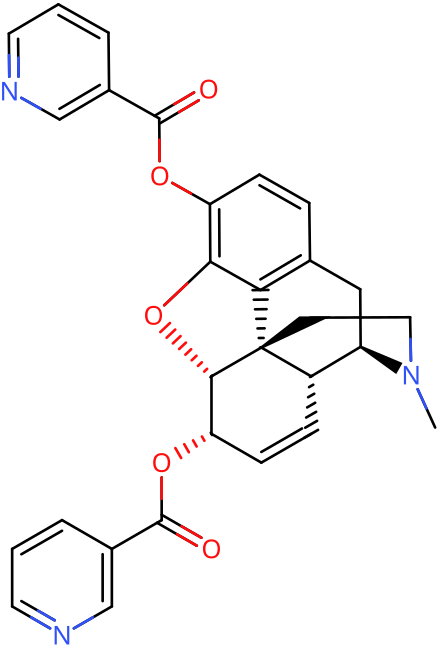
Nicomorphine Stats & Data
O=C(OC1C=CC2C3Cc4ccc(OC(=O)c5cccnc5)c5OC1C2(CCN3C)c45)c1cccnc1HNDXBGYRMHRUFN-CIVUWBIHSA-NHistory & Culture
Nicomorphine was first synthesized in 1904. Over fifty years later, the compound was patented under the trade name Vilan by the Austrian pharmaceutical company Lannacher Heilmittel G.m.b.H. in 1957. That same year, Pongratz and Zirm published the synthesis methodology in the journal Monatshefte für Chemie, describing the treatment of anhydrous morphine base with nicotinic anhydride at elevated temperatures. Their article also detailed the preparation of the related analogues nicocodeine and nicodicodeine as part of a broader examination of amides and esters of various organic acids. Nicomorphine has found medical application primarily in German-speaking countries and other regions of Central Europe, as well as in some countries of the former Soviet Union. It is used clinically for the management of post-operative pain, cancer-related pain, and chronic non-malignant and neuropathic pain conditions. The compound was never introduced to the United States medical market. Outside of pharmaceutical channels, nicomorphine occasionally appears on the European black market. It can be produced through improvised methods analogous to heroin homebake processes, involving the treatment of morphine with nicotinic anhydride or related chemicals.
Tolerance & Pharmacokinetics
drugs.wikiNo tolerance chart. Our decay curves for opioids were estimates, and a curve can make tolerance look longer-lasting than it is, which is the dangerous direction.
Opioid tolerance drops fast when you stop, and even a few days off can be enough, so a dose that used to be normal can now stop your breathing. Overdose deaths rise sharply after prison, detox or leaving treatment, and tolerance also falls during a hospital stay. After any break, start with a much smaller amount, try a test dose first, don't use alone, and keep naloxone within reach. Alcohol, benzodiazepines, gabapentinoids and other sedatives make an opioid overdose much more likely.
Sources: FRANK: heroin · National Harm Reduction Coalition · WHO: opioid overdose · Merrall et al. 2010 · Binswanger et al. 2007 · Strang et al. 2003 · FDA 2019: gabapentinoids and breathing