
LSD Stats & Data
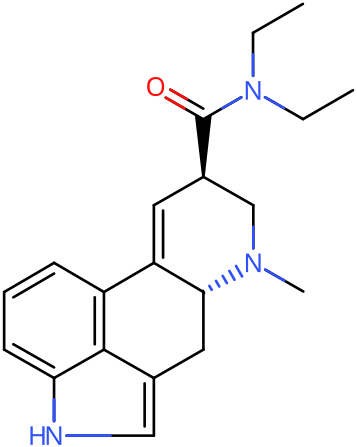
CCN(CC)C(=O)C1CN(C)C2Cc3cnc4cccc(c34)C2=C1.O=C([O-])C(O)C(O)C(=O)[O-].[H+].[H+]HQMPRARIZOUKRO-KEZWHQCISA-NPharmacology
DrugBankDescription
Debate continues over the nature and causes of chronic flashbacks. Explanations in terms of LSD physically remaining in the body for months or years after consumption have been discounted by experimental evidence. Some say HPPD is a manifestation of post-traumatic stress disorder, not related to the direct action of LSD on brain chemistry, and varies according to the susceptibility of the individual to the disorder. Many emotionally intense experiences can lead to flashbacks when a person is reminded acutely of the original experience. However, not all published case reports of chronic flashbacks appear to describe an anxious hyper-vigilant state reminiscent of post-traumatic stress disorder.
Mechanism of Action
LSD's mechanism of action is pleiotropic, primarily mediated by the serotonergic system in the Dorsal Raphe, binding the 5-HT2A receptor as a partial agonist and 5-HT1A as an agonist. LSD also modulates the Ventral Tegmental Area, at higher doses, by stimulating dopamine D₂, Trace Amine Associate receptor 1 (TAAR₁) and 5-HT2A. More studies clarifying the mechanism of action of the psychotic-like symptoms or psychosis induced by LSD in humans are needed. LSD's effects are mediated by a pleiotropic mechanism involving serotonergic, dopaminergic, and glutamatergic neurotransmission. Thus, the LSD-induced psychosis is a useful model to test the therapeutic efficacy of potential novel antipsychotic drugs, particularly drugs with dual serotonergic and dopaminergic (DA) mechanism or acting on TAAR₁ receptors.
Receptor Profile
Receptor Actions
Receptor Binding
Measured Affinities
Guide to PHARMACOLOGYMeasured binding and functional data for Lysergide, curated by the IUPHAR/BPS Guide to PHARMACOLOGY. Each row cites the paper it came from. Lower concentrations mean tighter binding — a value in the sub-nanomolar range indicates a very potent interaction.
| Target | Action | Measure | Value | Concentration | Species | Source |
|---|---|---|---|---|---|---|
| 5-HT2A receptor HTR2A | Full agonist | pKi | 9.4 | 0.398 nM | Human | PMID 8663249 |
| 5-HT1A receptor HTR1A | Full agonist | pKi | 9 | 1 nM | Human | PMID 12213075 |
| 5-HT2A receptor Htr2a | Full agonist | pKi | 8.5 | 3.16 nM | Rat | PMID 12213075 |
| 5-HT2B receptor HTR2B | Biased agonist | pKi | 8.43 | 3.72 nM | Human | PMID 23519215 |
| 5-HT6 receptor HTR6 | Full agonist | pKi | 8.4 | 3.98 nM | Human | PMID 9730917 |
| 5-HT2B receptor Htr2b | Full agonist | pKi | 8.3 | 5.01 nM | Rat | PMID 12213075 |
| 5-HT2C receptor HTR2C | Full agonist | pKi | — | — | Human | PMID 10611640 |
| 5-HT6 receptor Htr6 | Full agonist | pKi | — | — | Rat | — |
Reading this. pKi, pEC50 and pIC50 are negative log molar values, so a higher number means a tighter interaction; the concentration column converts them for you. Values from non-human species are laboratory measurements and do not translate directly to human effect. Receptor affinity is not a dose — it describes what a molecule binds, not how much of it is safe to take.
Receptor data from the IUPHAR/BPS Guide to PHARMACOLOGY (v2026.2), licensed CC BY-SA 4.0. Matched to this substance by InChIKey.
History & Culture
1938–1943
LSD was first synthesized on November 16, 1938, by Swiss chemist Albert Hofmann while working at Sandoz Laboratories in Basel, Switzerland. The compound emerged from a research program investigating potentially useful derivatives of ergot, a fungus that grows on rye and other grains. LSD was the twenty-fifth lysergamide derivative Hofmann synthesized from lysergic acid, which explains the designation LSD-25 (from the German "Lysergsäure-diethylamid"). The psychoactive properties of LSD remained unknown for five years until April 16, 1943, when Hofmann unintentionally ingested an unknown quantity of the substance, possibly through skin absorption. Three days later, on April 19, 1943, Hofmann conducted the first intentional self-experiment, ingesting 250 micrograms in the belief that this would produce only a threshold effect based on the typical potency of other ergot alkaloids. The effects proved far more potent than anticipated. After experiencing the onset of powerful alterations in consciousness, Hofmann rode his bicycle home—an event now commemorated annually as "Bicycle Day" among psychedelic enthusiasts. He later described experiencing unprecedented colors and kaleidoscopic, fantastic images that surged behind his closed eyes, alternating and rearranging themselves in constant flux.
1947–1965
In 1947, Sandoz introduced LSD to the medical community under the trade name Delysid, marketing it as an experimental tool for psychiatric applications. Two primary therapeutic models emerged: the "model-psychosis" approach, which used LSD to induce temporary psychotic-like states in healthy individuals for research purposes, and psycholytic or psychedelic therapy, which employed the substance to enhance psychotherapeutic treatments. The compound generated extraordinary interest within psychiatry during the 1950s and early 1960s. Within fifteen years of its introduction, research on LSD and related hallucinogens produced over 1,000 scientific papers, and the substance was prescribed to more than 40,000 patients. Psychiatrist Humphry Osmond pioneered applications for treating alcoholism with promising results, and the substance was reportedly tried in every type of mental disorder by 1960. Osmond also coined the term "psychedelic" (meaning "mind manifesting") to describe LSD and similar compounds, replacing the earlier "psychotomimetic" model which theorized the substance mimicked schizophrenia. The Sandoz patents on LSD expired in 1963, at which point the Czech company Spofa began production. Sandoz ceased production and distribution in 1965.
1950–1973
During the 1950s, the U.S. Central Intelligence Agency initiated a research program code-named Project MKUltra to investigate LSD's potential applications in mind control and chemical warfare. The CIA reportedly purchased the entire world supply of LSD for $240,000 and distributed it through front organizations to American hospitals, clinics, prisons, and research centers. The experiments involved administering LSD to CIA employees, military personnel, doctors, prostitutes, mentally ill patients, and members of the general public—frequently without their knowledge or consent. The most well-known example, Operation Midnight Climax, involved covertly dosing unwitting individuals to observe their reactions. These experiments resulted in at least one death. The U.S. Army Chemical Corps also evaluated LSD as a potential non-lethal incapacitant in the Edgewood Arsenal human experiments.
1960–1969
By the mid-1960s, LSD had become central to the youth counterculture, particularly in San Francisco's Haight-Ashbury neighborhood and in London. Several prominent intellectuals, including Aldous Huxley, Timothy Leary, Al Hubbard, and Alan Watts, began advocating for the mass consumption of LSD, profoundly influencing the thinking of a new generation. In 1966, Timothy Leary established the League for Spiritual Discovery with LSD as its sacrament. The first major underground LSD production operation was established by Owsley Stanley. Around this time, the Merry Pranksters, associated with novelist Ken Kesey, organized the Acid Tests—events featuring LSD consumption accompanied by light shows and improvised music. Their cross-country journeys in a psychedelically-decorated bus and interactions with major figures of the beat movement were later documented in Tom Wolfe's "The Electric Kool-Aid Acid Test" (1968). In January 1966, brothers Ron and Jay Thelin opened the Psychedelic Shop in Haight-Ashbury to promote safe use of LSD, helping establish the neighborhood as the epicenter of hippie culture. They organized the Love Pageant Rally in Golden Gate Park in October 1966 to protest California's impending ban on the substance. A parallel movement developed in London, led by British academic Michael Hollingshead, who had first experienced LSD in America in 1961. After interactions with Huxley, Leary, and Richard Alpert, Hollingshead returned to the UK in 1965 and founded the World Psychedelic Center in Chelsea, London.
1968–1993
On October 24, 1968, possession of LSD was made illegal in the United States. The counterculture's embrace of the substance had provoked widespread controversy and backlash in American society, leading to aggressive measures under the Nixon administration's war on drugs. Research was unceremoniously halted, and psychedelic study was driven underground. The last FDA-approved study of LSD in patients concluded in 1980, although a study in healthy volunteers was conducted in the late 1980s. Legally approved and regulated psychiatric use of LSD continued in Switzerland until 1993. The substance was placed under Schedule I of the 1971 United Nations Convention on Psychotropic Substances, establishing international prohibition.
2000–present
Following decades of institutional suppression, scientific research involving LSD has undergone a significant revival as part of the broader "psychedelic renaissance." The substance is currently being investigated for treatment applications including alcoholism, substance addiction, cluster headache, autism, and anxiety associated with terminal illness. In 2024, the U.S. Food and Drug Administration designated a form of LSD (MM120) as a breakthrough therapy for generalized anxiety disorder, marking a significant shift in regulatory attitudes toward the substance.
The influence of LSD on art and music became pronounced during the 1960s. San Francisco-based visual artists such as Rick Griffin, Victor Moscoso, and Wes Wilson contributed psychedelic poster and album art to the movement. A distinct visual art style emerged, inspired by the perceptual effects and hallucinatory experiences associated with the substance. Blotter art developed as a unique art form following LSD's prohibition, with decorative graphics printed on perforated sheets of absorbent paper infused with liquid LSD. This practice originated in the early 1970s, sometimes serving to identify the dose, maker, or batch. More than 350 blotter paper designs have been documented since 1975, and entire collections have been exhibited in galleries and museums. Musically, LSD profoundly shaped the development of psychedelic rock through the Acid Tests and performances by bands like the Grateful Dead, Jefferson Airplane, and Big Brother and the Holding Company. The Grateful Dead became central to a culture of devoted followers known as "Deadheads," with their music heavily influenced by the substance. Psychedelic music of the era sought to replicate the LSD experience through exotic instrumentation, electric guitars with effects pedals, and elaborate studio techniques including sitars, tablas, backward tapes, panning, and phasing. In the United Kingdom, Michael Hollingshead introduced LSD to various artists and musicians including Storm Thorgerson, Donovan, Keith Richards, and members of the Beatles. Despite the substance's illegal status from 1966, it was widely used by groups including the Beatles, the Rolling Stones, and the Moody Blues, influencing works such as "Sgt. Pepper's Lonely Hearts Club Band" and Cream's "Disraeli Gears."
Subjective Effects
Physical
- Spontaneous tactile sensations: The body high of LSD can be described as proportionally very intense in comparison to its accompanying visual and cognitive effects. It behaves as a euphoric, fast moving, sharp and location specific tingling sensation. For some it is manifested spontaneously at different unpredictable points throughout the trip, but for most it maintains a steady presence that rises with the onset and hits its limit once the peak has been reached. At moderate to high doses of LSD, this sensation will usually hit its highest level and become so overwhelming that people find themselves writhing on the floor in complete pleasure.
- Stimulation: In terms of its effects on the physical energy levels of the tripper, LSD is usually considered to be very energetic and stimulating without being forced. For example, when taken in any environment it will usually encourage physical activities such as running, walking, climbing or dancing. In comparison, other more commonly used psychedelics such as psilocin are generally sedating and relaxed.
- Nausea: Mild nausea is occasionally reported when consumed in moderate to high dosages and either passes instantly once the tripper has vomited or gradually fades by itself as the peak sets in.
- Increased bodily control
- Enhancement of touch: Feelings of enhanced tactile sensation are consistently present at moderate levels throughout most LSD trips. Once Level 7A visuals are reached, an intense sensation of suddenly becoming aware of and being able to feel every single nerve ending across a person's entire body all at once is consistently present.
Cognitive
In comparison to other psychedelics such as Psilocin, LSA and Ayahuasca, LSD is significantly more stimulating and fast paced in terms of the specific style of thought stream which it produces and contains a large number of potential effects.
- Enhancement of current mind state
- Acceleration of thought
- Feelings of fascination, importance and awe
- Time distortion
- Introspection
- Deja-Vu
- Multiple thought streams
- Removal of cultural filter
- Conceptual thinking
- Ego suppression, loss and death
- Personality regression
- Thought loops
- Feelings of interdependent opposites
- Delusions
- States of unity and interconnectedness
Sensory
- Enhancements
- Distortions
- Hallucinations
- Visual drifting: (Melting, Breathing, Morphing and Flowing) - In comparison to other psychedelics, this effect can be described as highly detailed yet cartoon in its appearance. The distortions are slow and smooth in motion and fleeting in their appearance.
- Tracers
- After images
- Texture repetition
- Colour shifting
- Scenery slicing
- Increased visual acuity
- Enhancement of colours
- Enhanced pattern recognition
LSD is capable of producing a full range of low and high level hallucinatory states in a fashion that is significantly less consistent and reproducible than that of many other commonly used psychedelics.
- External hallucinations
- Internal hallucinations: Although LSD is technically capable of producing hallucinatory states on par with psilocin or DMT in vividness and intensity, in comparison, these effects are extremely rare and inconsistent. Whilst traditional psychedelics such as LSA, Ayahuasca and Mescaline will induce internal hallucinations near consistently at level 5 geometry and above, LSD will for most simply go straight into Level 7A visual geometry.
Forked from Subjective Effect Documentation by Josie Kins, October 2012. Via dose.wiki (CC0).
Numerous studies have found that LSD is physiologically well-tolerated and has an extremely low toxicity relative to dose. There is no evidence for long-lasting effects on the brain or other organs and there are no documented deaths attributed to the direct effects of LSD toxicity. However, it is worth noting that while LSD as a chemical may not be capable of causing direct bodily toxicity or death, its improper use can still present serious hazards. For example, it has the potential to strongly impair the user's judgment and attention span, which may promote erratic or dangerous behaviors. In extreme cases, the user may experience powerful delusions e.g.
LD50
Estimates for the lethal dosage (LD50) of LSD range from 200 ug/kg to more than 1 mg/kg of human body mass, though most sources report that there are no known human cases of such an overdose.
Carcinogenicity
No indication of carcinogenicity to humans (not listed by IARC).
Overdose
Unlike other highly prohibited psychoactive substances, LSD has no known toxic dose; it is effectively impossible to physically overdose on. However, higher doses increase the risk of adverse psychological reactions such as anxiety, paranoia, panic attacks, delusions, psychosis, and, in rare cases, seizures. Medical attention is usually not needed except in the case of severe psychotic episodes or the suspected ingestion of so-called "fake acid", substances that mimics LSD's effects but carry the risk of physical toxicity and overdose (e.g.
Addiction & dependence
Like other serotonergic psychedelics, LSD is considered to be non-addictive with a low abuse potential. Notably, there are no literature reports of successful attempts to train animals to self-administer a serotonergic psychedelic, which is predictive of abuse liability, indicating that it does not have the necessary pharmacology to either initiate or maintain dependence. Additionally, there is no human clinical evidence that LSD can cause addiction.
Tolerance
LSD exhibits significant tachyphylaxis; i.e., tolerance to its effects forms almost immediately after ingestion; i.e., in as little as three hours.
Psychosis & mental-disorder risk
LSD can exacerbate symptoms (e.g. delusions, mania, psychosis) of various mental disorders. Specifically, it can precipitate the early onset of schizophrenia in vulnerable individuals.
Effect Profile
Curated + 2,080 ReportsStrong headspace and visuals with moderate auditory effects, mild body load
User Experiences
Duration Timeline
BluelightEmpirical Duration
Erowid ReportsMedian times after the dose that Erowid reports state. A curve is drawn only when reports state all four points (onset, peak begins, comedown begins, back to baseline) and the medians fall in that order. No point is estimated from another.
Community Effects
TripSitTolerance & Pharmacokinetics
drugs.wikiTolerance Decay
Cross-Tolerances
Demographics
Gender Distribution
Age Distribution
Reports Over Time
Effect Analysis
Erowid + BluelightEffects aggregated from 1,121 experience reports (1,071 single-substance Erowid + 1,009 Bluelight)
Effect Sentiment Distribution
Confidence Distribution
Each bar is the share of reports mentioning the effect; its whisker, and the band on the rows below, is the 95% interval: where the share could plausibly be with other reports of the same kind.
Positive Effects 66
Adverse Effects 44
Show 23 more adverse effects
Show 18 neutral or unclassified mentions
Also reported in combinations. In the 1,121 LSD reports where another drug was taken too, 128 (11.4%) mention hospital, emergency services or an overdose, 32 (2.9%) a seizure and 81 (7.2%) psychosis. In the 1,071 single-substance reports: 13.1%, 1.3% and 7.2%. These are not in the figures above: they cannot be put down to LSD alone, and a mention is not always something that happened to the writer.
Subjective Effect Ontology
Experience ReportsStructured effect tags extracted from 2,242 Erowid & Bluelight experience reports using a controlled vocabulary of 220+ canonical effects across 15 domains.
Auditory
Cognitive
Emotional
Gastrointestinal
Motor
Selfhood
Somatic
Tactile
Temporal
Visual
Dosage Distribution
Dose distribution from experience reports, one dose per report (the first listed). Doses above Q3 + 3×IQR, far above what people typically take, are left out of the median and range and listed under each route: most are real heavy doses or overdoses, not mistakes.
Oral
2 reports gave a dose above the typical range (750–3,000 µg), so they are not in the figures above. Listing a dose here does not mean it is safe.
1 dose more than 50 times the median may be a typing or unit error and is not in the figures either: check the report.
Sublingual
Real-World Dose Distribution
ErowidFrom 147 of 2519 recorded dose entries: those that state a weight (mg, g or µg), in routes with at least five of them. Values above Q3 + 3×IQR, far above what people typically take, are left out; they can include real heavy doses and overdoses, not only mistakes.
Sublingual (n=25)
Oral (n=112)
Common Combinations
Most co-occurring substances, as a share of all 2,192 reports filed under LSD; whiskers are 95% intervals
Form / Preparation
Most common forms and preparations, as a share of the 1,628 reports that give one; whiskers are 95% intervals
Body-Weight Dosing
Dose per kg of body weight, one dose per report (the first listed), from reports giving a weight of 30–250 kg. Doses above Q3 + 3×IQR, far above what people typically take, are left out of the median and range and listed under each route.
Unknown
Oral
1 report gave a dose above the typical range (0.012 mg/kg), so it is not in the figures above. Listing a dose here does not mean it is safe.
Show the report
- 0.012 mg/kg · another drug taken too
Sublingual
Redose Patterns
Redosing behavior across 1744 reports
Legal Status
| Country | Status | Notes |
|---|---|---|
| Australia | Schedule 9 | Prohibited substance under the Poisons Standard. Manufacture, possession, sale, or use is prohibited except for approved medical or scientific research. Possession of under 5 doses was decriminalized in the Australian Capital Territory as of October 28, 2023. |
| Austria | Illegal | Prohibited under the Suchtmittelgesetz (Addictive Substances Act). Possession, production, and sale are illegal. |
| Belgium | Illegal | Prohibited without government clearance. Possession, purchase, sale, and production are all illegal. |
| Brazil | Controlled | Listed on Portaria SVS/MS nº 344. Possession, production, and distribution are illegal. |
| Canada | Schedule III CDSA | Controlled under the Controlled Drugs and Substances Act. Possession carries imprisonment up to 3 years. Possession for purpose of trafficking is an indictable offense punishable by up to 10 years imprisonment. |
| Croatia | Controlled | Listed as a controlled substance under national drug legislation. |
| Czech Republic | Decriminalized (small amounts) | Since 2010, possession of up to 5 tabs has been decriminalized. Individuals possessing less than this threshold may be charged with a misdemeanor or receive a police warning rather than criminal prosecution. |
| Denmark | Category A | Classified as a Category A controlled substance, the most restrictive scheduling category in Danish drug law. |
| Finland | Controlled (hard drug) | Listed in Finland's controlled substances registry in the hard-drug category. |
| Germany | Anlage I BtMG | Controlled under Schedule I of the Betäubungsmittelgesetz (Narcotics Act) since February 25, 1967. Manufacturing, possession, import, export, purchase, sale, procurement, and dispensing are illegal without a license. |
| Greece | Class A | Classified as a Class A drug. Possession and sale are illegal without a special government license. |
| Italy | Tabella I | Schedule I controlled substance. Possession of less than 0.15 mg of active principle results in administrative sanctions. Higher amounts fall under penal code with imprisonment of 6 to 20 years and fines from €26,000 to €260,000. |
| Japan | Narcotic | Classified as a narcotic under the Narcotic and Psychotropic Drugs Control Act (麻薬及び向精神薬取締法). |
| Latvia | Schedule I | Listed as a Schedule I controlled substance under Latvian drug legislation. |
| Luxembourg | Prohibited | Classified as a prohibited substance under national drug laws. |
| Mexico | Controlled (personal use decriminalized) | Controlled substance, but a 2009 law decriminalized personal possession of up to 15 micrograms. This threshold is notably below the typical active dose. |
| Netherlands | List I (Opiumwet) | Controlled under List I of the Opium Law. Possession, distribution, and production are illegal without a license. Notably, personal use itself is not criminalized. |
| New Zealand | Class A (Schedule I) | Classified as a Class A controlled substance, the most restrictive category under New Zealand drug law. |
| Norway | Schedule I (Narcotic) | Classified as a narcotic substance. Purchase and possession without a special license are illegal. |
| Poland | I-P | Listed under 'Wykaz środków odurzających i substancji psychotropowych' (List of narcotic substances and psychotropic substances) in category I-P. Ownership, production, and sale are prohibited. |
| Portugal | Decriminalized (personal use) | Decriminalized for personal use since July 2001 under Law 30/2000. Possession of less than 500 µg is not a criminal offense, though the substance may be confiscated and individuals referred to a dissuasion commission or fined. Production and sale remain criminal offenses. |
| Russia | List I (Список I) | Controlled under List I of Russian drug legislation. Possession, production, and sale are illegal. Research may be conducted under special license. |
| Sweden | Schedule I (Förteckning I) | Listed in Schedule I of Swedish controlled substances law, the most restrictive category. |
| Switzerland | Verzeichnis D | Specifically listed as a controlled substance under Verzeichnis D of Swiss drug legislation. Legally approved psychiatric use continued until 1993. |
| United Kingdom | Class A | Controlled under the Misuse of Drugs Act 1971. Possession without a license is punishable by up to 7 years imprisonment and/or an unlimited fine. Trafficking carries penalties up to life imprisonment and unlimited fines. |
| United States | Schedule I | Controlled under Schedule I of the Controlled Substances Act of 1970. Possession was first made illegal on October 24, 1968. Manufacturing, purchasing, possession, processing, and distribution without a DEA license are prohibited. Classified as having high abuse potential with no accepted medical use. |
References
Data Sources
Cited References
- Dolder et al. 2016: Pharmacokinetics and Concentration-Effect Relationship
- Nichols 2016: Psychedelics (Pharmacological Reviews)
- Passie et al. 2008: The Pharmacology of LSD
- Schmid et al. 2015: Acute Effects of LSD in Healthy Subjects
- StatPearls: Lysergic Acid Diethylamide Toxicity
- TripSit: Combo Chart
- TripSit: LSD Factsheet
- DrugWise: LSD Information