
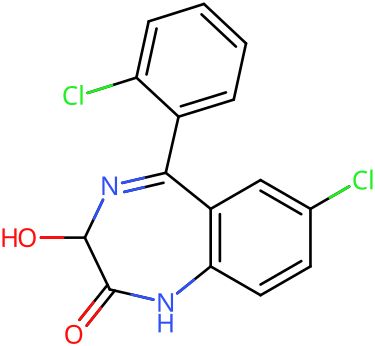
Lorazepam Stats & Data
DIWRORZWFLOCLC-UHFFFAOYSA-NInteraction Warnings
This combination can result in an increased risk of vomiting during unconsciousness and death from the resulting suffocation. If this occurs, users should attempt to fall asleep in the recovery position or have a friend move them into it.
It is dangerous to combine benzodiazepines with stimulants due to the risk of excessive intoxication. Stimulants decrease the sedative effect of benzodiazepines, which is the main factor most people consider when determining their level of intoxication. Once the stimulant wears off, the effects of benzodiazepines will be significantly increased, leading to intensified disinhibition as well as other effects.
Pharmacology
DrugBankDescription
Lorazepam is a short-acting and rapidly cleared benzodiazepine used commonly as a sedative and anxiolytic. It was developed by DJ Richards, presented and marketed initially by Wyeth Pharmaceuticals in the USA in 1977. The first historic FDA label approval is reported in 1985 by the company Mutual Pharm.
Mechanism of Action
Lorazepam allosterically binds on the benzodiazepine receptors in the post-synaptic GABA-A ligand-gated chloride channel in different sites of the central nervous system (CNS). This binding will result in an increase on the GABA inhibitory effects which is translated as an increase in the flow of chloride ions into the cell causing hyperpolarization and stabilization of the cellular plasma membrane. According to the binding site of lorazepam, we can observe different activities as the binding in the amygdala is known to help mainly in anxiety disorders while the binding in the cerebral cortex helps in seizure disorders.
Pharmacodynamics
The effect of lorazepam in GABA-A receptors produces an increase in the frequency of opening of the chloride ion channel. However, for its effect to generate, the neurotransmitter is required. The anticonvulsant properties of lorazepam are thought to be related to the binding to voltage-dependent sodium channels in which the sustained repetitive firing gets limited by the slow recovery of sodium channels due to the benzodiazepine effect. The effect of lorazepam seems to be very compartmental which was observed with a different generation of sleepiness and a dizziness effect.
Metabolism
Lorazepam is hepatically metabolized by CYP450 isoenzymes and extensively conjugated to the 3-0-phenolic glucuronide. This is an inactive metabolite and is eliminated mainly by the kidneys.
Absorption
Readily absorbed with an absolute bioavailability of 90% when given orally. When intramuscularly administered a dose of 4 mg, lorazepam is completely and rapidly absorbed and achieves a maximal serum concentration of 48 ng/ml in 15-30 minutes. When administered orally, the time to attained maximum concentration is observed to be of 2 hours.
Indication
Lorazepam is FDA-approved for the short-term relief of anxiety symptoms related to anxiety disorders and anxiety associated with depressive symptoms such as anxiety-associated insomnia. It is as well used as an anesthesia premedication in adults to relieve anxiety or to produce sedation/amnesia and for the treatment of status epilepticus. Some off-label indications of lorazepam include rapid tranquilization of an agitated patient, alcohol withdrawal delirium, alcohol withdrawal syndrome, muscle spasms, insomnia, panic disorder, delirium, chemotherapy-associated anticipatory nausea and vomiting, and psychogenic catatonia.
Half-life
When administered parentally, the registered half-life of lorazepam is of 14 hours.
Protein Binding
Reports indicate that 85% of lorazepam administered dose is protein bound.
Elimination
When a single 2 mg oral dose is given to healthy subjects, 88% of the administered dose is recovered in urine and 7% was recovered in feces. From the excreted dose in urine, the major form is the glucuronide version that represents 74% while only 0.3% of the dose is recovered as unchanged lorazepam.
Volume of Distribution
The reported volume of distribution of lorazepam is 1.3 L/kg. It is important to mention that due to the lipophilicity of lorazepam, it does not redistribute as fast in the brain.
Clearance
_In vivo_ studies with lorazepam have shown a clearance rate of 5.8 ml.min/kg.
Receptor Profile
Receptor Actions
Receptor Binding
Measured Affinities
Guide to PHARMACOLOGYMeasured binding and functional data for lorazepam, curated by the IUPHAR/BPS Guide to PHARMACOLOGY. Each row cites the paper it came from. Lower concentrations mean tighter binding — a value in the sub-nanomolar range indicates a very potent interaction.
| Target | Action | Measure | Value | Concentration | Species | Source |
|---|---|---|---|---|---|---|
| α1B-adrenoceptor Adra1b | Positive | pKi | 3.8 | 158,489 nM | Rat | PMID 10565838 |
| GPR68 GPR68 | Positive | - | — | — | Human | PMID 26550826 |
Reading this. pKi, pEC50 and pIC50 are negative log molar values, so a higher number means a tighter interaction; the concentration column converts them for you. Values from non-human species are laboratory measurements and do not translate directly to human effect. Receptor affinity is not a dose — it describes what a molecule binds, not how much of it is safe to take.
Receptor data from the IUPHAR/BPS Guide to PHARMACOLOGY (v2026.2), licensed CC BY-SA 4.0. Matched to this substance by InChIKey.
History & Culture
Lorazepam was initially patented in 1963 and is considered one of the "classical" benzodiazepines alongside diazepam, clonazepam, oxazepam, nitrazepam, flurazepam, bromazepam, and clorazepate. The compound was developed by D.J. Richards, who served as president of research at Wyeth Pharmaceuticals. The drug was introduced to the United States market in 1977 under the brand names Ativan and Temesta, with subsequent marketing under additional trade names in other regions. Wyeth's original patent on the compound has since expired. Lorazepam has achieved significant standing in modern pharmacology, being included on the World Health Organization's List of Essential Medicines. The compound is now available as a generic medication in many countries. As of 2023, it ranked as the 100th most commonly prescribed medication in the United States, with over six million prescriptions written annually. Non-medical use of lorazepam has been documented as a notable public health concern. A 2006 nationwide study by the Substance Abuse and Mental Health Services Administration examining pharmaceutical-related emergency department visits found that sedative-hypnotics represent the pharmaceutical category most frequently used outside of prescribed medical purposes in the United States, accounting for 35% of drug-related emergency department visits. Within this category, benzodiazepines constitute the most commonly encountered class, with lorazepam specifically ranking as the third-most-common benzodiazepine involved in non-prescription emergency department presentations.
Subjective Effects
Physical
The physical effects of lorazepam can be broken down into several components which progressively intensify proportional to dosage.
- Sedation: In terms of energy level alterations, this drug is extremely sedating and often results in an overwhelmingly lethargic state. At higher levels, this causes users to suddenly feel as if they are extremely sleep deprived and have not slept for days, forcing them to sit down and generally feel as if they are constantly on the verge of passing out instead of engaging in physical activities. This sense of sleep deprivation increases proportional to dosage and eventually becomes powerful enough to force a person into complete unconsciousness.
- Motor control loss
- Muscle relaxation
- Dizziness
- Respiratory depression
- Seizure suppression
Cognitive
The cognitive effects of lorazepam can be broken down into several components which progressively intensify proportional to dosage. The general head space of lorazepam is described by many as one of intense sedation and decreased inhibition. It contains a large number of typical depressant cognitive effects.
- Anxiety suppression
- Thought deceleration
- Disinhibition
- Information processing suppression
- Euphoria
- Amnesia
- Compulsive redosing
- Delusions of sobriety: This is the false belief that one is perfectly sober despite obvious evidence to the contrary such as severe cognitive impairment and an inability to fully communicate with others.
Forked from Subjective Effect Documentation by Josie Kins, September 2015. Via dose.wiki (CC0).
Lorazepam likely has a low toxicity relative to dose. However, it is potentially lethal when mixed with depressants like alcohol or opioids. It is strongly recommended that one use harm reduction practices when using this substance.
LD50
LD50, mouse, oral = 1850 mg/kgLD50: 3178mg/kg (oral, mice)
Carcinogenicity
No indication of carcinogenicity to humans (not listed by IARC).
Liver injury risk
Low concern (rare serious cases reported)
Overdose
Benzodiazepine overdose may occur when a benzodiazepine is taken in extremely heavy quantities or concurrently with other depressants. This is particularly dangerous with other GABAergic depressants such as barbiturates and alcohol since they work in a similar fashion, but bind to distinct allosteric sites on the GABAA receptor, thus their effects potentiate one another.
Effect Profile
Curated + 49 ReportsStrong anxiolysis with strong cognitive impairment, moderate sedation and euphoria
Tolerance & Pharmacokinetics
drugs.wikiNo tolerance chart. Our decay curves for these drugs were estimates, and a curve can make tolerance look longer-lasting than it is, which is the dangerous direction.
How fast tolerance to these drugs fades after a break has not been measured well enough to draw, so don't count on a dose you used to take still being safe: after time off, start with a much smaller amount and don't use alone. Mixing sedatives with each other, with alcohol or with opioids sharply raises the risk of a fatal overdose. If you've been using regularly, don't stop suddenly: withdrawal from benzodiazepines, alcohol or GHB/GBL can cause seizures or delirium, so get medical help to cut down gradually.
Sources: FRANK: benzodiazepines · Alcohol and Drug Foundation: GHB · FDA 2020: benzodiazepine boxed warning · FDA 2019: gabapentinoids and breathing · NHS: alcohol use disorder
Cross-Tolerances
Demographics
Gender Distribution
Age Distribution
Reports Over Time
Effect Analysis
Erowid + BluelightEffects aggregated from 49 experience reports (39 single-substance Erowid + 10 Bluelight)
Effect Sentiment Distribution
Confidence Distribution
Each bar is the share of reports mentioning the effect; its whisker, and the band on the rows below, is the 95% interval: where the share could plausibly be with other reports of the same kind.
Rows resting on fewer than 20 reports show a count (“3 of 7”) instead of a bar. Why 20?
Positive Effects 15
Adverse Effects 27
Show 7 more adverse effects
Show 18 neutral or unclassified mentions
Also reported in combinations. In the 57 Lorazepam reports where another drug was taken too, 19 (33.3%) mention hospital, emergency services or an overdose, 3 (5.3%) a seizure and 2 (3.5%) psychosis. In the 39 single-substance reports: 17.9%, 2.6% and 2.6%. These are not in the figures above: they cannot be put down to Lorazepam alone, and a mention is not always something that happened to the writer.
Dose-Response Correlation
How effect frequency changes across dose levels. Whiskers, and the numbers' hover text, give each figure's 95% interval.
Not drawn, too few reports (a dose tier needs 20): Oral Common (n=10), Oral Heavy (n=12). Why 20?
Dosage Distribution
Dose distribution from experience reports, one dose per report (the first listed). Doses above Q3 + 3×IQR, far above what people typically take, are left out of the median and range and listed under each route: most are real heavy doses or overdoses, not mistakes.
1 report gave a dose above the typical range (20 mg), so it is not in the figures above. Listing a dose here does not mean it is safe.
Show the report
- 20 mg · another drug taken too
Real-World Dose Distribution
ErowidFrom 172 of 189 recorded dose entries: those that state a weight (mg, g or µg), in routes with at least five of them. Values above Q3 + 3×IQR, far above what people typically take, are left out; they can include real heavy doses and overdoses, not only mistakes.
Oral (n=148)
Sublingual (n=12)
Insufflated (n=7)
Common Combinations
Most co-occurring substances, as a share of all 96 reports filed under Lorazepam; whiskers are 95% intervals
Form / Preparation
Most common forms and preparations, as a share of the 75 reports that give one; whiskers are 95% intervals
Body-Weight Dosing
Dose per kg of body weight, one dose per report (the first listed), from reports giving a weight of 30–250 kg. Doses above Q3 + 3×IQR, far above what people typically take, are left out of the median and range and listed under each route.
1 report gave a dose above the typical range (0.364 mg/kg), so it is not in the figures above. Listing a dose here does not mean it is safe.
Show the report
- 0.364 mg/kg · another drug taken too
Redose Patterns
Redosing behavior across 90 reports
Benzodiazepine Equivalence
Lorazepam - 1mg ~=10mg Diazepam.
Legal Status
| Country | Status | Notes |
|---|---|---|
| Argentina | Reportedly available without prescription | Unconfirmed reports suggest lorazepam may be obtainable at some pharmacies without prescription in 0.5 mg and 1 mg formulations. Regulatory enforcement may vary. |
| Austria | Prescription only | Legal for medical use under the Arzneimittelgesetz (AMG). Possession or sale without a prescription is prohibited under the Suchtmittelgesetz (SMG). |
| Canada | Schedule IV CDSA | Listed in Schedule IV of the Controlled Drugs and Substances Act alongside other benzodiazepines. Requires a valid prescription for lawful possession. |
| China | Class II psychotropic substance | Regulated as a Class II psychotropic substance under national drug control laws. Prescriptions are generally limited to a seven-day supply. |
| Germany | Anlage III BtMG | Controlled under Anlage III of the Betäubungsmittelgesetz (Narcotics Act) since August 1, 1986. Generally requires a narcotic prescription form, with an exception for preparations containing up to 2.5 mg lorazepam per dosage unit. |
| New Zealand | Class C | Controlled as a Class C drug under the Misuse of Drugs Act 1975. Prescription required for lawful possession. |
| Poland | Group IV-P psychotropic substance | Controlled under the psychotropic substances act as a Group IV-P substance, designated as having low potential for abuse. Legal for medical, scientific, and manufacturing purposes with appropriate authorization. |
| Russia | Schedule III | Classified as a Schedule III controlled substance since 2013. Requires prescription for lawful possession and use. |
| Switzerland | Verzeichnis B | Specifically named as a controlled substance under Verzeichnis B of Swiss narcotics legislation. Medicinal use is permitted with appropriate authorization. |
| Turkey | Green prescription only | Requires a 'green prescription' (special controlled substance prescription). Possession or sale without valid prescription is prohibited. |
| United Kingdom | Class C | Classified as a Class C drug under the Misuse of Drugs Act 1971. Listed under Schedule IV, Part I (CD Benz POM) of the Misuse of Drugs Regulations 2001, permitting possession with a valid prescription. |
| United States | Schedule IV | Controlled under the Controlled Substances Act as a Schedule IV depressant. Possession without a valid prescription is illegal, as is sale without appropriate licensing. |
Harm Reduction
drugs.wikiLorazepam is a GABA-A positive allosteric modulator that produces sedation, anxiolysis, muscle relaxation, anticonvulsant effects, and anterograde amnesia; mixing with alcohol or opioids greatly increases respiratory depression risk and overdose potential. It is primarily cleared by phase II glucuronidation to lorazepam-glucuronide (minimal CYP involvement), so classic CYP interactions are uncommon, but additive CNS depression with other sedatives remains the main hazard. Amnesia and disinhibition are dose-related; redosing while effects are ongoing is a common pathway to blackouts and risky behavior. In older adults, benzodiazepines increase falls, cognitive impairment, and crash risk; use lower doses and avoid driving/operating machinery while affected. Co-use with GHB/GBL or opioids is specifically flagged as dangerous by harm-reduction resources due to strong, unpredictable potentiation and aspiration risk if unconscious; avoid these combinations. Counterfeit tablets and designer benzodiazepines in the illicit market can contain highly potent analogues or incorrect doses; avoid non-prescribed products and be cautious with unknown sources. In suspected overdose, supportive care is first-line; flumazenil is generally avoided in chronic benzodiazepine users because it can precipitate severe withdrawal and seizures. Parenteral lorazepam (not oral) contains propylene glycol; prolonged high-dose IV use can cause propylene glycol toxicity—this is not a concern for standard oral dosing but matters in hospital settings. During lactation, usual maternal doses appear compatible with breastfeeding, but infants should be monitored for sedation or poor feeding. Abrupt cessation after repeated use may cause withdrawal (including seizures); any taper should be gradual and medically supervised.
References
Data Sources
Cited References
Additional references
- DrugBank – Lorazepam (DB00186)
- DrugBank – Lorazepam glucuronide metabolite
- TripSit – Drug combinations chart
- TripSit – Benzodiazepines (class page)
- EUDA/EMCDDA – Misuse of benzodiazepines among high-risk opioid users
- EUDA – EU Drug Market (new benzodiazepines, counterfeit risks)
- StatPearls – Benzodiazepine Toxicity
- StatPearls – Benzodiazepines (class overview, adverse effects)
- LactMed (NCBI) – Lorazepam and breastfeeding
- NCBI Guideline Evidence Review – Safe benzodiazepine withdrawal