
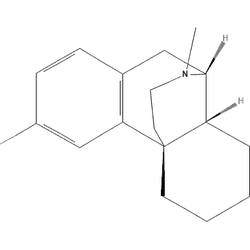
Levorphanol Stats & Data
Oc1ccc2CC3N(C)CCC4(CCCCC34)c2c1JAQUASYNZVUNQP-USXIJHARSA-NPharmacology
DrugBankDescription
A narcotic analgesic that may be habit-forming. It is nearly as effective orally as by injection.
Mechanism of Action
Like other mu-agonist opioids it is believed to act at receptors in the periventricular and periaqueductal gray matter in both the brain and spinal cord to alter the transmission and perception of pain.
Pharmacodynamics
Levorphanol is a potent synthetic opioid analgesic indicated for the management of moderate to severe pain or as a preoperative medication where an opioid analgesic is appropriate. Levorphanol is similar to morphine in its actions, however it is up to 8 times more potent than morphine. Levorphanol produces a degree of respiratory depression similar to that produced by morphine at equianalgesic doses, and like many mu-opioid drugs, levorphanol produces euphoria or has a positive effect on mood in many individuals.
Metabolism
Levorphanol is extensively metabolized in the liver and is eliminated as the glucuronide metabolite.
Absorption
Levorphanol is well absorbed after PO administration with peak plasma concentrations occurring approximately 1 hour after dosing.
Indication
For the management of moderate to severe pain or as a preoperative medication where an opioid analgesic is appropriate.
Measured Affinities
Guide to PHARMACOLOGYMeasured binding and functional data for levorphanol, curated by the IUPHAR/BPS Guide to PHARMACOLOGY. Each row cites the paper it came from. Lower concentrations mean tighter binding — a value in the sub-nanomolar range indicates a very potent interaction.
| Target | Action | Measure | Value | Concentration | Species | Source |
|---|---|---|---|---|---|---|
| μ receptor OPRM1 | Agonist | pIC50 | 9.89 | 0.129 nM | Human | PMID 12502358 |
| GluN2C GRIN2C | Channel blocker | pIC50 | 6.22 | 602.56 nM | Human | PMID 17303642 |
Reading this. pKi, pEC50 and pIC50 are negative log molar values, so a higher number means a tighter interaction; the concentration column converts them for you. Values from non-human species are laboratory measurements and do not translate directly to human effect. Receptor affinity is not a dose — it describes what a molecule binds, not how much of it is safe to take.
Receptor data from the IUPHAR/BPS Guide to PHARMACOLOGY (v2026.2), licensed CC BY-SA 4.0. Matched to this substance by InChIKey.
Like other mu-agonist opioids it is believed to act at receptors in the periventricular and periaqueductal gray matter in both the brain and spinal cord to alter the transmission and perception of pain.
LD50
LD50: 150 mg/kg (Oral, Rat) (A308)
Carcinogenicity
No indication of carcinogenicity to humans (not listed by IARC).
Health effects (PubChem excerpts)
Medical problems can include congested lungs, liver disease, tetanus, infection of the heart valves, skin abscesses, anemia and pneumonia. Death can occur from overdose.
Experience Report Analysis
ErowidDemographics
Gender Distribution
Too few reports for a chart: gender is known from 1 report, and a split is drawn only from 20 reports or more. Counts are shown instead. Why 20?
- Male 1 of 1
Reports Over Time
Opioid Equivalence (MME)
NIH HEAL 2024 & CDC 2022Levorphanol 0.9 mg oral ≈ 10 mg Morphine oral