
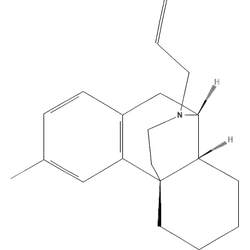
Levallorphan Stats & Data
C=CCN1CCC23CCCCC3C1Cc1ccc(O)cc12OZYUPQUCAUTOBP-QXAKKESOSA-NPharmacology
DrugBankDescription
An opioid antagonist with properties similar to those of naloxone; in addition it also possesses some agonist properties. It should be used cautiously; levallorphan reverses severe opioid-induced respiratory depression but may exacerbate respiratory depression such as that induced by alcohol or other non-opioid central depressants. (From Martindale, The Extra Pharmacopoeia, 30th ed, p683)
Mechanism of Action
Levallorphan antagonizes opioid effects by competing for the same receptor sites. It binds to the opioid mu receptor and the nicotinic acetylcholine receptor alpha2/alpha3.
Pharmacodynamics
Levallorphan, an opioid antagonist similar to naloxone, is used to treat drug overdoses. Levallorphan differs from naloxone in that it also possesses some agonist properties. It is an analogue of levelorphanol that counteracts the actions of narcotic analgesics such as morphine. It is used especially in the treatment of respiratory depression due to narcotic overdoses. Levallorphan prevents or reverses the effects of opioids including respiratory depression, sedation and hypotension. Also, it can reverse the psychotomimetic and dysphoric effects of agonist-antagonists such as pentazocine.
Indication
For the complete or partial reversal of narcotic depression, including respiratory depression, induced by opioids.
Measured Affinities
Guide to PHARMACOLOGYMeasured binding and functional data for levallorphan, curated by the IUPHAR/BPS Guide to PHARMACOLOGY. Each row cites the paper it came from. Lower concentrations mean tighter binding — a value in the sub-nanomolar range indicates a very potent interaction.
| Target | Action | Measure | Value | Concentration | Species | Source |
|---|---|---|---|---|---|---|
| μ receptor OPRM1 | Antagonist | pKi | — | — | Human | PMID 21621410 |
Reading this. pKi, pEC50 and pIC50 are negative log molar values, so a higher number means a tighter interaction; the concentration column converts them for you. Values from non-human species are laboratory measurements and do not translate directly to human effect. Receptor affinity is not a dose — it describes what a molecule binds, not how much of it is safe to take.
Receptor data from the IUPHAR/BPS Guide to PHARMACOLOGY (v2026.2), licensed CC BY-SA 4.0. Matched to this substance by InChIKey.
Toxicity
DrugBankToxicity (DrugBank)
Oral, rat LD50: 109±4 mg/kg