
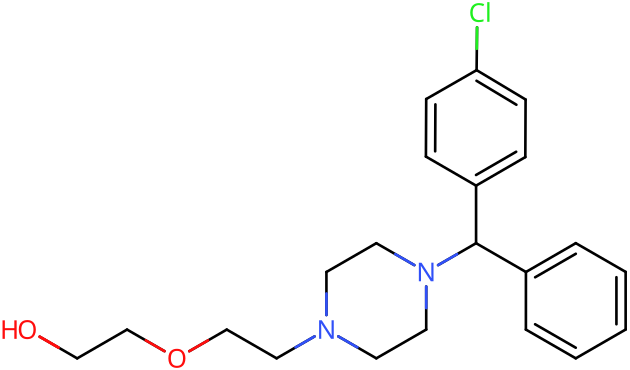
Hydroxyzine Stats & Data
ZQDWXGKKHFNSQK-UHFFFAOYSA-NPharmacology
DrugBankDescription
Hydroxyzine is a first-generation histamine H1-receptor antagonist of the dephenylmethane and piperazine classes that exhibits sedative, anxiolytic, and antiemetic properties. It was first developed in 1955, and has since remained a relatively common treatment for allergic conditions such as pruritus, urticaria, dermatoses, and histamine-mediated pruritus. The active metabolite of hydroxyzine, cetirizine, is also available as an active ingredient in allergic medications, and is responsible for much of its hydroxyzine's antihistaminic effect. Hydroxyzine is also used for generalized anxiety disorder, tension caused by psychoneurosis, and other conditions with manifestations of anxiety.
Mechanism of Action
The H1 histamine receptor is responsible for mediating hypersensitivity and allergic reactions. Exposure to an allergen results in degranulation of mast cells and basophils, which then release histamine and other inflammatory mediators. Histamine binds to, and activates, H1 receptors, which results in the further release of pro-inflammatory cytokines, such as interleukins, from basophils and mast cells. These downstream effects of histamine binding are responsible for a wide variety of allergic symptoms, such as pruritus, rhinorrhea, and watery eyes. Hydroxyzine is a potent inverse agonist of histamine H1-receptors - inverse agonists are agents that are considered to have a "negative efficacy", so rather than simply blocking activity at a receptor they actively dampen its activity. Inverse agonism at these receptors is responsible for hydroxyzine's efficacy in the treatment of histaminic edema, flare, and pruritus. Hydroxyzine is not a cortical depressant, so its sedative properties likely occur at the subcortical level of the CNS. These sedative properties allow activity as an anxiolytic. Antiemetic efficacy is likely secondary to activity at off-targets.
Pharmacodynamics
Hydroxyzine blocks the activity of histamine to relieve allergic symptoms such as pruritus. Activity at off-targets also allows for its use as a sedative anxiolytic and an antiemetic in certain disease states. Hydroxyzine is relatively fast-acting, with an onset of effect that occurs between 15 and 60 minutes and a duration of action between 4-6 hours. Hydroxyzine may potentiate the effects of central nervous system (CNS) depressants following general anesthesia - patients maintained on hydroxyzine should receive reduced doses of any CNS depressants required. Hydroxyzine is reported to prolong the QT/QTc interval based on postmarketing reports of rare events of Torsade de Pointes, cardiac arrest, and sudden death, and should be used with caution in patients with an increased baseline risk for QTc prolongation.
Metabolism
Hydroxyzine is metabolized in the liver by CYP3A4 and CYP3A5. While the precise metabolic fate of hydroxyzine is unclear, its main and active metabolite (~45 to 60% of an orally administered dose), generated by oxidation of its alcohol moiety to a carboxylic acid, is the second-generation antihistamine cetirizine. Hydroxyzine is likely broken down into several other metabolites, though specific structures and pathways have not been elucidated in humans.
Absorption
The absolute bioavailability of hydroxyzine has not been ascertained, as intravenous formulations are unavailable due to a risk of hemolysis. Hydroxyzine is rapidly absorbed from the gastrointestinal tract upon oral administration, reaching its maximum plasma concentration (Tmax) approximately 2 hours following administration.
Indication
Hydroxyzine is indicated for the symptomatic relief of anxiety and tension associated with psychoneuroses, and as an adjunct in organic disease states in which anxiety is manifested. It is also indicated in the treatment of histamine-mediated pruritus and pruritus due to allergic conditions such as chronic urticaria. Canadian labeling states that hydroxyzine is also indicated in adults and children as a premedication prior to medical procedures, such as dental surgery. It is also used in the control of nausea and vomiting, excluding nausea and vomiting of pregnancy.
Half-life
The half-life of hydroxyzine is reportedly 14-25 hours, and appears to be, on average, shorter in children (~7.1 hours) than in adults (~20 hours). Elimination half-life is prolonged in the elderly, averaging approximately 29 hours, and is likely to be similarly prolonged in patients with renal or hepatic impairment.
Protein Binding
Hydroxyzine has been shown to bind to human albumin _in vitro_, but the extent of protein binding in plasma has not been evaluated.
Elimination
Approximately 70% of hydroxyzine's active metabolite, cetirizine, is excreted unchanged in the urine. The precise extent of renal and fecal excretion in humans has not been determined.
Volume of Distribution
The mean volume of distribution is 16.0 ± 3.0 L/kg. Higher concentrations are found in the skin than in the plasma.
Clearance
Clearance of hydroxyzine has been reported to be 31.1 ± 11.1 mL/min/kg in children and 9.8 ± 3.3 mL/min/kg in adults.
Receptor Profile
Receptor Actions
Receptor Binding
Measured Affinities
Guide to PHARMACOLOGYMeasured binding and functional data for hydroxyzine, curated by the IUPHAR/BPS Guide to PHARMACOLOGY. Each row cites the paper it came from. Lower concentrations mean tighter binding — a value in the sub-nanomolar range indicates a very potent interaction.
| Target | Action | Measure | Value | Concentration | Species | Source |
|---|---|---|---|---|---|---|
| H1 receptor HRH1 | Antagonist | pKi | 8.7 | 2 nM | Human | PMID 11809864 |
Reading this. pKi, pEC50 and pIC50 are negative log molar values, so a higher number means a tighter interaction; the concentration column converts them for you. Values from non-human species are laboratory measurements and do not translate directly to human effect. Receptor affinity is not a dose — it describes what a molecule binds, not how much of it is safe to take.
Receptor data from the IUPHAR/BPS Guide to PHARMACOLOGY (v2026.2), licensed CC BY-SA 4.0. Matched to this substance by InChIKey.
Hydroxyzine competes with histamine for binding at H<sub>1</sub>-receptor sites on the effector cell surface, resulting in suppression of histaminic edema, flare, and pruritus. The sedative properties of hydroxyzine occur at the subcortical level of the CNS.
Carcinogenicity
No indication of carcinogenicity to humans (not listed by IARC).
Liver injury risk
No documented concern
Toxicity (DrugBank)
The oral LD50 is 840 mg/kg in rats and 400 mg/kg in mice. Overdose from hydroxyzine is most commonly characterized by hypersedation, but may also manifest as convulsions, stupor, nausea, and vomiting. In cases of overdose, consider the induction of vomiting and the use of gastric lavage. Other treatment should involve general symptomatic and supportive care. Hypotension may be controlled by intravenous fluids and pressors, and caffeine and sodium benzoate injection may be used to counteract any observed CNS depressant effects. Hemodialysis is unlikely to provide any benefit in the treatment hydroxyzine overdose.
Tolerance & Pharmacokinetics
drugs.wikiTolerance Decay
Cross-Tolerances
Experience Report Analysis
ErowidDemographics
Gender Distribution
Too few reports for a chart: gender is known from 15 reports, and a split is drawn only from 20 reports or more. Counts are shown instead. Why 20?
- Male 10 of 15
- Not Specified 2 of 15
- Female 3 of 15
Age Distribution
Reports Over Time
Effect Analysis
ErowidEffects aggregated from 7 experience reports (7 single-substance Erowid)
Effect Sentiment Distribution
Confidence Distribution
Each bar is the share of reports mentioning the effect; its whisker, and the band on the rows below, is the 95% interval: where the share could plausibly be with other reports of the same kind.
Too few reports for bars: these effects come from 7 single-substance Erowid reports, and a bar is drawn only from 20 reports or more. With fewer, a percentage cannot tell a common effect from a rare one. Counts are shown instead. Why 20?
Positive Effects 1
Adverse Effects 1
Also reported in combinations. In the 8 Hydroxyzine reports where another drug was taken too, 2 mention hospital, emergency services or an overdose, 0 a seizure and 0 psychosis (too few reports for percentages). In the 7 single-substance reports: 0, 0 and 0. These are not in the figures above: they cannot be put down to Hydroxyzine alone, and a mention is not always something that happened to the writer.
Real-World Dose Distribution
ErowidFrom 26 of 27 recorded dose entries: those that state a weight (mg, g or µg), in routes with at least five of them. Values above Q3 + 3×IQR, far above what people typically take, are left out; they can include real heavy doses and overdoses, not only mistakes.
Oral (n=25)
Form / Preparation
Most common forms and preparations, as a share of the 7 reports that give one
Too few reports for bars: these forms come from 7 reports, and a bar is drawn only from 20 reports or more. With fewer, a percentage cannot tell a common effect from a rare one. Counts are shown instead. Why 20?
- Pill / Tablet 5 of 7
Redose Patterns
Redosing behavior across 10 reports
Too few reports for a chart: redosing is known from 10 reports, and a split is drawn only from 20 reports or more. Counts are shown instead. Why 20?
- Single dose 8 of 10
- Redosed 2 of 10
References
Cited References
- Drugs.com: Hydroxyzine
- Drugs.com: Hydroxyzine-Oxycodone Interaction
- Drugs.com: Hydroxyzine-Xanax Interaction
- FDA: Vistaril (hydroxyzine pamoate) Label
- GoodRx: Hydroxyzine Side Effects
- Mayo Clinic: Hydroxyzine (Oral Route)
- Medical News Today: Hydroxyzine Interactions
- NCBI: Co-Administration of Subeffective Doses of Diazepam and Hydroxyzine
- NCBI LiverTox: Hydroxyzine
- PubMed: Potentiation of Pain Relief with Hydroxyzine
- Real Life Pharmacology: Hydroxyzine Pharmacology
- ScienceDirect: Hydroxyzine Overview
- Talkiatry: Hydroxyzine vs Xanax
- WebMD: Hydroxyzine (Atarax, Vistaril)