
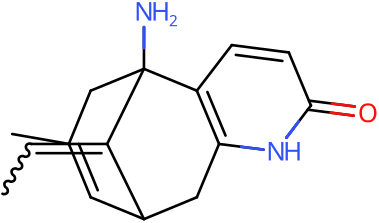
HUPERZINE-A Stats & Data
CC=C1C2C=C(C)CC1(N)c1ccc(=O)nc1C2ZRJBHWIHUMBLCN-YQEJDHNASA-NPharmacology
DrugBankDescription
Huperzine A, is a naturally occurring sesquiterpene alkaloid found in the extracts of the firmoss _Huperzia serrata_. The botanical has been used in China for centuries for the treatment of swelling, fever and blood disorders. Recently in clinical trials in China, it has demonstrated neuroprotective effects. It is currently being investigated as a possible treatment for diseases characterized by neurodegeneration – particularly Alzheimer’s disease.
Mechanism of Action
Huperzine A has been found to be an inhibitor of the enzyme acetylcholinesterase. This is the same mechanism of action of pharmaceutical drugs such as galantamine and donepezil used to treat Alzheimer's disease.
Pharmacodynamics
Huperzine A is an alkaloid derived from <i>Huperzia serrata</i> (which is available as an herbal product in the US). It is under investigation as an acetylcholinesterase inhibitor. Clinical trials in China have shown that huperzine A is comparably effective to the drugs currently on the market, and may even be somewhat safer in terms of side effects.
Indication
Investigated for use/treatment in alzheimer's disease.
Measured Affinities
Guide to PHARMACOLOGYMeasured binding and functional data for huperzine A, curated by the IUPHAR/BPS Guide to PHARMACOLOGY. Each row cites the paper it came from. Lower concentrations mean tighter binding — a value in the sub-nanomolar range indicates a very potent interaction.
| Target | Action | Measure | Value | Concentration | Species | Source |
|---|---|---|---|---|---|---|
| acetylcholinesterase (Yt blood group) ACHE | Inhibition | pKd | 7.77 | 16.98 nM | Human | PMID 33570950 |
Reading this. pKi, pEC50 and pIC50 are negative log molar values, so a higher number means a tighter interaction; the concentration column converts them for you. Values from non-human species are laboratory measurements and do not translate directly to human effect. Receptor affinity is not a dose — it describes what a molecule binds, not how much of it is safe to take.
Receptor data from the IUPHAR/BPS Guide to PHARMACOLOGY (v2026.2), licensed CC BY-SA 4.0. Matched to this substance by InChIKey.