
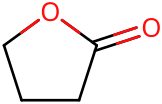
GBL Stats & Data
YEJRWHAVMIAJKC-UHFFFAOYSA-NInteraction Warnings
This combination can result in an increased risk of vomiting during unconsciousness and death from the resulting suffocation. If this occurs, users should attempt to fall asleep in the recovery position or have a friend move them into it.
It is dangerous to combine GBL, a depressant, with stimulants due to the risk of excessive intoxication. Stimulants decrease the sedative effect of GBL, which is the main factor most people consider when determining their level of intoxication. Once the stimulant wears off, the effects of GHB will be significantly increased, leading to intensified disinhibition as well as other effects. If combined, one should strictly limit themselves to only dosing a certain amount of GHB per hour.
Pharmacology
DrugBankDescription
One of the furans with a carbonyl thereby forming a cyclic lactone. It is an endogenous compound made from gamma-aminobutyrate and is the precursor of gamma-hydroxybutyrate. It is also used as a pharmacological agent and solvent.
Mechanism of Action
GBL is a rapidly- and short-acting prodrug to GHB with an uneven conversion rate into the same. (1g GHB = 1.6 ml GBL)
Pharmacodynamics
GBL can be converted to GHB prior to ingestion with a strong base, or after ingestion via blood lactonases.
Receptor Profile
Receptor Actions
History & Culture
GBL has a long history as an industrial chemical, primarily valued as a solvent and intermediate in the synthesis of other compounds. Its commercial applications have included use as a flavoring agent, stain remover, wheel cleaner, paint stripper, superglue remover, and as a solvent in certain wet aluminum electrolytic capacitors. The recreational history of GBL is closely intertwined with the scheduling of GHB. Following restrictions placed on GHB, GBL was marketed as a nutritional supplement under brand names such as Revivarant and Renewtrient, capitalizing on its property as a GHB prodrug that enhances sleep-related growth hormone secretion. These products were eventually prohibited by the FDA. In response to tightening regulations on both substances, home synthesis kits emerged that enabled users to convert GBL and 1,4-butanediol into GHB, effectively circumventing restrictions on the scheduled substance. The relative accessibility of GBL's precursors has contributed to its popularity in certain recreational contexts, particularly among young people in French nightclub scenes where it can be produced with readily available materials. Both GBL and GHB are colloquially referred to as "K.-o.-Tropfen" (knockout drops) in German-speaking countries. While concerns have been raised regarding the potential use of GBL as a drug-facilitated sexual assault agent—particularly as an alternative to scheduled GHB—the available evidence suggests such use is not widespread, especially when compared to alcohol, partly due to GBL's distinctively strong taste.
Subjective Effects
Physical
The physical effects of GBL can be broken down into several components which progressively intensify proportional to dosage.
- Stimulation and Sedation: At lower dosages GBL is physically stimulating, encouraging movement and wakefulness. At higher dosages, however, it becomes physically sedating, encouraging sleep and lethargy.
- Respiratory depression: In cases of GBL overdoses, many reportedly experience an abnormal pattern of breathing characterized by progressively deeper and sometimes faster breathing, followed by a gradual decrease that results in a temporary stop in breathing called an apnea.
- Euphoria
- Nausea
- Motor control loss
- Dizziness
- Dehydration
Cognitive
The cognitive effects of GBL can be broken down into several components which progressively intensify proportional to dosage.
- Empathy, love and sociability enhancement: Unlike alcohol which merely increases sociability through disinhibition, GBL presents strong entactogenic effects which although weaker than that of MDMA are still prominent and well defined.
- Disinhibition
- Information processing suppression
- Thought deceleration
- Amnesia
- Euphoria
- Anxiety suppression
Forked from Subjective Effect Documentation by Josie Kins, September 2015. Via dose.wiki (CC0).
GBL is not active in its own right; its mechanism of action stems from its identity as a prodrug of GHB, meaning that it is rapidly converted into GHB in the body. GBL is not considered to be as safe as GHB used responsibly or medicinally, since it is theorized to display additional toxic effects on the body in difference to GHB. The LD50 is above the active dosage, and there is no danger of acute toxicity. However, it can become dangerous when used as a recreational drug, abused, or in combination with other drugs. There have been many negative reports from recreational users who have overdosed, combined GBL with alcohol or other drugs, or accidentally dosed themselves unexpectedly or way above the common dosage range.
LD50
LD50: 17.2 mL/kg (Oral, Rat) (581)
Carcinogenicity
Group 3: Not classifiable as to its carcinogenicity to humans
Organ-specific toxicity
GBL itself may also produce neurotoxic effects, in addition to the effects of GHB, to which it is converted to by the body. In multiple studies, GHB has been found to impair spatial memory, working memory, learning and memory in rats with chronic administration. These effects are associated with decreased NMDA receptor expression in the cerebral cortex and possibly other areas as well.
Community Effects
TripSitTolerance & Pharmacokinetics
drugs.wikiNo tolerance chart. Our decay curves for these drugs were estimates, and a curve can make tolerance look longer-lasting than it is, which is the dangerous direction.
How fast tolerance to these drugs fades after a break has not been measured well enough to draw, so don't count on a dose you used to take still being safe: after time off, start with a much smaller amount and don't use alone. Mixing sedatives with each other, with alcohol or with opioids sharply raises the risk of a fatal overdose. If you've been using regularly, don't stop suddenly: withdrawal from benzodiazepines, alcohol or GHB/GBL can cause seizures or delirium, so get medical help to cut down gradually. With GHB and GBL, tolerance drops after you stop, so the amount you used to take can cause an overdose, and the gap between the dose you want and an overdose is small and hard to judge.
Sources: FRANK: benzodiazepines · Alcohol and Drug Foundation: GHB · FDA 2020: benzodiazepine boxed warning · FDA 2019: gabapentinoids and breathing · NHS: alcohol use disorder · FRANK: GHB
Cross-Tolerances
Experience Report Analysis
ErowidDemographics
Gender Distribution
Age Distribution
Reports Over Time
Effect Analysis
ErowidEffects aggregated from 42 experience reports (42 single-substance Erowid)
Effect Sentiment Distribution
Confidence Distribution
Each bar is the share of reports mentioning the effect; its whisker, and the band on the rows below, is the 95% interval: where the share could plausibly be with other reports of the same kind.
Positive Effects 9
Adverse Effects 7
Show 4 neutral or unclassified mentions
Also reported in combinations. In the 38 GBL reports where another drug was taken too, 10 (26.3%) mention hospital, emergency services or an overdose, 3 (7.9%) a seizure and 2 (5.3%) psychosis. In the 42 single-substance reports: 26.2%, 7.1% and 9.5%. These are not in the figures above: they cannot be put down to GBL alone, and a mention is not always something that happened to the writer.
Dosage Distribution
Dose distribution from experience reports, one dose per report (the first listed). Doses above Q3 + 3×IQR, far above what people typically take, are left out of the median and range and listed under each route: most are real heavy doses or overdoses, not mistakes.
1 report gave a dose above the typical range (20 ml), so it is not in the figures above. Listing a dose here does not mean it is safe.
Show the report
Real-World Dose Distribution
ErowidFrom 9 of 71 recorded dose entries: those that state a weight (mg, g or µg), in routes with at least five of them. Values above Q3 + 3×IQR, far above what people typically take, are left out; they can include real heavy doses and overdoses, not only mistakes.
Oral (n=8)
Common Combinations
Most co-occurring substances, as a share of all 80 reports filed under GBL; whiskers are 95% intervals
Form / Preparation
Most common forms and preparations, as a share of the 52 reports that give one; whiskers are 95% intervals
Redose Patterns
Redosing behavior across 65 reports
Legal Status
| Country | Status | Notes |
|---|---|---|
| Australia | Border Controlled Substance | Illegal to import without a permit. Importation of a commercial quantity (over 1 kg) is punishable by up to life imprisonment and/or an AUD $825,000 fine. |
| Austria | Illegal (NPSG) | Since January 1, 2012, possession, production, and sale are prohibited under the Neue-Psychoaktive-Substanzen-Gesetz (New Psychoactive Substances Act). |
| Canada | Schedule VI (CDSA) | Controlled under Schedule VI of the Controlled Drugs and Substances Act. Vendors must collect purchase information. Import and export are prohibited, punishable as an indictable offence (up to 10 years) or summary conviction (up to 18 months). Personal possession is not illegal. |
| Germany | Controlled Distribution | Not listed in the Betäubungsmittelgesetz (Narcotics Act), but distribution is controlled. Possession is not illegal unless intended for human consumption or GHB synthesis, in which case the Arzneimittelgesetz (Medicines Act) may apply. |
| Hong Kong | Schedule 1 (Dangerous Drugs Ordinance) | Controlled as a dangerous drug under Schedule 1 of the Dangerous Drugs Ordinance, Cap.134, with exemption clause at Paragraph 16D. Unauthorized possession punishable by a fine of HK$1,000,000 and imprisonment for 7 years upon indictment. |
| Israel | Proscribed Substance | Classified as a proscribed substance since 2007. Possession, production, and distribution are prohibited under national drug control legislation. |
| Netherlands | Legal (Industrial Use) | Freely available as a cleaning agent. Retailers do not require a license to sell the substance for legitimate industrial purposes. |
| Poland | Controlled Drug | Classified as a drug under national pharmaceutical legislation. Handling requires a pharmaceutical license; unauthorized possession and distribution are prohibited. |
| Sweden | Health-Endangering Substance | Not classified as a narcotic drug but designated a health-endangering substance. Legislation enacted in April 2011 enabled GBL to be treated as a controlled substance when not used for legitimate industrial purposes. |
| Switzerland | Illegal (GHB Analog) | Considered an ester analog of GHB, making it controlled under Buchstabe B of Swiss narcotics legislation. Industrial use remains permitted with appropriate authorization. |
| Turkey | Illegal | Classified as a controlled drug. Possession, production, supply, and importation are prohibited under national drug legislation. |
| United Kingdom | Conditionally Controlled | Under Regulation 4B of the Misuse of Drugs Regulations 2001, it is lawful to import, export, produce, supply, or possess GBL for legitimate purposes. The substance becomes controlled when a person handles it knowing or believing it will be used for human ingestion. |
| United States | List I Controlled Chemical | Regulated as a List I controlled chemical under federal law. As a GHB analog, it is treated as a Schedule I controlled substance under the Controlled Substances Act when intended for human consumption. |
Harm Reduction
drugs.wikiGBL is a prodrug rapidly converted to GHB in vivo; relative to GHB it is more potent by volume and has a faster, sharper onset, which increases overdose risk from small mismeasurements. GBL is a skin/mucosal irritant solvent; always dilute in a non‑alcoholic drink before swallowing, avoid contact with eyes/skin, and never inject or insufflate. The dose‑response curve is steep: recreational doses lie close to doses causing unrousable sleep and, at higher levels or when mixed with other depressants, life‑threatening respiratory depression. Redosing too soon causes stacking: wait at least 2 hours between doses and reduce any redose; dopamine‑rebound wakefulness 3–5 hours later can create a strong compulsion to redose but increases risk of dependence. Food reduces/slow s absorption; many HR groups suggest dosing at least 2 hours after eating and avoiding further redose until effects fully plateau. Never combine with alcohol, benzodiazepines, opioids, barbiturates, Z‑drugs, or other depressants; ketamine with G markedly increases loss of consciousness and breathing problems. If someone becomes unrousable, place them in the recovery position, keep airway clear, monitor breathing, and seek emergency help; do not ‘wake’ them with stimulants or give more substances. Tolerance can develop in days with frequent use; withdrawal may begin within 1–6 hours after the last dose and can escalate to agitation, delirium, tachycardia, and life‑threatening complications — medical supervision is essential for dependent users. Concentration varies by source and bottles; unknown dilution is common — start low (0.3–0.5 mL), measure precisely to 0.1 mL, and label doses/times to avoid mistakes. GHB/GBL may reduce efficacy of some HIV medications; avoid co‑use and consult a clinician if on antiretrovirals. As a solvent, GBL can degrade some plastics; prefer glass (or chemically resistant equipment) for storage/measurement, clearly label, add a food‑safe dye to avoid accidental ingestion, and keep locked away from children/pets. Do not drive or operate machinery; some HR groups advise waiting at least 24 hours after last dose before driving due to residual impairment and stacking.
References
Cited References
- ACMD: GBL & 1,4-BD Assessment of Risk to the Individual
- Corkery et al. 2015 - GHB, GBL and 1,4-BD Literature Review
- DrugBank: Gamma-Butyrolactone
- Erowid: Gamma Butyrolactone Vault
- Goodwin & Weerts 2006 - Behavioral Effects of GBL in Baboons
- Teiber et al. 2003 - Lactonase Activities of PON1
- TripSit: Drug Combinations Chart
- WHO ECDD: Gamma-butyrolactone Critical Review
- DrugWise: GBL Factsheet
- Erowid: GBL Basics