
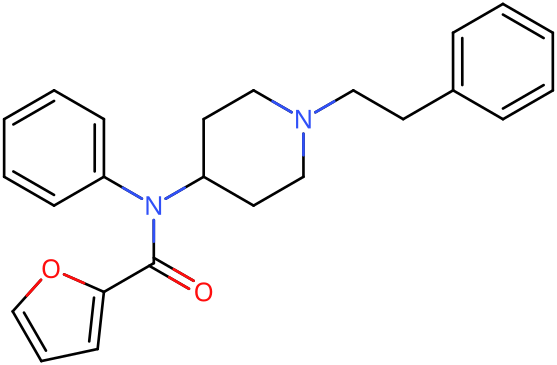
Furanylfentanyl Stats & Data
c1ccc(cc1)CCN1CCC(CC1)N(c1ccccc1)C(=O)c1ccco1FZJVHWISUGFFQV-UHFFFAOYSA-NReceptor Profile
Receptor Actions
History & Culture
Furanylfentanyl was first characterized during research conducted in the 1980s, when studies in humans demonstrated it to be approximately 50 to 100 times more potent than morphine, placing it at roughly half the potency of fentanyl. Despite this early pharmacological characterization, the compound remained largely obscure outside of research contexts for several decades. The substance emerged on the illicit drug market in 2015, appearing as part of a broader proliferation of novel synthetic opioids. This wave of designer fentanyl analogs represented a continuation of trends that had begun in Estonia in the early 2000s, subsequently spreading throughout Europe and the former Soviet republics, where fentanyl derivatives had already caused hundreds of fatalities by the time furanylfentanyl appeared. By 2016, life-threatening adverse reactions attributed to furanylfentanyl had been documented in Sweden and Canada. In the United States, at least seven deaths in Cook County, Illinois were linked to the substance during 2016, with additional fatalities reported in suburban Chicago the following year. These incidents contributed to growing international concern regarding the rapid emergence of potent synthetic opioids on illicit drug markets.
Effect Profile
Curated + 2 ReportsStrong euphoria and pain relief with strong itching/nausea, low sedation
Tolerance & Pharmacokinetics
drugs.wikiNo tolerance chart. Our decay curves for opioids were estimates, and a curve can make tolerance look longer-lasting than it is, which is the dangerous direction.
Opioid tolerance drops fast when you stop, and even a few days off can be enough, so a dose that used to be normal can now stop your breathing. Overdose deaths rise sharply after prison, detox or leaving treatment, and tolerance also falls during a hospital stay. After any break, start with a much smaller amount, try a test dose first, don't use alone, and keep naloxone within reach. Alcohol, benzodiazepines, gabapentinoids and other sedatives make an opioid overdose much more likely.
Sources: FRANK: heroin · National Harm Reduction Coalition · WHO: opioid overdose · Merrall et al. 2010 · Binswanger et al. 2007 · Strang et al. 2003 · FDA 2019: gabapentinoids and breathing
Cross-Tolerances
Experience Report Analysis
ErowidDemographics
Gender Distribution
Too few reports for a chart: gender is known from 3 reports, and a split is drawn only from 20 reports or more. Counts are shown instead. Why 20?
- Male 1 of 3
- Not Specified 2 of 3
Age Distribution
Reports Over Time
Form / Preparation
Most common forms and preparations, as a share of the 2 reports that give one
Too few reports for bars: these forms come from 2 reports, and a bar is drawn only from 20 reports or more. With fewer, a percentage cannot tell a common effect from a rare one. Counts are shown instead. Why 20?
- Powder / Crystals 2 of 2
Harm Reduction
drugs.wikiEvidence from the EU Early Warning System shows furanylfentanyl has been sold as powders and liquids, including ready‑to‑use nasal sprays and e‑liquids, which can deliver unpredictable doses and increase overdose risk due to concentration errors and non‑uniform mixing. Carry naloxone and be prepared to give repeat doses: synthetic opioids often require redosing every 2–5 minutes and larger total amounts to restore breathing; the aim is ventilation, not full arousal, and medical help should be called immediately. Naloxone will not reverse the effects of non‑opioid adulterants such as xylazine or medetomidine, both of which have been frequently found alongside fentanyl‑class opioids; persistent heavy sedation after naloxone suggests these may be present and requires airway support and monitoring until help arrives. Fentanyl test strips can detect fentanyl and certain analogues at very low levels but are binary only and can give false positives or false negatives depending on sample composition and preparation; follow manufacturer or local drug‑checking instructions and do not assume a negative result means safety. Drug‑checking programs regularly find veterinary tranquilizers (xylazine, medetomidine), benzodiazepine‑related drugs, and multiple high‑potency opioids co‑present in expected fentanyl samples; co‑use greatly increases risk of respiratory depression and prolonged sedation. Because psychoactive doses are in the microgram range, volumetric dosing is strongly preferred over attempting to weigh single doses; use appropriately dilute solutions and labeled containers to reduce dosing error risk. Avoid using alone, avoid rapid redosing during the first 30–45 minutes, and be aware that re‑narcotization can occur after naloxone wears off (30–90 minutes), especially with long‑acting co‑depressants. Ready‑made nasal sprays purchased online or self‑prepared from powders have been seized in Europe; without analytical confirmation, assume concentration may vary bottle‑to‑bottle and within a bottle. Practice basic respiratory first aid during suspected overdose (rescue breaths while awaiting naloxone effect), and continue monitoring due to frequent polydrug contamination in current supplies. Treat any white powder or pressed tablet as potentially containing fentanyl‑class substances; test a small, well‑dissolved sample when possible and start with a sub‑threshold microdose to assess sensitivity.
References
Data Sources
Cited References
- Bluelight Forum: Furanylfentanyl Discussion
- CDC MMWR: Furanylfentanyl Crack-Cocaine Overdose Cluster, BC 2016
- DEA Final Order: Furanylfentanyl Schedule I (83 FR 61320)
- DHS Master Question List: Synthetic Opioids (2024)
- EMCDDA Risk Assessment Report: Furanylfentanyl (2017)
- Erowid Experience: Extinguishing the Light Within (Furanylfentanyl)
- Goggin et al.: Furanylfentanyl Metabolites in Urine, J Anal Toxicol (2017)
- Guerrieri et al.: Postmortem Findings in Furanylfentanyl Deaths, J Anal Toxicol (2017)
- Hudson S et al.: μ-Receptor Affinity Study (PMID 33091380)
- Mohr AL et al.: Furanylfentanyl Fatalities, J Anal Toxicol 40(9):709-717 (2016)
- PubChem: Furanylfentanyl (CID 13653606)
- UNODC: Fentanyl Analogues Identification Methods (2017)
- Watanabe et al.: Furanylfentanyl Metabolism, Forensic Toxicol (2017)
- Bilel S et al., Neuropharmacology 209:109020 (2022)
- Calderon SN et al., Respiratory ED50 comparison (PMID 34673011)
- DrugWatch Information Sheet: Fentanyls (2017)
- CDC HAN alert on fentanyl-laced pills (2016)
- PubChem: 11957557
Additional references
- DEA Final Order placing Furanylfentanyl in Schedule I (83 FR 61320)
- CDC MMWR – Furanylfentanyl crack-cocaine overdose cluster, BC 2016
- Mohr AL et al., J Anal Toxicol 40 (9):709-717 (2016)
- Hudson S et al., μ-Receptor affinity study (PMID 33091380)
- Bilel S et al., Neuropharmacology 209:109020 (2022)
- Calderon SN et al., Respiratory ED50 comparison (PMID 34673011)
- DrugWatch Information Sheet: Fentanyls (2017)
- DHS Master Question List – Synthetic Opioids (2024)
- UNODC Recommended Methods – Fentanyl analogues (2017)
- CDC HAN alert on fentanyl-laced pills (2016)
- EU decision to control furanylfentanyl; forms seized include nasal sprays and e‑liquids
- Council Implementing Decision (EU) 2017/2170 – subjecting furanylfentanyl to control measures
- EMCDDA–Europol Joint Report page for furanylfentanyl
- EMCDDA Drugnet Europe note: typical administration includes nasal spray, oral, insufflation; vaping e‑liquids reported; deaths documented
- EMCDDA slides: novel fentanil products (nasal sprays, e‑liquids) and overdose risks; repeated naloxone may be required
- StatPearls (NCBI): Naloxone redosing every 2–5 min; larger totals may be needed with synthetic opioids
- Toronto’s Drug Checking Service: frequent xylazine/medetomidine and benzo‑related drugs in fentanyl samples (multiple 2024–2025 reports)
- Toronto’s Drug Checking Service: veterinary tranquilizers prevalent; multiple high‑potency opioids co‑present
- Xylazine HR page: naloxone does not reverse xylazine; continue rescue breathing and supportive care
- Medetomidine HR page: identified in fentanyl supply; potent sedative
- Fentanyl test strip overview and limitations (BTNX strips; sensitivity/specificity; limitations)
- Service & technology limitations: BTNX FTS advertised sensitivity and scope
- TripSit Quick Guide to Volumetric Dosing (HR guide for sub‑mg actives)