
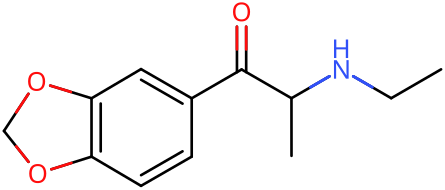
Ethylone Stats & Data
CCNC(C)C(=O)c1ccc2OCOc2c1MJEMIOXXNCZZFK-QMMMGPOBSA-NReceptor Profile
Receptor Actions
History & Culture
Ethylone is a synthetic cathinone that represents the β-keto analogue of MDEA, a substance colloquially known as "Eve." The compound has only a brief history of documented human use, with minimal records of consumption prior to its commercial emergence around 2011. In the United States, ethylone began appearing in cathinone products in late 2011, marking the start of its presence in recreational drug markets. As a designer drug, ethylone has been commonly sold alongside other synthetic cathinones such as butylone and 3-MMC. It frequently appears as a substitute or counterfeit product for MDMA and methylone, particularly as methylone's availability on the research chemical market declined. The substance is reported to be less potent than its structural relative methylone. Very little scientific data exists regarding ethylone's properties, and its history of human usage remains notably limited compared to more established entactogens.
Toxicity
PsychonautWikiThe toxicity and long-term health effects of recreational ethylone use do not seem to have been studied in any scientific context and the exact toxic dosage is unknown. This is because methylone has very little history of human usage. Anecdotal evidence from people who have tried ethylone within the community suggest that there do not seem to be any negative health effects attributed to simply trying this drug at low to moderate doses by itself and using it sparingly (but nothing can be completely guaranteed). It is strongly recommended that one use harm reduction practices when using this substance.
Addiction & dependence
As with other stimulants, the chronic use of ethylone can be considered moderately addictive with a high potential for abuse and is capable of causing psychological dependence among certain users. When addiction has developed, cravings and withdrawal effects may occur if a person suddenly stops their usage. Tolerance to many of the effects of ethylone develops with prolonged and repeated use.
Effect Profile
Curated + 11 ReportsModerate euphoria with mild stimulation and sensory enhancement, low empathy
Moderate euphoria and focus with strong anxiety/jitters, low stimulation
Tolerance & Pharmacokinetics
drugs.wikiTolerance Decay
Experience Report Analysis
ErowidDemographics
Gender Distribution
Too few reports for a chart: gender is known from 13 reports, and a split is drawn only from 20 reports or more. Counts are shown instead. Why 20?
- Male 13 of 13
Age Distribution
Reports Over Time
Effect Analysis
ErowidEffects aggregated from 11 experience reports (11 single-substance Erowid)
Effect Sentiment Distribution
Confidence Distribution
Each bar is the share of reports mentioning the effect; its whisker, and the band on the rows below, is the 95% interval: where the share could plausibly be with other reports of the same kind.
Too few reports for bars: these effects come from 11 single-substance Erowid reports, and a bar is drawn only from 20 reports or more. With fewer, a percentage cannot tell a common effect from a rare one. Counts are shown instead. Why 20?
Positive Effects 4
Adverse Effects 3
Show 1 neutral or unclassified mention
Real-World Dose Distribution
ErowidFrom 16 of 19 recorded dose entries: those that state a weight (mg, g or µg), in routes with at least five of them. Values above Q3 + 3×IQR, far above what people typically take, are left out; they can include real heavy doses and overdoses, not only mistakes.
Oral (n=16)
Form / Preparation
Most common forms and preparations, as a share of the 9 reports that give one
Too few reports for bars: these forms come from 9 reports, and a bar is drawn only from 20 reports or more. With fewer, a percentage cannot tell a common effect from a rare one. Counts are shown instead. Why 20?
- Powder / Crystals 8 of 9
Legal Status
| Country | Status | Notes |
|---|---|---|
| Brazil | Illegal | Prohibited under Portaria SVS/MS nº 344. Possession, production, and sale are illegal. |
| China | Controlled | Classified as a controlled substance as of October 2015 under national drug control regulations. |
| Germany | Anlage I BtMG | Listed in Anlage I of the Betäubungsmittelgesetz (Narcotics Act, Schedule I) since December 13, 2014. Manufacturing, possession, import, export, purchase, sale, procurement, and dispensing without a license are prohibited. |
| Sweden | Controlled | Classified as a controlled substance since 1992 under Swedish narcotics legislation. |
| Switzerland | Controlled (Verzeichnis D) | Specifically named as a controlled substance under Verzeichnis D of Swiss narcotics legislation. |
| United Kingdom | Class B | Controlled as a Class B substance under the Misuse of Drugs Act 1971 through the cathinone catch-all clause, which encompasses synthetic cathinone derivatives. |
| United States | Unscheduled | Not specifically scheduled under federal law. However, as a structural analogue of methylone and MDMA, it may be prosecuted under the Federal Analogue Act when sold for human consumption. |
References
Cited References
- Australian Drug Foundation: Ethylone
- Bluelight: Ethylone / BK-MDEA Discussion Thread
- Cozzi et al. (1999) - Beta-ketoamphetamine transporter inhibition
- DEA: 3,4-Methylenedioxyethcathinone (Ethylone)
- Kamata et al. (2006) - Metabolism of bk-MDEA and bk-MBDB
- Nagai et al. (2007) - Effects of cathinones on monoamine neurotransmission
- Simmler et al. (2013) - Pharmacological characterization of designer cathinones