
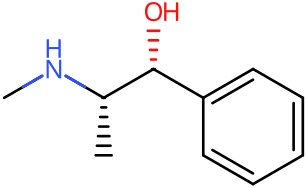
Ephedrine Stats & Data
CC(C(C1=CC=CC=C1)O)NCKWGRBVOPPLSCSI-WPRPVWTQSA-NPharmacology
DrugBankDescription
Ephedra is an alkaloid chemical compound traditionally obtained from the plant _Ephedra sinica_. The sale of ephedra-containing supplements intended to increase muscle weight or promote weight loss was banned in the United States in 2004 due to the risk for adverse effects and a lack of evidence for clinical effectiveness. The drug is still sold in Canada in OTC formulations for respiratory conditions associated with bronchial asthma.
Mechanism of Action
The alkaloids ephedrine and pseudoephedrine are the active constituents of Ephedra. Pseudoephedrine is used in over-the-counter decongestants. Derivatives of ephedrine are used to treat low blood pressure, but alternatives with reduced cardiovascular risk have replaced it for treating asthma. Ephedrine is also considered a performance-enhancing drug and is prohibited in most competitive sports. Ephedrine is a sympathomimetic amine - that is, its principal mechanism of action relies on its direct and indirect actions on the adrenergic receptor system, which is part of the sympathetic nervous system. Ephedrine increases post-synaptic noradrenergic receptor activity by (weakly) directly activating post-synaptic α-receptors and β-receptors, but the bulk of its effect comes from the pre-synaptic neuron being unable to distinguish between real adrenaline or noradrenaline from ephedrine. The ephedrine, mixed with noradrenaline, is transported through the noradrenaline reuptake complex and packaged (along with real noradrenaline) into vesicles that reside at the terminal button of a nerve cell. Ephedrine's action as an agonist at most major noradrenaline receptors and its ability to increase the release of both dopamine and to a lesser extent, serotonin by the same mechanism is presumed to have a major role in its mechanism of action.
Pharmacodynamics
Ephedrine is a sympathomimetic amine that activates adrenergic receptors, increasing heart rate and blood pressure, and causing bronchodilation. The therapeutic window is wide as patients can be given doses of 5mg up to 50mg. Patients should be counselled regarding the pressor effects of sympathomimetic amines and the risk of tachyphylaxis.
Metabolism
Ephedrine is largely unmetabolized in the body. Ephedrine can be N-demethylated to norephedrine, or demethylated and deaminized to benzoic acid conjugates and 1,2-hydroxypropylbenzene.
Absorption
Oral ephedrine reaches an average Cmax of 79.5ng/mL, with a Tmax of 1.81h, and a bioavailability of 88%.
Indication
Ephedra is indicated for the temporary relief of shortness of breath, tightness of chest, and wheezing due to bronchial asthma. For the temporary relief of bronchial asthma in over-the-counter formulations.
Half-life
Oral ephedrine has a plasma elimination half life of approximately 6 hours, but there is a large degree of inter-patient variability.
Protein Binding
(-) Ephedrine is 4.9±0.3% bound to human serum albumin and (+) Ephedrine is 6.9±1.4% bound to human serum albumin.
Elimination
Ephedrine is mainly eliminated in the urine. Approximately 60% is eliminated as the unmetabolized parent compound, 13% as benzoic acid conjugates, and 1% as 1,2-dihydroxypropylbenzene.
Volume of Distribution
Oral ephedrine has an average volume of distribution of 215.6L.
Clearance
Oral ephedrine has a clearance of 23.3L/h but there is a high degree of inter-patient variability.
Receptor Profile
Receptor Actions
Receptor Binding
Measured Affinities
Guide to PHARMACOLOGYMeasured binding and functional data for ephedrine, curated by the IUPHAR/BPS Guide to PHARMACOLOGY. Each row cites the paper it came from. Lower concentrations mean tighter binding — a value in the sub-nanomolar range indicates a very potent interaction.
| Target | Action | Measure | Value | Concentration | Species | Source |
|---|---|---|---|---|---|---|
| β2-adrenoceptor ADRB2 | Partial agonist | pKi | 5.6 | 2,512 nM | Human | PMID 9295336 |
Reading this. pKi, pEC50 and pIC50 are negative log molar values, so a higher number means a tighter interaction; the concentration column converts them for you. Values from non-human species are laboratory measurements and do not translate directly to human effect. Receptor affinity is not a dose — it describes what a molecule binds, not how much of it is safe to take.
Receptor data from the IUPHAR/BPS Guide to PHARMACOLOGY (v2026.2), licensed CC BY-SA 4.0. Matched to this substance by InChIKey.
History & Culture
206 BC–present
Ephedrine's botanical source, the plant Ephedra sinica known as má huáng in Chinese, has been employed in traditional Chinese medicine for over two millennia. Documentation of its use as an anti-asthmatic and stimulant dates back to the Han dynasty (206 BC – 220 AD). Multiple species within the genus Ephedra have been utilized medicinally by indigenous peoples across various regions, and some researchers have proposed these plants as possible candidates for Soma, the ritual substance referenced in ancient Indo-Iranian religious texts.
1885–present
The compound was first isolated in 1885 by Nagai Nagayoshi, a Japanese organic chemist whose research centered on traditional Japanese and Chinese herbal medicines. His work marked the transition of ephedrine from folk remedy to a chemically characterized substance suitable for pharmaceutical development.
1920–1959
Industrial manufacture of ephedrine commenced in China during the 1920s, with the pharmaceutical company Merck marketing the drug under the trade name ephetonin. The compound achieved rapid commercial success—exports from China to Western markets increased dramatically from 4 tonnes in 1926 to 216 tonnes by 1928. Ephedrine entered medical practice in the United States in 1926, and by 1948 it appeared as the active ingredient in Vicks Vatronol nose drops for nasal decongestion. The compound proved particularly valuable for treating asthma because, unlike adrenaline which had been the standard therapy, it could be administered orally. This practical advantage drove widespread adoption among physicians and patients. Ephedrine's use as an asthma medication reached its zenith during the late 1950s, after which newer bronchodilators gradually replaced it in clinical practice.
As ephedrine's prominence in mainstream medicine waned, the compound found renewed interest in nutritional supplements and weight loss products. Research demonstrated that ephedrine promotes modest short-term fat loss, with methylxanthines such as caffeine and theophylline producing synergistic effects when combined. This pharmacological synergy led to the development of the ECA stack—a formulation combining ephedrine, caffeine, and aspirin—which gained popularity among bodybuilders and athletes seeking to reduce body fat before competitions. The compound's structural resemblance to methamphetamine has positioned it as a significant precursor chemical. Through relatively straightforward chemical reduction, the hydroxyl group can be removed to yield methamphetamine, while simple oxidation can produce methcathinone. These conversion pathways led to ephedrine's classification as a table-I precursor under the United Nations Convention Against Illicit Traffic in Narcotic Drugs and Psychotropic Substances.
It is strongly recommended that one use harm reduction practices when using this substance. In comparison to other stimulants, ephedrine has particularly strong effects on the cardiovascular system, and its use has been associated with heart attacks, strokes, and arrythmia.
Carcinogenicity
No indication of carcinogenicity to humans (not listed by IARC).
Toxicity (DrugBank)
Patients experiencing an overdose of ephedrine will present with rapidly increasing blood pressure. Manage overdose with blood pressure monitoring, and possibly the administration of parenteral antihypertensives. The LD50 in mice after oral administration is 785mg/kg, after intraperitoneal administration if 248mg/kg, and after subcutaneous administration is 425mg/kg.
Effect Profile
Curated + 20 ReportsStrong stimulation and euphoria with strong anxiety/jitters, low focus
Tolerance & Pharmacokinetics
drugs.wikiTolerance Decay
Tachyphylaxis to pressor and subjective stimulant effects is common with repeated dosing over hours–days; substantial recovery generally occurs over several days of abstinence. Data are largely theoretical/anecdotal for recreational patterns.
Cross-Tolerances
Experience Report Analysis
ErowidDemographics
Gender Distribution
Age Distribution
Reports Over Time
Effect Analysis
ErowidEffects aggregated from 20 experience reports (20 single-substance Erowid)
Effect Sentiment Distribution
Confidence Distribution
Each bar is the share of reports mentioning the effect; its whisker, and the band on the rows below, is the 95% interval: where the share could plausibly be with other reports of the same kind.
Positive Effects 3
Adverse Effects 3
Show 2 neutral or unclassified mentions
Also reported in combinations. In the 43 Ephedrine reports where another drug was taken too, 2 (4.7%) mention hospital, emergency services or an overdose, 1 (2.3%) a seizure and 1 (2.3%) psychosis. In the 20 single-substance reports: 15.0%, 0.0% and 0.0%. These are not in the figures above: they cannot be put down to Ephedrine alone, and a mention is not always something that happened to the writer.
Dosage Distribution
Dose distribution from experience reports, one dose per report (the first listed). Doses above Q3 + 3×IQR, far above what people typically take, are left out of the median and range and listed under each route: most are real heavy doses or overdoses, not mistakes.
1 report gave a dose above the typical range (325 mg), so it is not in the figures above. Listing a dose here does not mean it is safe.
Show the report
Real-World Dose Distribution
ErowidFrom 85 of 115 recorded dose entries: those that state a weight (mg, g or µg), in routes with at least five of them. Values above Q3 + 3×IQR, far above what people typically take, are left out; they can include real heavy doses and overdoses, not only mistakes.
Oral (n=83)
Common Combinations
Most co-occurring substances, as a share of all 63 reports filed under Ephedrine; whiskers are 95% intervals
Form / Preparation
Most common forms and preparations, as a share of the 35 reports that give one; whiskers are 95% intervals
Body-Weight Dosing
Dose per kg of body weight, one dose per report (the first listed), from reports giving a weight of 30–250 kg. Doses above Q3 + 3×IQR, far above what people typically take, are left out of the median and range and listed under each route.
2 reports gave a dose above the typical range (3.799–3.983 mg/kg), so they are not in the figures above. Listing a dose here does not mean it is safe.
Show the reports
Redose Patterns
Redosing behavior across 41 reports
Legal Status
| Country | Status | Notes |
|---|---|---|
| Canada | Restricted OTC | Can be sold over-the-counter for breathing purposes only in 8 milligram doses. Health Canada has restricted sales to approved breathing health products and prohibited ephedrine in weight loss or energy boosting products. |
| Croatia | Controlled Precursor | Listed as a precursor for illegal drugs under national legislation. Ephedrine hydrochloride is only available to pharmacies where nasal drops are produced in-house. Required to be stored in special locked areas within pharmacies to prevent theft. |
| Finland | Prescription Only | Classified as a prescription medication. Possession without a valid prescription is illegal, including ordering through postal services from outside Finland regardless of whether it is plant material or synthetic. |
| Germany | Prescription Only | Controlled under the Grundstoffüberwachungsgesetz (GÜG), which regulates precursor chemicals used in the manufacture of controlled substances. No longer available over-the-counter; can only be obtained through a pharmacy with prescription. |
| Indonesia | Available OTC (unconfirmed) | Reportedly sold over-the-counter at pharmacies in 25 milligram packets of 20 pills. This information has not been independently verified. |
| Netherlands | Prescription Only | Since April 6, 2004, ephedrine and ephedra-alkaloid containing extracts may only be prescribed by doctors. Over-the-counter sales are prohibited. |
| Sweden | Prescription Only | Classified as a prescription-only medication. Not otherwise controlled but requires valid prescription for legal acquisition. |
| United Kingdom | Prescription Only (Schedule VI) | Legal to possess and use but requires a prescription. Not available over-the-counter at retail pharmacies. |
| United States | Regulated (Special Control) | Controlled under the Combat Methamphetamine Epidemic Act of 2005. FDA-approved for medical use but heavily regulated as a methamphetamine precursor. Daily purchase limit of 3.6 grams and monthly limit of 9 grams per individual. All purchases require photo ID and are tracked in state databases. Banned in dietary supplements since 2004 but available behind the counter at pharmacies for approved uses. Some states impose stricter controls: Mississippi classifies it as Schedule III requiring prescription; Oklahoma places it in Schedule V; Oregon lists it as Schedule III with possession of more than 300 tablets being a crime. |
Harm Reduction
drugs.wiki- Ephedrine is a mixed-acting sympathomimetic: it directly agonizes alpha- and beta-adrenergic receptors and indirectly releases norepinephrine; this underlies its pressor, bronchodilatory, and tachycardic effects. This mechanism also explains rapid tolerance/tachyphylaxis with repeated dosing. [Cited: DrugBank DB01364].
- Oral dosing has reasonably consistent community and clinical consensus; start at the low end and avoid frequent redosing to limit tachycardia, hypertension, anxiety, and insomnia. Deaths and severe events have been reported at higher or repeated doses and during exertion. [Cited: Erowid dosage page; AHRQ review].
- Half-life averages about 6 hours but varies with urinary pH; at pH ~6.3 t½ ~6 h and at pH ~5 t½ ~3 h. Acidifying urine to hasten elimination is not recommended in toxicity. Plan timing to avoid nighttime insomnia. [Cited: Erowid Ephedra overview].
- Populations at higher risk: people with hypertension, tachyarrhythmias, ischemic heart disease/heart failure, hyperthyroidism, angle-closure glaucoma, urinary retention/BPH, and renal impairment; pregnancy and lactation require caution or avoidance outside medical indications. [Cited: StatPearls Ephedrine].
- Avoid combining with MAO inhibitors (including linezolid/methylene blue): can precipitate hypertensive crisis. If discontinuing an MAOI, wait at least 14 days before ephedrine use. Seek urgent care for severe headache, chest pain, or neurological symptoms. [Cited: StatPearls MAOIs; StatPearls Ephedrine].
- Combining with caffeine increases adverse-event frequency (palpitations, autonomic hyperactivity, anxiety); use conservative doses, vigilant hydration, and avoid strenuous heat/exertion on the stack. [Cited: AHRQ ephedra/ephedrine+caffeine review].
- Hydration: during stimulation, sip ~300–500 mL water per hour and include electrolytes if sweating; avoid alcohol which masks intoxication and increases dehydration risk. Saferparty provides similar guidance. [Cited: Saferparty factsheet].
- Insufflation is higher risk than oral due to potent local vasoconstriction and mucosal dryness/irritation; expect disproportionate cardiovascular stimulation for marginal subjective benefit. If used despite risks: keep doses low, space lines, rotate nostrils, and rinse with isotonic saline after use. Prefer oral route for lower harm. [Mechanistic rationale + general harm reduction; Saferparty nasal hygiene guidance].
- Renal clearance is predominant and can be slowed in renal impairment; dose accumulation increases adverse effects. People with kidney disease should be especially cautious and avoid repeat dosing without medical oversight. [Cited: StatPearls Ephedrine].
- Adulteration: ephedrine is sometimes detected as an adulterant in cocaine samples, creating unexpectedly strong stimulant mixes that elevate cardiac risk; drug checking is advised. [Cited: Saferparty warning].
- Salt forms: dosing by mass depends on the salt. Ephedrine HCl contains ~0.82 g free base per 1 g salt; ephedrine sulfate contains ~0.77 g free base per 1 g salt (approximate stoichiometric calculation). Adjust if switching forms to avoid inadvertent over- or under-dosing. [Cited: DrugBank salt entries].
- Exercise/heat: case series link ephedra/ephedrine use to serious cardiovascular and neurologic events, especially with exertion/heat. Avoid heavy exercise and hot environments on days you take ephedrine. [Cited: NCBI report on military personnel/safety reviews].
References
Data Sources
Cited References
Additional references
- Erowid Ephedrine: Dosage
- Erowid Ephedra: Overview with Pharmacology (urine pH effects)
- DrugBank: Ephedrine (DB01364) — mechanism, PK, tachyphylaxis mention
- StatPearls: Ephedrine (contraindications, MAOI warning, renal impairment, pregnancy/lactation)
- StatPearls: MAO Inhibitors (hypertensive crisis with sympathomimetics)
- AHRQ Evidence Report: Ephedra/Ephedrine for Weight Loss (adverse events; ephedrine+caffeine risk)
- Saferparty.ch: Ephedrin (factsheet, safer use)
- Saferparty.ch warning: Cocaine adulterated with ephedrine
- DrugBank: Ephedrine salts (HCl and sulfate)
- DrugBank: Ephedrine sulfate (salt entry)