
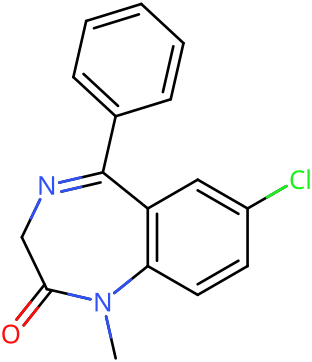
Diazepam Stats & Data
AAOVKJBEBIDNHE-UHFFFAOYSA-NInteraction Warnings
This combination can result in an increased risk of vomiting during unconsciousness and death from the resulting suffocation. If this occurs, users should attempt to fall asleep in the recovery position or have a friend move them into it.
It is dangerous to combine benzodiazepines with stimulants due to the risk of excessive intoxication. Stimulants decrease the sedative effect of benzodiazepines, which is the main factor most people consider when determining their level of intoxication. Once the stimulant wears off, the effects of benzodiazepines will be significantly increased, leading to intensified disinhibition as well as other effects.
Pharmacology
DrugBankDescription
A benzodiazepine with anticonvulsant, anxiolytic, sedative, muscle relaxant, and amnesic properties and a long duration of action. Its actions are mediated by enhancement of gamma-aminobutyric acid activity. It is used in the treatment of severe anxiety disorders, as a hypnotic in the short-term management of insomnia, as a sedative and premedicant, as an anticonvulsant, and in the management of alcohol withdrawal syndrome. (From Martindale, The Extra Pharmacopoeia, 30th ed, p589) Given diazepam's storied history as a commonly used and effective medication for a variety of indications, contemporary advancements in the formulation and administration of the agent include the development and US FDA approval of an auto-injectable formulation for the rapid treatment of uncontrolled seizures in 2015-2016 . Combining diazepam, a proven effective therapy for acute repetitive seizures, with an auto-injector designed for subcutaneous administration that is quickly and easily administered offers the potential for complete, consistent drug absorption and rapid onset of effect . This current development is subsequently an important addition to the rescue therapy tool chest for patients with epilepsy .
Mechanism of Action
Diazepam is a benzodiazepine tranquilliser with anticonvulsant, sedative, muscle relaxant and amnesic properties . Benzodiazepines, such as diazepam, bind to receptors in various regions of the brain and spinal cord. This binding increases the inhibitory effects of gamma-aminobutyric acid (GABA) . GABAs functions include CNS involvement in sleep induction. Also involved in the control of hypnosis, memory, anxiety, epilepsy and neuronal excitability .
Pharmacodynamics
Diazepam is a benzodiazepine that exerts anxiolytic, sedative, muscle- relaxant, anticonvulsant and amnestic effects . Most of these effects are thought to result from facilitation of the action of gamma aminobutyric acid (GABA), an inhibitory neurotransmitter in the central nervous system .
Metabolism
Diazepam is N-demethylated by CYP3A4 and 2C19 to the active metabolite N-desmethyldiazepam, and is hydroxylated by CYP3A4 to the active metabolite temazepam . N-desmethyldiazepam and temazepam are both further metabolized to oxazepam . Temazepam and oxazepam are further largely eliminated by way of conjugation to glucuronic acid via glucuronidation . Furthermore, oxidation of diazepam is mediated by cytochrome P450 isozymes; formation of desmethyl-diazepam mainly by CYP2C19 and CYP3A and 3-hydroxy-diazepam (temazepam) and oxazepam by CYP3A. Because CYP2C19 is polymorphic, extensive metabolizers (EMs), and poor metabolizers (PMs) of diazepam can be distinguished . PMs of diazepam showed significantly lower clearance (12 vs 26 mL/min) and longer elimination half-life (88 vs 41 h) of diazepam than EMs after a single oral dose . Also, PMs had lower clearance, higher AUC and longer elimination half-life of desmethyl-diazepam .
Absorption
After oral administration, it is considered that diazepam is rapidly and completely absorbed from the gastrointestinal tract as >90% of diazepam is absorbed and the average time to achieve peak plasma concentrations is 1 – 1.5 hours with a range of 0.25 to 2.5 hours . Absorption is delayed and decreased when administered with a moderate fat meal . In the presence of food mean lag times are approximately 45 minutes as compared with 15 minutes when fasting . There is also an increase in the average time to achieve peak concentrations to about 2.5 hours in the presence of food as compared with 1.25 hours when fasting . This results in an average decrease in Cmax of 20% in addition to a 27% decrease in AUC (range 15% to 50%) when administered with food .
Indication
In general, diazepam is useful in the symptomatic management of mild to moderate degrees of anxiety in conditions dominated by tension, excitation, agitation, fear, or aggressiveness such as may occur in psychoneurosis, anxiety reactions due to stress conditions, and anxiety states with somatic expression. Moreover, in acute alcoholic withdrawal, diazepam may be useful in the symptomatic relief of acute agitation, tremor, and impending acute delirium tremens. Furthermore, diazepam is a useful adjunct for the relief of skeletal muscle spasm due to reflex spasm to local pathologies, such as inflammation of the muscle and joints or secondary to trauma; spasticity caused by upper motor neuron disorders, such as cerebral palsy and paraplegia; athetosis and the rare "stiff man syndrome". Particular label information from the United Kingdom also lists particular age-specific indications, including for adults: (1) The short-term relief (2-4 weeks) only, of anxiety which is severe, disabling, or subjecting the individual to unacceptable distress, occurring alone or in association with insomnia or short-term psychosomatic, organic or psychotic illness, (2) cerebral palsy, (3) muscle spasm, (4) as an adjunct to certain types of epilepsy (eg. myoclonus), (5) symptomatic treatment of acute alcohol withdrawal, (6) as oral premedication for the nervous dental patient, and (7) for premedication before surgery.
Half-life
Diazepam has a biphasic half-life with an initial rapid distribution phase followed by a prolonged terminal elimination phase of 1 or 2 days; its action is further prolonged by the even longer half-life of 2-5 days of its principal active metabolite, desmethyldiazepam (nordiazepam), the relative proportion of which increases in the body on long-term administration . The plasma half-life of diazepam is prolonged in neonates, in the elderly, and in patients with kidney or liver disease .
Protein Binding
Despite high binding to plasma proteins (98-99%) - mainly albumin and to a lesser extent α1-acid glycoprotein - diazepam is widely distributed into tissues and crosses the blood-brain barrier and is highly lipid soluble, which causes the initial effects to decrease rapidly as it is redistributed into fat deposits and tissues .
Elimination
Diazepam and its metabolites are excreted mainly in the urine, predominantly as their glucuronide conjugates .
Volume of Distribution
In young healthy males, the volume of distribution at steady-state is 0.8 to 1.0 L/kg .
Clearance
The clearance of diazepam is 20 to 30 mL/min in young adults .
Receptor Profile
Receptor Actions
Receptor Binding
Measured Affinities
Guide to PHARMACOLOGYMeasured binding and functional data for diazepam, curated by the IUPHAR/BPS Guide to PHARMACOLOGY. Each row cites the paper it came from. Lower concentrations mean tighter binding — a value in the sub-nanomolar range indicates a very potent interaction.
| Target | Action | Measure | Value | Concentration | Species | Source |
|---|---|---|---|---|---|---|
| GABAA receptor α1 subunit GABRA1 | Positive | pKi | 7.79 | 16.22 nM | Human | PMID 2551039 |
| GABAA receptor α2 subunit GABRA2 | Positive | pKi | 7.77 | 16.98 nM | Human | PMID 2551039 |
| GABAA receptor α3 subunit GABRA3 | Positive | pKi | 7.77 | 16.98 nM | Human | PMID 2551039 |
| TRH1 receptor Trhr | Antagonist | pKi | 5.15 | 7,079 nM | Rat | PMID 2566295 |
Reading this. pKi, pEC50 and pIC50 are negative log molar values, so a higher number means a tighter interaction; the concentration column converts them for you. Values from non-human species are laboratory measurements and do not translate directly to human effect. Receptor affinity is not a dose — it describes what a molecule binds, not how much of it is safe to take.
Receptor data from the IUPHAR/BPS Guide to PHARMACOLOGY (v2026.2), licensed CC BY-SA 4.0. Matched to this substance by InChIKey.
History & Culture
1959–1963
Diazepam was the second benzodiazepine developed by chemist Leo Sternbach at Hoffmann-La Roche's facility in Nutley, New Jersey, following his earlier creation of chlordiazepoxide (marketed as Librium), which had received approval for medical use in 1960. Sternbach patented diazepam in 1959, and it was released to market in 1963 as an improved formulation of its predecessor. The new compound demonstrated approximately 2.5 times greater potency than chlordiazepoxide, which it rapidly surpassed in commercial sales.
1963–1985
Following its 1963 launch, diazepam quickly became one of the most frequently prescribed medications in the world, a distinction it has maintained for decades. The drug's commercial success was propelled by an extensive marketing campaign conceived by the William Douglas McAdams Agency under the direction of Arthur Sackler. This promotional effort helped establish diazepam as the top-selling pharmaceutical in the United States from 1969 to 1982, with peak annual sales reaching 2.3 billion tablets in 1978 alone. The drug's commercial dominance transformed Hoffmann-La Roche into a pharmaceutical industry giant. When the patent expired in 1985, generic manufacturers entered the market, and diazepam has since been marketed under hundreds of brand names—currently exceeding 500 different formulations worldwide. Despite increased competition and evolving prescribing practices, the medication remains widely used; as of 2023, it ranked as the 183rd most commonly prescribed medication in the United States with more than 2 million prescriptions annually.
Beyond its conventional medical applications, diazepam has been adopted for several specialized institutional purposes. The United States military employs a specialized preparation known as CANA (Convulsive Antidote, Nerve Agent), which is typically issued to service members alongside Mark I NAAK kits when operating in environments where exposure to chemical weapons in the form of nerve agents is considered a potential hazard. Diazepam has also been incorporated into capital punishment protocols in the United States. The states of California and Florida offer the drug to condemned inmates as a pre-execution sedative within their lethal injection programs. In August 2018, Nebraska utilized diazepam as part of the drug combination administered during the execution of Carey Dean Moore, marking the first execution carried out in that state in over 21 years. In 2015-2016, the U.S. Food and Drug Administration approved an auto-injectable formulation of diazepam designed for the rapid treatment of uncontrolled seizures, representing a contemporary advancement in the drug's delivery methods.
Subjective Effects
Physical
The physical effects of diazepam can be broken down into several components which progressively intensify proportional to dosage.
- Muscle relaxation: In comparison to alprazolam (Xanax), diazepam has greater amounts of muscle relaxation.
- Sedation: In terms of energy level alterations, this drug is sedating and often results in an overwhelmingly lethargic state. At higher levels, this causes users to suddenly feel as if they are extremely sleep deprived and have not slept for days, forcing them to sit down and generally feel as if they are constantly on the verge of passing out instead of engaging in physical activities. This sense of sleep deprivation increases proportional to dosage and eventually becomes powerful enough to force a person into complete unconsciousness.
- Motor control loss
- Respiratory depression
- Dizziness
- Seizure suppression
Cognitive
The cognitive effects of diazepam can be broken down into several components which progressively intensify proportional to dosage. The general head space of diazepam is described by many as one of intense sedation and decreased inhibition. It contains a large number of typical depressant cognitive effects. Paradoxical reactions to benzodiazepines such as increased seizures (in epileptics), aggression, increased anxiety, violent behavior, loss of impulse control, irritability and suicidal behavior sometimes occur (although they are rare in the general population, with an incidence rate below 1%). These paradoxical effects occur with greater frequency in recreational abusers, individuals with mental disorders, children, and patients on high-dosage regimes.
- Anxiety suppression
- Disinhibition
- Thought deceleration
- Euphoria
- Amnesia
- Information processing suppression
- Compulsive redosing
- Delusions of sobriety: This is the false belief that one is perfectly sober despite obvious evidence to the contrary such as severe cognitive impairment and an inability to fully communicate with others.
Forked from Subjective Effect Documentation by Josie Kins, September 2015. Via dose.wiki (CC0).
Diazepam has a low toxicity relative to dose. However, it is potentially lethal when mixed with depressants like alcohol or opioids. It is strongly recommended that one use harm reduction practices, such as volumetric dosing, when using this substance to ensure the administration of the intended dose.
LD50
LD50: 1200 mg/kg (oral, rat) (L1862)LD50: 1000 mg/kg (oral, dog) (L1862)LD50: 700 mg/kg (oral, mice) (L1862)
Carcinogenicity
Group 3: Not classifiable as to its carcinogenicity to humans
Liver injury risk
Low concern (rare serious cases reported)
Overdose
Benzodiazepine overdose may occur when a benzodiazepine is taken in extremely heavy quantities or concurrently with other depressants. This is particularly dangerous with other GABAergic depressants such as barbiturates and alcohol since they work in a similar fashion, but bind to distinct allosteric sites on the GABAA receptor, thus their effects potentiate one another.
Effect Profile
Curated + 51 ReportsStrong anxiolysis with moderate sedation and cognitive impairment, low euphoria
User Experiences
Tolerance & Pharmacokinetics
drugs.wikiNo tolerance chart. Our decay curves for these drugs were estimates, and a curve can make tolerance look longer-lasting than it is, which is the dangerous direction.
How fast tolerance to these drugs fades after a break has not been measured well enough to draw, so don't count on a dose you used to take still being safe: after time off, start with a much smaller amount and don't use alone. Mixing sedatives with each other, with alcohol or with opioids sharply raises the risk of a fatal overdose. If you've been using regularly, don't stop suddenly: withdrawal from benzodiazepines, alcohol or GHB/GBL can cause seizures or delirium, so get medical help to cut down gradually.
Sources: FRANK: benzodiazepines · Alcohol and Drug Foundation: GHB · FDA 2020: benzodiazepine boxed warning · FDA 2019: gabapentinoids and breathing · NHS: alcohol use disorder
Cross-Tolerances
Demographics
Gender Distribution
Age Distribution
Reports Over Time
Effect Analysis
Erowid + BluelightEffects aggregated from 51 experience reports (36 single-substance Erowid + 15 Bluelight)
Effect Sentiment Distribution
Confidence Distribution
Each bar is the share of reports mentioning the effect; its whisker, and the band on the rows below, is the 95% interval: where the share could plausibly be with other reports of the same kind.
Rows resting on fewer than 20 reports show a count (“3 of 7”) instead of a bar. Why 20?
Positive Effects 20
Adverse Effects 28
Show 8 more adverse effects
Show 8 neutral or unclassified mentions
Also reported in combinations. In the 65 Diazepam reports where another drug was taken too, 15 (23.1%) mention hospital, emergency services or an overdose, 4 (6.2%) a seizure and 2 (3.1%) psychosis. In the 36 single-substance reports: 2.8%, 0.0% and 5.6%. One or more of the three comes up more often in the combination reports (26.2% against 8.3%), by more than chance would explain; that does not show the combination caused it. These are not in the figures above: they cannot be put down to Diazepam alone, and a mention is not always something that happened to the writer.
Dose-Response Correlation
How effect frequency changes across dose levels. Whiskers, and the numbers' hover text, give each figure's 95% interval.
Not drawn, too few reports (a dose tier needs 20): Oral Common (n=10). Why 20?
Dosage Distribution
Dose distribution from experience reports, one dose per report (the first listed). Doses above Q3 + 3×IQR, far above what people typically take, are left out of the median and range and listed under each route: most are real heavy doses or overdoses, not mistakes.
1 report gave a dose above the typical range (60 mg), so it is not in the figures above. Listing a dose here does not mean it is safe.
Show the report
- 60 mg · another drug taken too
Real-World Dose Distribution
ErowidFrom 217 of 256 recorded dose entries: those that state a weight (mg, g or µg), in routes with at least five of them. Values above Q3 + 3×IQR, far above what people typically take, are left out; they can include real heavy doses and overdoses, not only mistakes.
Oral (n=205)
Insufflated (n=8)
Common Combinations
Most co-occurring substances, as a share of all 101 reports filed under Diazepam; whiskers are 95% intervals
Form / Preparation
Most common forms and preparations, as a share of the 63 reports that give one; whiskers are 95% intervals
Body-Weight Dosing
Dose per kg of body weight, one dose per report (the first listed), from reports giving a weight of 30–250 kg. Doses above Q3 + 3×IQR, far above what people typically take, are left out of the median and range and listed under each route.
Redose Patterns
Redosing behavior across 75 reports
Benzodiazepine Equivalence
Diazepam - 10mg ~=10mg Diazepam.
Legal Status
| Country | Status | Notes |
|---|---|---|
| Canada | Prescription | Approved prescription medication with various formulations marketed including oral tablets in multiple strengths and rectal gel preparations. |
| Indonesia | Prescription | Available as a prescription medication. Marketed both as a standalone product and in combination formulations with other active ingredients such as metamizole sodium. |
| United Kingdom | Prescription Only | Available exclusively through medical prescription. First launched in 1963 and has been one of the most widely prescribed medicines. Since its patent expired in 1985, it has been marketed under numerous brand names. |
| United States | Prescription (Controlled) | Classified as both 'Approved' and 'Illicit' indicating legitimate medical use alongside controlled substance status. Multiple prescription formulations are marketed including oral tablets, rectal gels (Diastat), and injectable solutions for intramuscular and intravenous administration. |
Harm Reduction
drugs.wikiDiazepam is long-acting and lipophilic; repeated or high doses can accumulate in fat with slow redistribution, causing prolonged next-day sedation and impaired coordination—avoid redosing to chase euphoria. Benzodiazepines plus opioids or alcohol markedly increase risk of respiratory depression, coma, and death; this combination carries an FDA boxed warning and should be strictly avoided. In older adults, paradoxical agitation, disinhibition, confusion, and falls are more likely; use the lowest possible dose or avoid non-prescribed use in this group. Hepatic impairment (cirrhosis, hepatitis) extends diazepam half-life substantially; even usual doses can over-sedate—avoid self-escalation and seek medical guidance. Diazepam is metabolized mainly by CYP2C19 and CYP3A4; strong inhibitors (e.g., ketoconazole, macrolides, protease inhibitors; some SSRIs and PPIs) can raise levels and increase sedation, while inducers (carbamazepine, phenytoin, rifampin, St John’s wort) can reduce effect unpredictably. Grapefruit products inhibit intestinal CYP3A4 and can raise exposure to several benzodiazepines; effect on diazepam may be smaller due to CYP2C19 involvement, but increased sedation is still possible—avoid co-use. Avoid driving, cycling, operating machinery, or risky activities for at least the day of use and until you feel fully alert the next day. Do not inject tablets or non-sterile solutions; IV diazepam requires medical-grade formulation and slow administration due to risks of apnea, hypotension, and solvent-related toxicity. Rectal and intranasal medical products exist for seizures but are not appropriate for recreational use. Abrupt cessation after days-to-weeks of regular use can cause severe withdrawal (anxiety, tremor, perceptual changes) and, at higher dependence levels, seizures; cessation should be gradual under medical supervision. Flumazenil can reverse benzodiazepine sedation but may precipitate withdrawal and seizures in dependent users; it is not a general safety net for non-medical use. Pregnancy and breastfeeding: diazepam crosses the placenta and enters breast milk; prenatal exposure is linked to neonatal withdrawal and floppy infant syndrome, and infants may become excessively sedated—avoid non-prescribed use and seek medical advice. Unregulated drug supplies can contain unexpected benzodiazepines or be co-formulated with opioids or veterinary tranquilizers; when available, use drug checking services and avoid unknown tablets.
References
Data Sources
Cited References
Additional references
- StatPearls: Diazepam
- TripSit Wiki: Diazepam
- TripSit: Drug Combinations Chart
- DrugBank: Diazepam (DB00829)
- Erowid: Diazepam Vault
- EUDA: Misuse of benzodiazepines among high-risk opioid users
- DrugBank Article: Grapefruit juice interaction with benzodiazepines (triazolam/quazepam)
- Drug Checking Community: Benzo-dope overview
- StatPearls: Omeprazole (CYP2C19 inhibition affecting diazepam)
- Ashton Manual (archived on Drugs-Forum): Equivalence and withdrawal risks