
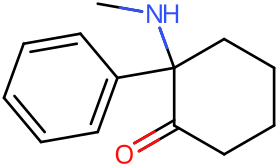
Deschloroketamine Stats & Data
CNC1(CCCCC1=O)C2=CC=CC=C2ZAGBSZSITDFFAF-UHFFFAOYSA-NMeasured Affinities
Guide to PHARMACOLOGYMeasured binding and functional data for S-deschloroketamine, curated by the IUPHAR/BPS Guide to PHARMACOLOGY. Each row cites the paper it came from. Lower concentrations mean tighter binding — a value in the sub-nanomolar range indicates a very potent interaction.
| Target | Action | Measure | Value | Concentration | Species | Source |
|---|---|---|---|---|---|---|
| GluN2B GRIN2B | Antagonist | pKd | 5.44 | 3,631 nM | Human | PMID 34519023 |
Reading this. pKi, pEC50 and pIC50 are negative log molar values, so a higher number means a tighter interaction; the concentration column converts them for you. Values from non-human species are laboratory measurements and do not translate directly to human effect. Receptor affinity is not a dose — it describes what a molecule binds, not how much of it is safe to take.
Receptor data from the IUPHAR/BPS Guide to PHARMACOLOGY (v2026.2), licensed CC BY-SA 4.0. Matched to this substance by InChIKey.
History & Culture
1966–present
Deschloroketamine was first described in a 1966 patent filed by Calvin Stevens at Parke-Davis in Michigan. Stevens, who is also credited with the synthesis of ketamine and phencyclidine, outlined the preparation methods for this structurally related compound. Despite this early documentation, the substance did not see significant investigation or use for several decades following its initial synthesis.
1998–2000
In the late 1990s, researchers Detlef Preiss and Akos Tatar from Germany filed a series of patents describing potential medical applications for deschloroketamine. Their work proposed that the substance possessed antimicrobial properties and could provide therapeutic benefit for bacterial, fungal, viral, and protozoal infections. The patents also suggested potential immunomodulatory effects at low doses of approximately 2 milligrams per day. These claims have remained largely uninvestigated by subsequent research, and speculation regarding these alleged properties continues within discussions of the substance. The potential implications of any antimicrobial or immunosuppressive activity, if validated, could represent health concerns for individuals using the substance recreationally.
2015–2016
Deschloroketamine first appeared on European drug monitoring systems in March 2015, when the European Monitoring Centre for Drugs and Drug Addiction received its initial report through the European Union's Early Warning System. This report originated from the United Kingdom. Analysis of drug seizures in Italy between 2015 and 2016 revealed that deschloroketamine was being sold misrepresented as ketamine. Of 102 envelopes seized that were purportedly ketamine powder, all green and blue envelopes were determined to contain deschloroketamine, while pink envelopes contained methoxetamine. By 2016, the substance had established a presence on dark net marketplaces including AlphaBay and Valhalla. Data from the United States Drug Enforcement Administration's laboratory system documented at least eight seizures of deschloroketamine within the country during that year. The compound has since become readily accessible through online research chemical vendors, where it continues to be sold as a designer drug despite its very limited history of human use and minimal data regarding its pharmacological properties and toxicity.
Subjective Effects
Physical
- Muscle relaxation
- Tactile disconnection
- Spontaneous tactile sensations
- Tactile suppression
- Physical autonomy
- Motor control loss
- Physical euphoria
- Perception of decreased weight
- Dizziness
- Nausea
- Visual sliding
- Decreased libido
Cognitive
- Depersonalization
- Derealization
- Consciousness disconnection
- Memory suppression
- Ego death
- Thought deceleration
- Immersion enhancement
- Information processing suppression
- Time distortion
- Euphoria
- Introspection
- Déjà vu
- Conceptual thinking
- Compulsive redosing
- Anxiety
- Disinhibition
- Amnesia
- Creativity enhancement
- Language suppression
- Existential self-realization
Sensory
- Suppression
- Distortions
- Hallucinations
- Perspective distortions
- Environmental cubism
- Environmental orbism
- Scenery slicing
- Internal hallucinations: (autonomous entities; settings, sceneries, and landscapes; alterations in perspective and scenarios and plots)
- Visual disconnection: This eventually results in DCK's equivalent of the famous "k-hole" or, more specifically, holes, spaces and voids alongside of structures.
- Visual acuity suppression
- Double vision
- Pattern recognition suppression
- Frame rate suppression
Forked from Subjective Effect Documentation work by Josie Kins, August 2016. Via dose.wiki (CC0).
Toxicity
PsychonautWikiThe toxicity and long-term health effects of recreational DCK use do not seem to have been studied in any scientific context and the exact toxic dosage is unknown. This is because DCK has very little history of human usage. Anecdotal evidence from people who have tried DCK within the community suggests that there do not seem to be any negative health effects attributed to simply trying this drug at low to moderate doses by itself and using it sparingly (but nothing can be completely guaranteed). Independent research should always be done to ensure that a combination of two or more substances is safe before consumption. As DCK has been speculated to have antibacterial properties, its prolonged use could potentially pose a serious threat to one's health and immune system.
Effect Profile
Curated + 12 ReportsStrong dissociative depth with strong motor impairment, mild mania, low insight
Duration Timeline
BluelightCommunity Effects
TripSitTolerance & Pharmacokinetics
drugs.wikiTolerance Decay
Anecdotal data suggest marked acute tolerance after a day or two of consecutive dosing, partial decay after several days, and near‑baseline after 1–2 weeks; cross‑tolerance is common across NMDA‑antagonist dissociatives. Data quality is low and individualized.
Cross-Tolerances
Experience Report Analysis
ErowidDemographics
Gender Distribution
Age Distribution
Reports Over Time
Effect Analysis
ErowidEffects aggregated from 12 experience reports (12 single-substance Erowid)
Effect Sentiment Distribution
Confidence Distribution
Each bar is the share of reports mentioning the effect; its whisker, and the band on the rows below, is the 95% interval: where the share could plausibly be with other reports of the same kind.
Too few reports for bars: these effects come from 12 single-substance Erowid reports, and a bar is drawn only from 20 reports or more. With fewer, a percentage cannot tell a common effect from a rare one. Counts are shown instead. Why 20?
Positive Effects 4
Adverse Effects 1
Show 3 neutral or unclassified mentions
Also reported in combinations. In the 19 Deschloroketamine reports where another drug was taken too, 0 mention hospital, emergency services or an overdose, 0 a seizure and 3 psychosis (too few reports for percentages). In the 12 single-substance reports: 2, 0 and 1. These are not in the figures above: they cannot be put down to Deschloroketamine alone, and a mention is not always something that happened to the writer.
Real-World Dose Distribution
ErowidFrom 63 of 70 recorded dose entries: those that state a weight (mg, g or µg), in routes with at least five of them. Values above Q3 + 3×IQR, far above what people typically take, are left out; they can include real heavy doses and overdoses, not only mistakes.
Rectal (n=28)
Oral (n=14)
Sublingual (n=5)
Insufflated (n=15)
Common Combinations
Most co-occurring substances, as a share of all 31 reports filed under Deschloroketamine; whiskers are 95% intervals
Form / Preparation
Most common forms and preparations, as a share of the 27 reports that give one; whiskers are 95% intervals
Body-Weight Dosing
Dose per kg of body weight, one dose per report (the first listed), from reports giving a weight of 30–250 kg. Doses above Q3 + 3×IQR, far above what people typically take, are left out of the median and range and listed under each route.
Redose Patterns
Redosing behavior across 28 reports
Legal Status
| Country | Status | Notes |
|---|---|---|
| Austria | Illegal | Controlled under the Neue-Psychoaktive-Substanzen-Verordnung (NPSV), Austria's new psychoactive substances regulation. |
| Canada | Controlled | Prohibited under a general ban on arylcyclohexylamines. Production, distribution, and possession are illegal. |
| Czech Republic | Legal | Not currently scheduled or controlled under Czech drug legislation. Possession and use are not criminalized. |
| Germany | NpSG (Controlled) | Controlled under the Neue-psychoaktive-Stoffe-Gesetz (New Psychoactive Substances Act) since July 18, 2019. Production and import with intent to distribute, administration to others, and trading are criminal offenses. Possession is prohibited but not subject to criminal penalties. |
| Italy | Illegal | Classified as an illegal substance under Italian drug control legislation. |
| Latvia | Illegal | Prohibited substance under Latvian controlled substances laws. |
| Netherlands | Legal (under review) | Remains unscheduled as of the available information, though regulatory review was scheduled with a plenary hearing set for January 21, 2025. |
| Switzerland | Controlled (Verzeichnis E) | Specifically named as a controlled substance under Verzeichnis E of the Swiss narcotics scheduling system. |
| United Kingdom | Class B | Controlled under the Misuse of Drugs Act 1971. Covered by the arylcyclohexylamine generic clause as an N-alkyl derivative of 2-amino-2-phenylcyclohexanone, added via S.I. 2013/239 effective February 26, 2013. Possession, production, supply, and import are prohibited. |
| United States | Uncontrolled | Not a scheduled substance at the federal level as of July 2017. However, it may be subject to prosecution under the Federal Analogue Act if sold for human consumption due to its structural similarity to ketamine. |
Harm Reduction
drugs.wiki• Identity/purity vary: DCK is frequently confused with or sold alongside ketamine analogues; lab checking is strongly advised where available. Toronto’s Drug Checking Service has detected deschloroketamine within expected ketamine submissions, highlighting substitution/mixing risk in real-world markets. Use lab‑grade drug checking when possible; reagents alone are not definitive. • Compared to racemic ketamine, DCK is typically reported as roughly 2–3× as potent by weight and longer‑lasting; this increases the risk of accidental over-intoxication if dosing by ‘ketamine-sized’ lines. • Strong dissociation can rapidly escalate to incapacitation or delusional states at higher doses; plan set/setting, sit down before dosing, and avoid heights/water. Physical accident risk is increased on dissociatives. • Bladder/urinary toxicity: heavy or frequent arylcyclohexylamine use is linked to ulcerative cystitis and kidney issues; stop immediately if you notice urgency, frequency, pain, hematuria, or incontinence, and seek medical evaluation. Space sessions (days to weeks), hydrate normally (avoid extreme over-hydration), and urinate regularly during/after use to reduce urothelial exposure. • Tolerance rises quickly and can promote compulsive redosing; many users report mood instability, insomnia, and cognitive fog after binges. • Insufflation harms nasal mucosa; crush finely, use your own sterile straw/scoop, rinse with saline, and rest your nose. • Vaporizing/inhalation has an ultra-rapid onset that can cause sudden blackout; avoid using in risky environments and beware of freebase aerosolization. • Do not mix with other depressants (alcohol, GHB/GBL, opioids); this combination is associated with unexpected unconsciousness and aspiration risk. Benzodiazepines add sedation and can complicate airway protection if you lose consciousness. • Avoid driving or operating machinery for at least 24 hours after dissociative use (and longer if you still feel affected). • Leave at least 48–72 h between sessions to curb tolerance and reduce urinary risk; weeks are safer after heavy days. • Always weigh doses on a milligram scale; if the batch is unverified, start at the threshold range and titrate slowly.
References
Cited references
- Isomer Design: Deschloroketamine (names/structure)
- PubChem CID 437168: Deschloroketamine (registry)
- Erowid DCK experience vault index (timing/dose examples)
- Erowid DCK report: ‘Unpleasant First Hole’ (insufflated timing)
- Erowid DCK report: ‘Surprising…’ (dose/onset/feel)
- Bluelight Big & Dandy Deschloroketamine thread (naming, potency vs ketamine)
- Bluelight post comparing potency (~2–3× ketamine)
- Hi‑Ground: Ketamine HR (snorting care, combos, long‑term risks)
- TripSit Wiki: Ketamine (psychosis risk; duration context)
- Toronto Drug Checking Service 2021 report (ketamine samples may include deschloroketamine)
- Toronto Drug Checking Service site (program and reporting)
- Reddit: tried vaping deschloroketamine (abrupt onset/blackout risk anecdote)
- DrugWise: Ketamine (urotoxicity, accidents, dependence)