
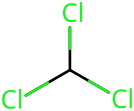
Chloroform Stats & Data
ClC(Cl)ClHEDRZPFGACZZDS-UHFFFAOYSA-NPharmacology
DrugBankDescription
Chloroform is an organic small molecule, member of the family of the chloromethanes that presents a formula of CHCl3. It is a colorless, sweet-smelling, dense liquid that is produced on a large scale as a precursor to PTFE and refrigerants, but the latter application is declining.
Measured Affinities
Guide to PHARMACOLOGYMeasured binding and functional data for chloroform, curated by the IUPHAR/BPS Guide to PHARMACOLOGY. Each row cites the paper it came from. Lower concentrations mean tighter binding — a value in the sub-nanomolar range indicates a very potent interaction.
| Target | Action | Measure | Value | Concentration | Species | Source |
|---|---|---|---|---|---|---|
| TRPM3 TRPM3 | Antagonist | pIC50 | 3.78 | 165,959 nM | Human | PMID 31987857 |
| K2P16.1 KCNK16 | Channel blocker | - | — | — | Human | PMID 11263999 |
| K2P17.1 KCNK17 | Channel blocker | - | — | — | Human | PMID 11263999 |
| K2P2.1 KCNK2 | Activator | - | — | — | Human | PMID 10321245 |
Reading this. pKi, pEC50 and pIC50 are negative log molar values, so a higher number means a tighter interaction; the concentration column converts them for you. Values from non-human species are laboratory measurements and do not translate directly to human effect. Receptor affinity is not a dose — it describes what a molecule binds, not how much of it is safe to take.
Receptor data from the IUPHAR/BPS Guide to PHARMACOLOGY (v2026.2), licensed CC BY-SA 4.0. Matched to this substance by InChIKey.
This section covers risks general risks for both medical and nonmedical inhalants. For specific risks with nonmedical inhalants, see Toxicity and harm potential for toxic inhalants It is strongly recommended that one use harm reduction practices when using this class of substances. Both medical and nonmedical inhalants should be avoided by:
LD50
LD50: 36 mg/kg (Oral, Mouse) (L138)LD50: 623 mg/kg (Intraperitoneal, Mouse) (L138)LD50: 704 mg/kg (Subcutaneous, Mouse) (L138)
Carcinogenicity
Group 2B: Possibly carcinogenic to humans
Addiction & dependence
The chronic use of many inhalants can be considered moderately addictive with a high potential for abuse and is capable of causing psychological dependence among certain users. When addiction has developed, cravings and withdrawal effects may occur if a person suddenly stops their usage.
Tolerance & Pharmacokinetics
drugs.wikiNo tolerance chart. Our decay curves for these drugs were estimates, and a curve can make tolerance look longer-lasting than it is, which is the dangerous direction.
How fast tolerance to these drugs fades after a break has not been measured well enough to draw, so don't count on a dose you used to take still being safe: after time off, start with a much smaller amount and don't use alone. Mixing sedatives with each other, with alcohol or with opioids sharply raises the risk of a fatal overdose. If you've been using regularly, don't stop suddenly: withdrawal from benzodiazepines, alcohol or GHB/GBL can cause seizures or delirium, so get medical help to cut down gradually.
Sources: FRANK: benzodiazepines · Alcohol and Drug Foundation: GHB · FDA 2020: benzodiazepine boxed warning · FDA 2019: gabapentinoids and breathing · NHS: alcohol use disorder
Experience Report Analysis
ErowidDemographics
Gender Distribution
Too few reports for a chart: gender is known from 11 reports, and a split is drawn only from 20 reports or more. Counts are shown instead. Why 20?
- Male 11 of 11
Age Distribution
Reports Over Time
Effect Analysis
ErowidEffects aggregated from 10 experience reports (10 single-substance Erowid)
Effect Sentiment Distribution
Confidence Distribution
Each bar is the share of reports mentioning the effect; its whisker, and the band on the rows below, is the 95% interval: where the share could plausibly be with other reports of the same kind.
Too few reports for bars: these effects come from 10 single-substance Erowid reports, and a bar is drawn only from 20 reports or more. With fewer, a percentage cannot tell a common effect from a rare one. Counts are shown instead. Why 20?
Positive Effects 1
Adverse Effects 1
Show 2 neutral or unclassified mentions
Form / Preparation
Most common forms and preparations, as a share of the 6 reports that give one
Too few reports for bars: these forms come from 6 reports, and a bar is drawn only from 20 reports or more. With fewer, a percentage cannot tell a common effect from a rare one. Counts are shown instead. Why 20?
- Gas 3 of 6
- Liquid 3 of 6