
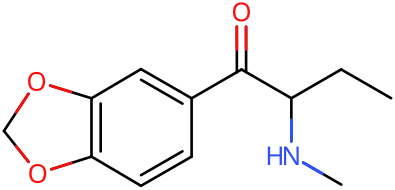
Butylone Stats & Data
CCC(C(=O)C1=CC2=C(C=C1)OCO2)NCCGKQZIULZRXRRJ-UHFFFAOYSA-NReceptor Profile
Receptor Actions
History & Culture
Butylone was first synthesized in 1967 by Koeppe, Ludwig, and Zeile, who documented their work in a paper from that year. Following its initial synthesis, the compound remained an obscure product of academic chemistry for nearly four decades, receiving little attention outside of laboratory settings. The substance emerged on the designer drug market in 2005, when it began to be sold as a recreational product. Structurally, butylone bears the same relationship to methylone that MBDB bears to MDMA—both are beta-keto analogues of their respective parent compounds. Formal pharmacological research on butylone did not commence until 2009, when studies demonstrated that it undergoes metabolic processes similar to those of related cathinones such as methylone. As methylone's availability on the research chemical market declined, butylone became commonly sold alongside ethylone as a substitute or counterfeit for MDMA and methylone. These substances, along with other cathinones, have collectively come to be referred to as "Molly" in street terminology. Despite behavioral and pharmacological similarities to MDMA, butylone has a very short history of documented human use, and limited data exists regarding its full range of effects in humans.
Toxicity
PsychonautWikiThe toxicity and long-term health effects of recreational butylone use do not seem to have been studied in any scientific context and the exact toxic dosage is unknown. This is because butylone has very little history of human usage. Anecdotal evidence from people who have tried butylone within the community suggests that there do not seem to be strong adverse effects attributed to using this substance at low to moderate doses and sparingly. It is strongly recommended that one use harm reduction practices when using this substance.
Effect Profile
Curated + 16 ReportsModerate euphoria with mild stimulation and sensory enhancement, low empathy
Moderate euphoria and focus with strong anxiety/jitters, low stimulation
Tolerance & Pharmacokinetics
drugs.wikiTolerance Decay
Evidence for tolerance kinetics in butylone is limited to user reports and extrapolation from other serotonergic cathinones. Acute tolerance develops within a session and across consecutive days; perceived effects drop markedly on day 2–3, with partial recovery over 1–2 weeks and closer to baseline by ~3–4 weeks. Cross‑tolerance is likely with MDMA/methylone due to overlapping transporter mechanisms. Data quality: anecdotal/theoretical.
Cross-Tolerances
Experience Report Analysis
ErowidDemographics
Gender Distribution
Age Distribution
Reports Over Time
Effect Analysis
ErowidEffects aggregated from 16 experience reports (16 single-substance Erowid)
Effect Sentiment Distribution
Confidence Distribution
Each bar is the share of reports mentioning the effect; its whisker, and the band on the rows below, is the 95% interval: where the share could plausibly be with other reports of the same kind.
Too few reports for bars: these effects come from 16 single-substance Erowid reports, and a bar is drawn only from 20 reports or more. With fewer, a percentage cannot tell a common effect from a rare one. Counts are shown instead. Why 20?
Positive Effects 7
Adverse Effects 4
Show 2 neutral or unclassified mentions
Dosage Distribution
Dose distribution from experience reports, one dose per report (the first listed). Doses above Q3 + 3×IQR, far above what people typically take, are left out of the median and range and listed under each route: most are real heavy doses or overdoses, not mistakes.
Real-World Dose Distribution
ErowidFrom 34 of 46 recorded dose entries: those that state a weight (mg, g or µg), in routes with at least five of them. Values above Q3 + 3×IQR, far above what people typically take, are left out; they can include real heavy doses and overdoses, not only mistakes.
Oral (n=27)
Rectal (n=6)
Common Combinations
Most co-occurring substances, as a share of all 31 reports filed under Butylone; whiskers are 95% intervals
Form / Preparation
Most common forms and preparations, as a share of the 18 reports that give one
Too few reports for bars: these forms come from 18 reports, and a bar is drawn only from 20 reports or more. With fewer, a percentage cannot tell a common effect from a rare one. Counts are shown instead. Why 20?
- Powder / Crystals 16 of 18
- Capsule 2 of 18
Body-Weight Dosing
Dose per kg of body weight, one dose per report (the first listed), from reports giving a weight of 30–250 kg. Doses above Q3 + 3×IQR, far above what people typically take, are left out of the median and range and listed under each route.
Redose Patterns
Redosing behavior across 18 reports
Too few reports for a chart: redosing is known from 18 reports, and a split is drawn only from 20 reports or more. Counts are shown instead. Why 20?
- Single dose 7 of 18
- Redosed 11 of 18
Legal Status
| Country | Status | Notes |
|---|---|---|
| Austria | Illegal (NPSG) | Prohibited under the Neue-Psychoaktive-Substanzen-Gesetz (New Psychoactive Substances Act). Possession, production, and sale are illegal. |
| Brazil | Controlled substance | Controlled since September 7, 2018 under a blanket ban covering all cathinone analogues, appended to Portaria SVS/MS nº 344. Possession, use, and distribution are illegal. |
| Canada | Schedule I (CDSA) | Listed as a Schedule I substance under the Controlled Drugs and Substances Act. Manufacturing, possession, and distribution carry significant criminal penalties. |
| China | Controlled substance | Designated a controlled substance as of October 2015 under national drug control legislation. |
| Finland | Controlled substance | Scheduled under the government decree on psychoactive substances banned from the consumer market. |
| France | Stupéfiant | Classified as a stupéfiant (recognized drug of abuse) under French drug legislation. Possession, purchase, sale, and manufacture are prohibited. |
| Germany | Anlage II BtMG | Listed in Anlage II of the Betäubungsmittelgesetz (Narcotics Act) since July 26, 2012. Manufacturing, possession, import, export, purchase, sale, procurement, and dispensing without a license are prohibited. |
| Israel | Controlled substance | Regulated as a controlled substance under national drug control legislation. |
| Japan | Controlled substance | Designated a controlled substance under Japanese pharmaceutical and narcotics regulations. |
| Norway | Controlled substance | Classified as a controlled substance under Norwegian drug control legislation. |
| Poland | Controlled substance | Listed as a controlled substance under Polish narcotics legislation. |
| Sweden | Schedule I (Narcotic) | Added to Schedule I (substances without accepted medical use) as of February 1, 2010. Listed by the Medical Products Agency in regulation LVFS 2022:48 under the designation Butylon. |
| Switzerland | Controlled (Verzeichnis D) | Specifically named as a controlled substance in Verzeichnis D of the Swiss narcotics regulations. |
| United Kingdom | Class B | Controlled as a Class B substance under the Misuse of Drugs Act 1971 through the cathinone catch-all clause, which covers synthetic cathinone derivatives. |
| United States | Schedule I | Listed as a Schedule I controlled substance under the Controlled Substances Act. Additionally, as a structural analogue of MDMA and methylone, it may be prosecuted under the Federal Analogue Act when intended for human consumption. |
Harm Reduction
drugs.wikiIdentity and class: Butylone is a substituted cathinone closely related to methylone; both act at monoamine transporters and can release serotonin, with butylone generally described as milder and more stimulating than MDMA. Pharmacology: In vitro work shows butylone inhibits DAT/NET/SERT and can induce 5‑HT release (MDMA‑like), supporting risks typical of serotonergic stimulants (e.g., hyperthermia, serotonin toxicity when combined inappropriately). Duration and dosing are highly variable between batches; begin with an allergy test and use a calibrated milligram scale. Avoid redosing early: peaks can be short and redose compulsion is common in cathinones, increasing cardiovascular strain, anxiety, and next‑day crash. Overheating and dehydration are key risks under hot/crowded conditions; take cooling breaks, avoid heavy exertion, sip 250–500 mL water per hour if dancing (less if sedentary), and avoid overhydration (alternate water with small electrolyte intake). Serotonin syndrome risk increases with MAOIs, DXM, tramadol, and other serotonergic combinations; seek urgent care if high fever, confusion, clonus, or severe agitation occurs. Insufflation causes pronounced nasal irritation and disproportionate side effects per user reports; oral administration is typically preferred for harm reduction. Adulteration/mis‑selling is common in stimulant markets and MDMA pills/powders may contain cathinones; use reagent/drug‑checking services where available before ingestion. People with cardiovascular disease, hypertension, seizure history, or on serotonergic or pro‑convulsant medications should avoid use. Space sessions by multiple weeks to limit tolerance and mood after‑effects; sleep, nutrition, and gentle recovery practices reduce comedown severity.
References
Cited References
- Baumann et al. 2019 - Butylone and pentylone neuropharmacology (DOI)
- Bluelight: The Big & Dandy bk-MBDB (Butylone) Thread
- Cozzi et al. 1999 - Beta-ketoamphetamine transporter inhibition (DOI)
- Erowid: Butylone Vault
- Leong et al. 2020 - Synthetic cathinones induce cell death in dopaminergic cells (DOI)
- Lopez-Arnau et al. 2012 - Comparative neuropharmacology of cathinones (DOI)
- Nagai et al. 2007 - Effects on monoamine neurotransmission (DOI)
- Simmler et al. 2013 - Pharmacological characterization of designer cathinones (DOI)
- Zaitsu et al. 2009 - Butylone metabolism study
- Erowid: Butylone Vault
- UNODC: Global SMART Programme 2013
- IsomerDesign: Cathinones Report
- Bluelight: Butylone Experiences
Additional references
- Erowid bk‑MBDB (Butylone) Vault (overview, experiences)
- Erowid experience report with dose/time course (150 mg + redose)
- Bluelight Big & Dandy bk‑MBDB (user dosing/duration; insufflation irritation)
- PubChem entry (identity, synonyms)
- Comparative neuropharmacology of butylone, mephedrone, methylone (in vitro; transporters)
- Pharmacological characterization of designer cathinones in vitro (butylone releases 5‑HT; transporter profile)
- TripSit Drug Combinations (general interaction categories; MAOIs/DXM/serotonergic risks)
- EMCDDA/EUDA synthetic cathinones drug profile (class context; butylone listed)
- EMCDDA/EUDA 2024 report highlights adulteration (MDMA with cathinones) and market risks
- Isomerdesign (Health Canada) — email confirming Butylone controlled (CDSA Schedule III)
- Methylone human PK (used by analogy for half‑life estimate) — PubMed