
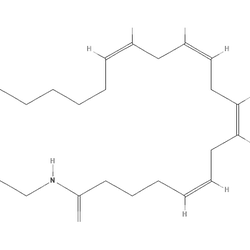
Anandamide Stats & Data
CCCCCC=CCC=CCC=CCC=CCCCC(=O)NCCOLGEQQWMQCRIYKG-DOFZRALJSA-NMeasured Affinities
Guide to PHARMACOLOGYMeasured binding and functional data for anandamide, curated by the IUPHAR/BPS Guide to PHARMACOLOGY. Each row cites the paper it came from. Lower concentrations mean tighter binding — a value in the sub-nanomolar range indicates a very potent interaction.
| Target | Action | Measure | Value | Concentration | Species | Source |
|---|---|---|---|---|---|---|
| GPR55 GPR55 | Agonist | pEC50 | 7.74 | 18.2 nM | Human | PMID 17876302 |
| glycine receptor α1 subunit GLRA1 | Potentiation | pEC50 | 7.4 | 39.81 nM | Human | — |
| Glycine Receptor (All subtypes) | Potentiation | pEC50 | 7.2 | 63.1 nM | None | PMID 18755158 |
| Cav3.2 CACNA1H | Antagonist | pIC50 | 6.5 | 316.23 nM | Human | PMID 11742980 |
| K2P3.1 KCNK3 | Channel blocker | pIC50 | 6.15 | 707.95 nM | Human | PMID 11226154 |
| Cav3.3 CACNA1I | Antagonist | pIC50 | 6 | 1,000 nM | Human | PMID 11742980 |
| TRPV1 TRPV1 | Agonist | pEC50 | 5.9 | 1,259 nM | Human | PMID 10694225 |
| K2P3.1 KCNK3 | Inhibition | pIC50 | 5.6 | 2,512 nM | Human | PMID 11226154 |
| Kv1.2 KCNA2 | Pore blocker | pIC50 | 5.6 | 2,512 nM | Human | PMID 8938728 |
| GPR18 GPR18 | Full agonist | pEC50 | 5.42 | 3,802 nM | Human | PMID 21595653 |
| Cav3.1 CACNA1G | Antagonist | pIC50 | 5.4 | 3,981 nM | Human | PMID 11742980 |
| TRPV1 Trpv1 | Agonist | pEC50 | 5.3 | 5,012 nM | Rat | PMID 10440374 |
| TRPV1 TRPV1 | Activation | pEC50 | 5 | 10,000 nM | Human | PMID 12761211 |
| CB1 receptor CNR1 | Partial agonist | pKi | — | — | Human | — |
| CB2 receptor CNR2 | Partial agonist | pKi | — | — | Human | — |
| K2P9.1 KCNK9 | Inhibitor | - | — | — | Human | PMID 10747866 |
Reading this. pKi, pEC50 and pIC50 are negative log molar values, so a higher number means a tighter interaction; the concentration column converts them for you. Values from non-human species are laboratory measurements and do not translate directly to human effect. Receptor affinity is not a dose — it describes what a molecule binds, not how much of it is safe to take.
Receptor data from the IUPHAR/BPS Guide to PHARMACOLOGY (v2026.2), licensed CC BY-SA 4.0. Matched to this substance by InChIKey.