
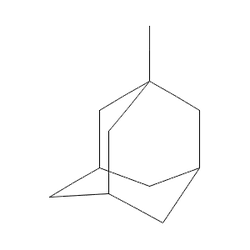
Amantadine Stats & Data
NC12CC3CC(CC(C3)C1)C2DKNWSYNQZKUICI-UHFFFAOYSA-NPharmacology
DrugBankDescription
An antiviral that is used in the prophylactic or symptomatic treatment of influenza A. It is also used as an antiparkinsonian agent, to treat extrapyramidal reactions, and for postherpetic neuralgia. The mechanisms of its effects in movement disorders are not well understood but probably reflect an increase in synthesis and release of dopamine, with perhaps some inhibition of dopamine uptake.
Mechanism of Action
The mechanism of its antiparkinsonic effect is not fully understood, but it appears to be releasing dopamine from the nerve endings of the brain cells, together with stimulation of norepinephrine response. It also has NMDA receptor antagonistic effects. The antiviral mechanism seems to be unrelated. The drug interferes with a viral protein, M2 (an ion channel), which is needed for the viral particle to become "uncoated" once it is taken inside the cell by endocytosis.
Pharmacodynamics
Amantadine is an antiviral drug which also acts as an antiparkinson agent, for which it is usually combined with L-DOPA when L-DOPA responses decline (probably due to tolerance). It is a derivate of adamantane, like a similar drug rimantadine. The mechanism of action of amantadine in the treatment of Parkinson's disease and drug-induced extrapyramidal reactions is not known. It has been shown to cause an increase in dopamine release in the animal brain, and does not possess anticholinergic activity.
Metabolism
No appreciable metabolism, although negligible amounts of an acetyl metabolite have been identified.
Absorption
Amantadine is well absorbed orally from the gastrointestinal tract.
Indication
For the chemoprophylaxis, prophylaxis, and treatment of signs and symptoms of infection caused by various strains of influenza A virus. Also for the treatment of parkinsonism and drug-induced extrapyramidal reactions.
Half-life
Mean half-lives ranged from 10 to 14 hours, however renal function impairment causes a severe increase in half life to 7 to 10 days.
Protein Binding
Approximately 67% bound to plasma proteins over a concentration range of 0.1 to 2.0 µg/mL.
Elimination
It is primarily excreted unchanged in the urine by glomerular filtration and tubular secretion.
Clearance
* 0.2 - 0.3 L/hr/kg * 0.10 +/- 0.04 L/hr/kg healthy, elderly male
Measured Affinities
Guide to PHARMACOLOGYMeasured binding and functional data for amantadine, curated by the IUPHAR/BPS Guide to PHARMACOLOGY. Each row cites the paper it came from. Lower concentrations mean tighter binding — a value in the sub-nanomolar range indicates a very potent interaction.
| Target | Action | Measure | Value | Concentration | Species | Source |
|---|---|---|---|---|---|---|
| GluN2C GRIN2C | Channel blocker | pIC50 | 4.65 | 22,387 nM | Human | PMID 17303642 |
Reading this. pKi, pEC50 and pIC50 are negative log molar values, so a higher number means a tighter interaction; the concentration column converts them for you. Values from non-human species are laboratory measurements and do not translate directly to human effect. Receptor affinity is not a dose — it describes what a molecule binds, not how much of it is safe to take.
Receptor data from the IUPHAR/BPS Guide to PHARMACOLOGY (v2026.2), licensed CC BY-SA 4.0. Matched to this substance by InChIKey.
There currently is no minimum toxicity dose listed. The limitation for increased doses beyond 400 mg per day is due to CNS effects. The mechanism of its antiparkinsonic effect is not fully understood, but it appears to be releasing dopamine from the nerve endings of the brain cells, together with stimulation of norepinephrine response. It also has NMDA receptor antagonistic effects.
LD50
LD50: 800 mg/kg (Oral, Rat)LD50: 700 mg/kg (Oral, Mouse)
Carcinogenicity
No indication of carcinogenicity to humans (not listed by IARC).
Liver injury risk
Low concern (rare serious cases reported)
Health effects (PubChem excerpts)
Acute overdosage of amantadine has resulted in cardiac dysfunction (e.g., arrhythmia, tachycardia, hypertension); pulmonary edema and respiratory distress (including adult respiratory distress syndrome); renal dysfunction (e.g., increased BUN, decreased creatinine clearance, renal insufficiency); or CNS toxicity (e.g., insomnia, anxiety, psychotic reactions, lethargy, somnolence, coma). Hyperthermia also has occurred with amantadine overdosage. In addition, seizures may be exacerbated in patients with a history of a seizure disorder (A620).
Experience Report Analysis
ErowidDemographics
Gender Distribution
Too few reports for a chart: gender is known from 3 reports, and a split is drawn only from 20 reports or more. Counts are shown instead. Why 20?
- Male 3 of 3
Age Distribution
Reports Over Time
Form / Preparation
Most common forms and preparations, as a share of the 2 reports that give one
Too few reports for bars: these forms come from 2 reports, and a bar is drawn only from 20 reports or more. With fewer, a percentage cannot tell a common effect from a rare one. Counts are shown instead. Why 20?
- Pill / Tablet 2 of 2